Guides · For job seekers
Dispatcher Resume: Your Calls, Your Loads, and the Systems You Run
Dispatcher resumes are read for volume, accuracy under pressure, and the systems you run. Here's how to write yours for 911 dispatch or truck and freight dispatch, with real numbers and the training you actually completed.
Published 10/13/2026 · Updated 10/30/2026
A dispatcher resume is often read by someone who has done the job, such as a communications supervisor or a fleet manager. They are looking for proof that you can handle volume without losing accuracy, that you know the systems they run, and that you hold the training their center or their carrier requires. A resume that says “responsible for answering calls and dispatching units” tells them none of that.
Dispatch work is measured closely, so you likely know your own numbers well: the calls you answered on a shift, the loads you covered in a week, and how often you hit the center’s or the carrier’s targets. Put them on the page.
Two jobs share the title
The word “dispatcher” covers two different careers, and the resume should make clear which one you are applying for.
Public safety dispatchers, also called 911 dispatchers or telecommunicators, answer emergency and non-emergency calls, gather information, and send police, fire, and EMS units. O*NET lists them as public safety telecommunicators.
Truck, freight, and service dispatchers schedule drivers, crews, and vehicles for freight, passengers, or field service work. O*NET groups them as dispatchers, except police, fire, and ambulance, a group that also includes taxi, school bus, paratransit, and train dispatchers.
The sections below cover both. Use the one that matches the posting, and keep the other job as its own entry if you have done both.
Lead with your volume, your accuracy, and your systems
Before: “911 dispatcher responsible for answering calls and dispatching police, fire, and EMS.”
After: “911 dispatcher at a [county] communications center: answered about [60] calls a shift on [CAD system], dispatched police, fire, and EMS on [N] radio channels, APCO Public Safety Telecommunicator and EMD certified, [N] commendations.”
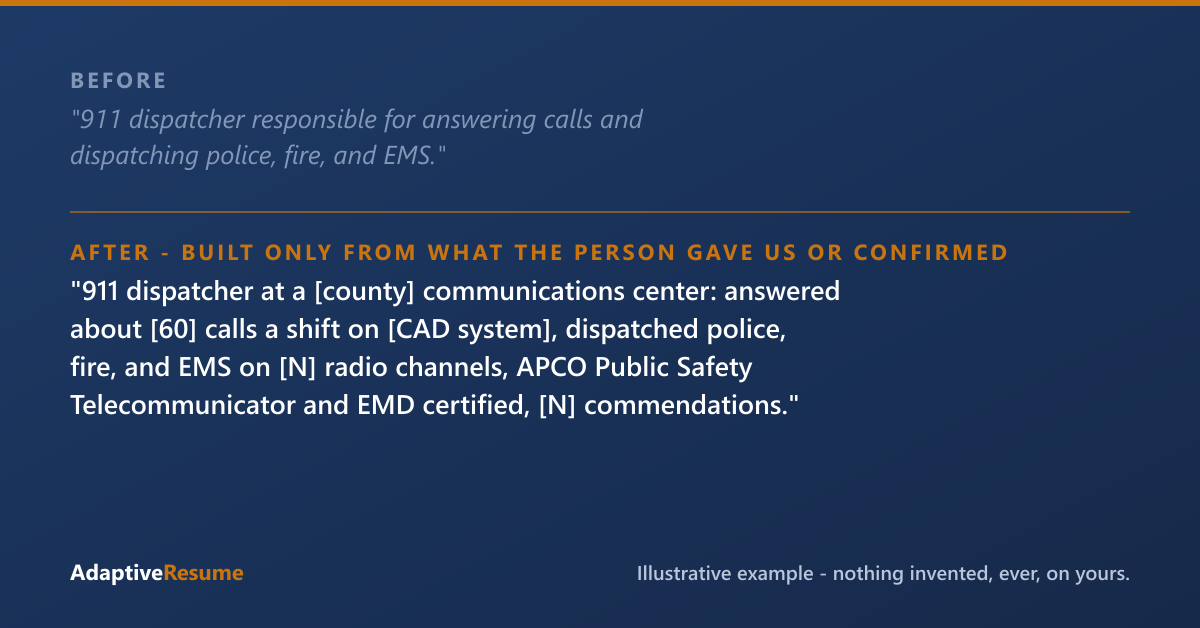
Illustrative example. Everything on your resume is yours: the experience you listed, plus the systems, certifications, and training your work already involved, each added only after you confirm it’s true.
The second version tells the supervisor the setting, the volume, the systems, the training, and the record in two lines.
For 911 and public safety dispatch
Certifications, named exactly. Write each certification with its issuer and its date. Common ones include the APCO Institute’s Public Safety Telecommunicator 1 course, which APCO runs as a 40-hour basic course, and Emergency Medical Dispatch (EMD) certification from APCO or the International Academies of Emergency Dispatch. APCO’s certifications renew every two years with continuing dispatch education, so write the current expiration date if you have it. Some states add their own requirement. Texas licenses telecommunicators through its law enforcement commission, and California’s POST program sets a basic course for dispatchers at participating agencies. If your state requires a license or certificate, name it.
Database access. If you were trained and certified to query state and national criminal justice databases, such as NCIC through your state’s system, say so. Agencies with that access must give staff security awareness training under the FBI’s CJIS Security Policy, and a candidate who already holds the state certification may save the center part of that training.
Call numbers. Give calls answered per shift or per month, the share that were 911 calls, and the call types you handled. If your center tracked answer times, you can write how you performed against them. The national standard from NENA sets a target that 90% of 911 calls be answered within 15 seconds, so a line like “answered within the center’s 15-second standard on [N]% of calls” means something to a communications supervisor.
Systems. Name the computer-aided dispatch (CAD) system, the radio consoles, the phone system, and any protocol software you used, such as EMD card sets or ProQA. Also name text-to-911, mapping, and records systems. Recruiters often search for these names, and knowing the system can shorten your training.
Critical calls and training roles. Describe the high-stakes work in plain terms: structure fires, pursuits, cardiac arrests talked through to the arrival of EMS, multi-agency incidents. Training others matters too. If you served as a communications training officer, write how many new dispatchers you trained and how many completed the program.
The ENP credential from NENA is a senior professional certification: candidates need at least three years of experience in emergency communications, enough eligibility points from experience, education, and training, and a passing score on the exam. If you hold it, it belongs near the top.
For truck, freight, and service dispatch
Loads, trucks, and lanes. Give the number of trucks or drivers you dispatched, loads booked or covered per week, the lanes or regions you ran, and the equipment types, such as dry van, reefer, flatbed, or tanker.
On-time and service numbers. Write on-time pickup and delivery rates, loaded miles or revenue per truck if your carrier tracked them, and how you cut empty miles or detention time.
Hours of service. A dispatcher plans every load around the driver’s legal hours. Under the federal rule for property-carrying drivers, a driver needs 10 consecutive hours off duty, may drive up to 11 hours inside a 14-hour window, and needs a 30-minute break after 8 hours of driving, with weekly limits of 60 or 70 hours. Federal rules also bar a motor carrier and its agents from coercing a driver to break those limits. A line such as “planned [N] loads a week with no hours-of-service violations traced to dispatch” shows a safety manager that you plan loads within the rules.
Systems. Name the transportation management system (TMS), such as McLeod, TMW, or a carrier’s own system, the electronic logging devices and telematics you read, such as Samsara or Omnitracs, and the load boards you booked on, such as DAT or Truckstop.
Field service and transit dispatch. For service, tow, utility, or transit dispatch, give the technicians, routes, or vehicles you scheduled, jobs dispatched per day, response or arrival times, and the scheduling software you used.
Moving up
Lines that point upward matter even for a first dispatch job: covering a lead’s shift, training new hires, handling a busier position or a larger fleet, or being trusted with major incidents or high-value customers. If you are aiming at a supervisor role next, add the size of the team you led on your shifts and any quality review or scheduling work you took on.
Format notes
Length follows your history. A dispatcher with one or two positions usually fits on one page. Two pages is normal and expected once you have more than one substantive job to describe, such as several centers, a carrier plus a brokerage, or a military communications history. Keep the numbers, the systems, the certifications, and the critical work; cut the duties every dispatch job shares.
Use reverse chronological order and a single column, and leave out graphics and photos. Many public agencies and large carriers run applications through hiring software, and a two-column template can scramble the read. For a public safety job, list each certification with its issuer and dates in its own section so a background investigator can verify it quickly.
Gaps get one plain dated line.
Dispatcher resume examples: a bullet bank you can adapt — keep only what’s true
- “Answered about [N] calls a shift at a [county/city] 911 center; [N]% of 911 calls answered within the center’s 15-second standard”
- “Dispatched police, fire, and EMS on [N] radio channels using [CAD system]; handled [N] multi-agency incidents in [year]”
- “APCO Public Safety Telecommunicator certified ([year]); EMD certified through [issuer], current to [month/year]”
- “Certified for [state] criminal justice database queries, including NCIC, [year]”
- “Trained [N] new dispatchers as a communications training officer; [N] completed the program”
- “Dispatched [N] trucks across [region] lanes; booked or covered about [N] loads a week on [load board]”
- “Kept [N]% on-time pickup and delivery across [N] months; planned every load within drivers’ hours of service”
- “Scheduled [N] field technicians a day in [software]; cut average arrival time from [N] to [N] hours”
What screening software looks for on a dispatcher resume
Filters commonly read for: dispatcher, 911 dispatcher, telecommunicator, public safety answering point, PSAP, CAD, computer-aided dispatch, radio, EMD, emergency medical dispatch, APCO, NCIC, CJIS, multi-line phones, call taking, truck dispatcher, freight dispatcher, load board, DAT, TMS, McLeod, ELD, hours of service, FMCSA, routing, scheduling, on-time delivery, and customer service.
The highest-risk lines are the ones a center or a carrier can check in a phone call: a certification listed as current that has lapsed, a call volume your old supervisor will not recognize, or a system you only watched someone else use. Write what you actually did and how you were measured.
The Role Skills Checklist below helps you inventory what your dispatch history actually proves, which is usually more than the resume currently says. Our build does it with you: we work backwards from your real jobs, shifts, and systems, and we ask you about the certifications, training, and tools that work like yours normally involves. Nothing goes on your resume that you didn’t give us or confirm, so a certification, a system, or a number you never told us about stays off the page.
Common questions
Should a 911 dispatcher resume and a truck dispatcher resume look the same?
They should not look the same. They share a title, but they are read for different things. A 911 resume is read for call volume, protocols, certifications, and calm accuracy on the radio. A truck dispatch resume is read for loads, lanes, on-time delivery, and keeping drivers inside their hours of service. If you have done both, keep them as separate entries and lead with the one that matches the posting.
I don't know my call volume. What do I write?
Think through a normal shift: about how many calls you answered, and how many of them were 911 calls. If a supervisor or a former coworker told you a typical number, you can use that instead. Either way, round it down and write it as approximate.
Can I list a certification that my agency paid for but has lapsed?
List it with its dates and say it has lapsed, or leave it off. Do not list it as current. Dispatch certifications are easy for an agency to check, and a lapsed card listed as current can end an application.
I am moving into dispatch from a call center or a driving job. What carries over?
A great deal of it carries over. Call center work shows phone volume, calm handling of upset callers, and data entry while you talk. Driving work shows that you know routes, hours of service, and what a driver needs from dispatch. Write those jobs with their numbers, and list any dispatch training you have completed with the issuer and the date.
Role Skills Checklist
Pop your email in and the download unlocks right here. Joining our list also takes 25% off your first purchase within 30 days of joining, when you create your account with this same email. We'll also send the occasional useful note. No spam.
Download: Role Skills ChecklistThanks, you're on our list, and your download is ready just above. Your 25% off a first purchase is good for 30 days from the day this email joined our list.
That email didn't look right — mind trying it again?
Ready to do this on your own resume?
We'll find what you've left off, and nothing goes on your resume that you didn't give us or confirm.
Get your resume build — $29Every purchase is one payment, and nothing renews. A single resume build can be used any time within 12 months of buying it, and AR Pass builds you don't use end when its 90 days end.
Try the demo first — a sample review, no sign-up · See how the service works
Paid a resume service and got a template back? Start at Fix my resume.