Guides · For job seekers
Flight Attendant Resume: FAA Certificate, Fleet, and Real Scope
Airline recruiters read a flight attendant resume for safety readiness first and service second. Here's how to state the FAA certificate honestly, name your aircraft and base, and write a strong page even with no flying experience yet.
Published 09/08/2026
Airline hiring reads a flight attendant resume for safety readiness first and service second. The recruiter wants to know, in a few seconds, whether you have finished an air carrier’s training and hold the FAA (Federal Aviation Administration) certificate that comes with it, which aircraft you are qualified on, and whether you have actually worked a full cabin. Generic language (“ensured passenger safety and delivered exceptional customer service”) answers none of that. The specifics do.
The other thing that trips up flight attendant resumes is a credential claimed before it exists. The FAA Certificate of Demonstrated Proficiency cannot be earned in advance; an airline trains you first, then the FAA issues it. “FAA certified” with no airline behind it is a claim the recruiter knows cannot be true, and it colors every other line. This guide covers what to write instead — for the crew member changing airlines and for the first-time applicant.
The role line: your scope in one sentence
Under each flying role, give one line another crew member would recognize instantly.
Before: “Flight attendant responsible for passenger safety and providing excellent customer service on domestic and international flights.”
After: “Flight attendant, [Airline], [DFW] base; qualified on [Boeing 737] and [Airbus A321]; domestic and [Latin America] flying, [4] years; lead flight attendant on [40]% of trips; FAA Certificate of Demonstrated Proficiency, Group [II].”
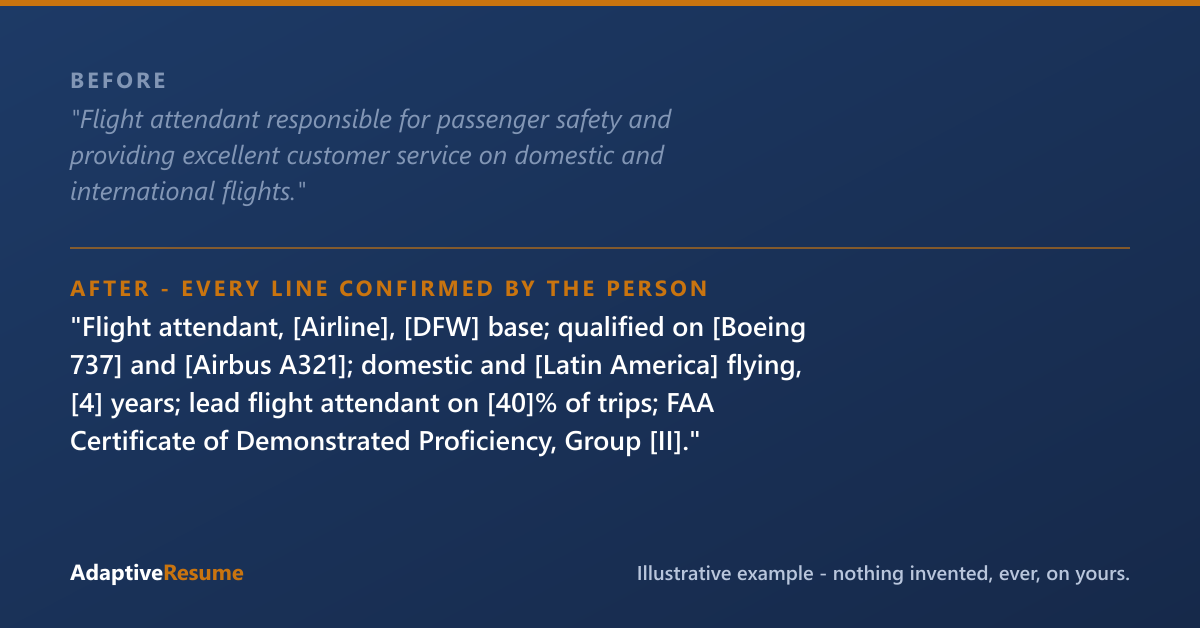
Illustrative example. On your resume, every line comes from your real history — proposed as a question, added only when you confirm it.
The second version is scannable in four seconds and answers what the first leaves a reader guessing at. Notice the rewrite invents nothing; it just says plainly what the vague version was hiding. Fill the brackets with your real airline and numbers.
Credentials, exactly as held
Every item in this block gets checked during onboarding, so it has to be exactly right. Our guide on how to list certifications on a resume covers placement and format; here is what belongs in a flight attendant block.
- FAA Certificate of Demonstrated Proficiency. Federal law (49 U.S.C. 44728) says no one may serve as a flight attendant for an air carrier without this certificate, and that the FAA issues it after the air carrier notifies the FAA that you completed its approved flight attendant training. The airline’s director of operations makes that call, and the certificate names the airplane group it covers. So: if you have completed an airline’s initial training, list it — “FAA Certificate of Demonstrated Proficiency, Group [I/II], issued [year].” (Group I is propeller airplanes and Group II is jets, under 14 CFR 121.400.) If you have not, leave it off entirely. There is no way to hold it first.
- Airline initial and recurrent training. An air carrier’s approved program under 14 CFR Part 121 covers initial and recurrent training, with emergency drills — exits, fire extinguishers, oxygen, flotation gear, ditching — repeated at least once every 24 calendar months under 14 CFR 121.417. Name the airline and your last recurrent: “Recurrent training current through [month/year].”
- CPR (cardiopulmonary resuscitation) and AED. 14 CFR 121.805 requires Part 121 passenger airlines to train flight attendants in CPR and automated external defibrillators, with recurrent drills at least once every 24 months. That is the airline’s training; list it as such. A separate CPR/AED or first-aid card from the American Heart Association or the American Red Cross goes on the page with its expiration date — first-time applicants especially.
- Aircraft qualified on. By type, exactly as your airline names them: Boeing 737, Airbus A320 family, Embraer E175. A recruiter compares this against their own fleet.
- Languages. Name the language and an honest level — “Spanish, professional working proficiency” or a CEFR level (Common European Framework of Reference, A1 through C2) if you have been assessed. Airlines that pay for a language will test it; write the level you would pass.
Background checks — including the fingerprint-based criminal history records check that TSA (Transportation Security Administration) rules require for unescorted access to secure airport areas (49 CFR 1544.229) — are run by the airline, not listed by you. List exactly what you hold. A premature credential is the fastest way to lose ground in a job where the certificate is checked against an FAA record.
The parts of the job that carry the most weight
Safety work you have actually done. Pre-flight equipment checks, safety demonstrations, cabin-secure checks, and the drills you have run. Be precise about drilled versus worked: “evacuation drills each recurrent cycle” is honest; “led an emergency evacuation” belongs on the page only if you did it.
Medical events and unruly passengers. The CPR, AED, and first-aid response you gave, and the coordination with the flight deck and ground medical support. Passenger de-escalation, with the outcome. Count them: “[N] in-flight medical events over [N] years.”
Irregular operations. Weather holds, diversions, extended ground delays, aircraft swaps. Write what you did for the cabin during them — briefings, rebooking help, service changes — because that is where the reader learns how you handle a bad day.
Lead and purser roles. Lead flight attendant, purser, in-flight service manager — names vary by airline, but the work is the same: crew briefing, flight-deck liaison, service ownership, and the reports. Give the role a line with frequency and scope, plus any customer-feedback scores or commendation counts your airline shares with you — real figures only. Our guide on how to list promotions on a resume shows the step up without inflating it.
Corporate and charter cabin crew. If you flew business aviation or charter, say so plainly: aircraft, operator type (Part 91 private or corporate flying, or Part 135 charter), passenger count, and what you owned on the ground, such as catering and cabin prep. Our pilot resume guide and aircraft mechanic resume guide cover the other seats on the same aircraft.
No flight attendant experience yet: write what airlines are really screening for
Airlines hire first-time flight attendants from restaurants, hotels, hospitals, retail, and call centers; their own training supplies the aviation part. What they cannot train is the judgment you show when a customer is angry or someone is hurt. Show that in plain numbers:
- Service under pressure. “Server, [N]-seat restaurant; [N] tables per shift; resolved guest complaints without a manager on [N]% of shifts.”
- Safety and medical responsibility. “CNA (certified nursing assistant) on a [N]-bed unit; responded to [N] rapid-response calls; CPR/BLS (basic life support) current through [month/year].”
- Reliability. Overnight, holiday, and rotating shifts you actually worked — a real qualification for reserve flying.
- Hospitality standards. Guest-satisfaction scores and sales results from hotel and restaurant work; our hotel manager resume guide covers those numbers.
Then leave the aviation credentials off. No “FAA certified,” and no private-school “flight attendant training” presented as if it were an airline’s approved program. A short line at the top — “Seeking a first flight attendant role; [N] years of customer-facing service and current CPR/AED” — tells the recruiter what they are reading.
Format notes
Length follows your history, not a page rule. One page is right for first-time applicants; two pages is normal once you have more than one substantive flying role to describe. Order matters more than length: the certificate and training block near the top in its own labeled section, then experience with a role line atop each airline.
One genuine exception worth knowing: federal applications through USAJOBS cap at two pages as of the September 2025 OPM change. That is a hard requirement, not a style preference.
Otherwise: reverse chronological, single column, standard headings, real text rather than graphics or tables — airline applicant systems parse plain layouts most reliably. Skip the photo and the graphics.
A bullet bank you can adapt — keep only what’s true
- “Flight attendant, [Airline], [base]; qualified on [aircraft types]; [domestic/international] flying, [N] years”
- “FAA Certificate of Demonstrated Proficiency, Group [I/II]; recurrent training current through [month/year]”
- “Lead flight attendant on [N]% of trips; briefed crews of [N], liaised with the flight deck, and owned cabin reports”
- “Responded to [N] in-flight medical events, including [CPR/AED use]; coordinated with ground medical support”
- “Managed cabin through [N] diversions and extended ground delays; briefed passengers and coordinated rebooking help”
- “De-escalated [N] disruptive-passenger situations without diversion; filed reports per company procedure”
- “Delivered [premium-cabin/international] service on [N]-seat aircraft; [N] customer commendations in [year]”
Each bullet is a frame, not a claim. If a line is not true of your flying, it does not go on your page.
What screening software looks for on a flight attendant resume
Airline applicant systems read for the vocabulary of cabin work, and a human reads for the same words minutes later. The terms that typically matter: flight attendant, cabin crew, FAA Certificate of Demonstrated Proficiency, recurrent training, safety demonstration, emergency evacuation, CPR, AED, first aid, in-flight medical, irregular operations, de-escalation, lead flight attendant, purser, aircraft types by name, domestic, international, and language names with proficiency levels.
O*NET profiles this work under Flight Attendants (53-2031.00). The profile leads with the safety tasks — checking emergency equipment, demonstrating procedures, monitoring the cabin — which is exactly the order your resume should follow.
The highest-risk lines are the ones that overstate: an FAA certificate written before an airline issued it, a drill written as an emergency you worked, an aircraft type you were never qualified on, or a language level you could not pass. Airlines check.
The Role Skills Checklist below helps you inventory what your cabin work actually proves, which is often considerably more than the resume currently says. Our build does it with you: we work backwards from your real airlines, aircraft, and training history, propose the lines and credentials that history supports — each one offered as a question, not a decision made for you — and ask you to confirm every item before it appears. We never add a certificate, an aircraft type, or an emergency you didn’t tell us about.
Common questions
Can I get FAA certified as a flight attendant before I apply?
No. The FAA (Federal Aviation Administration) Certificate of Demonstrated Proficiency is issued only after an air carrier tells the FAA you finished its approved flight attendant training. Under 49 U.S.C. 44728, the airline's director of operations decides you completed the training, and the FAA issues the certificate from that notice. There is no school, course, or exam you can take on your own to hold it in advance. If you have not been through an airline's training, do not write 'FAA certified' on your resume.
How do I write a flight attendant resume with no experience?
Lead with the experience airlines actually screen for: customer-facing work under pressure, safety or medical responsibility, and reliability. A server who handled [N] tables a shift, a CNA who followed emergency protocols, a hotel front-desk agent who calmed upset guests — each of those is real evidence. Write it in plain numbers, list any CPR or first-aid card you hold with its date, name your language proficiency honestly, and skip anything you have not done.
Do I list every aircraft type I've flown on?
List the types you are qualified on at your airline, exactly as the airline names them — Boeing 737, Airbus A321, Embraer E175, and so on. That is what a recruiter at another airline compares against their own fleet. Do not list a type you rode as a passenger or observed but were never qualified on.
Is a lead flight attendant or purser role worth its own line?
Yes. Lead, purser, and in-flight service manager titles vary by airline, but they all mean you ran the cabin — briefed the crew, coordinated with the flight deck, and owned the service and the paperwork. Give it a line with how often you held the role ('lead on [N]% of trips') and what you were responsible for. Our guide on listing promotions covers how to show the step up without inflating it.
Role Skills Checklist
Pop your email in and the download unlocks right here — and being on the list before launch day locks in 25% off your first build. We'll also send the occasional useful note and tell you the moment AdaptiveResume goes live. No spam.
Download: Role Skills ChecklistThanks — you're on the launch list, your 25% is locked in, and your download is ready below.
That email didn't look right — mind trying it again?
Ready to do this on your own resume?
We'll find what you've left off and you approve every line — nothing made up.
Build your resume — $49Try the demo first — a sample review, no sign-up · See how the service works
Paid a resume service and got a template back? Start at Fix my resume.