Guides · For job seekers
How to Explain an Employment Gap on Your Resume (Honestly)
Most gaps need less explaining than you fear — and none of them need hiding. Honest framings for caregiving, health, layoffs, and job searches, and where each explanation belongs.
Published 08/11/2026
There’s a stretch of months — maybe years — between two jobs on your resume, and every time you get ready to apply, it’s the thing your eyes go to. Caregiving, health, a layoff that took a while to recover from, school, or simply a long search. Here’s the honest playbook: when a gap actually needs explaining, the framings that work, where the explanation belongs — and the two things you must never do about it.
When an employment gap on your resume needs explaining at all
Less often than you fear. A few months between jobs is ordinary — hiring processes are slow and normal job searches take months, and every recruiter knows it. Older gaps matter less than recent ones, and a gap followed by solid tenure barely registers.
A gap earns a line of explanation when the reader will otherwise wonder: roughly six months or more, recent, or right in the middle of your strongest stretch of experience. The test is simple — if a stranger reading your dates would pause and ask “what happened here?”, answer the question before they ask it. An unexplained hole invites a guess, and their guess is rarely kinder than your truth.
Honest ways to explain an employment gap on your resume
Every one of these is a legitimate reason to be out of work, and each works best stated plainly, without apology:
- Caregiving: “Full-time caregiver for a family member, 03/2023 – 06/2024.” If you kept skills warm — bookkeeping for the household, volunteer coordination — a second line is fair game, if it’s true.
- Health: “Personal medical leave, resolved — 2022.” You owe no diagnosis, and “resolved” answers the only question the employer legitimately has: availability now.
- Layoff: “Position eliminated in company-wide reduction, 01/2024.” A layoff is an event that happened to you, not a verdict on you — name it as one. If the company’s struggles were public, so much the better.
- Education or retraining: “Completed [program/credential], 2023 – 2024.” This one often stops reading as a gap entirely — list it under Education with dates and let it be the answer.
- Job search: the hardest to phrase because it feels like admitting failure. It isn’t. A line is optional here; if asked, “I was searching deliberately and turned down roles that weren’t a fit” is honest for many people — but only say it if it’s true of you.
One line, stated once, in the flow of your work history where the dates sit. Gaps read the way you present them: an accounted-for gap reads as a life; an evaded one reads as a risk.
Years vs. months: the date-format trade-off, stated plainly
Some resumes date jobs “2021 – 2024” instead of “03/2021 – 06/2024.” You should know exactly what that choice does and costs:
- Years-only dating makes gaps of a few months invisible and is a real convention some people use.
- Recruiters know the convention — and know why it’s often chosen. Many will ask for month-level dates on the application form anyway, where you must answer accurately.
- Month-level dates read as confident and leave nothing to discover.
Our advice: use months, and explain what needs explaining. But the line that actually matters is this one — either format is honest only if the dates are accurate. Choosing years-only is a formatting decision; stretching an end date into a gap is a fabrication, and it’s checkable.
Resume, cover letter, or interview?
Each venue gets a different depth:
- Resume: one factual line, as above. The resume states; it doesn’t discuss.
- Cover letter: two or three sentences if the gap is recent and significant — what the time was, that it’s concluded, and why you’re ready now. Then move on to what you offer.
- Interview: the full, calm version, ending forward: “Here’s what that time was, here’s why it’s behind me, here’s what I’m bringing to this role.” Rehearse it once out loud so it’s a paragraph, not a wince.
The mistake is mismatching depth — a defensive paragraph on the resume, or a shrug in the interview.
What never to do
Two hard lines, because both get checked:
- Never invent an employer, consulting work, or a “family business” role that didn’t happen. Employment verification and reference checks exist; a fabricated employer is the single fastest way to turn a survivable gap into a withdrawn offer.
- Never stretch dates to swallow a gap. Extending an end date by “a few months” contradicts the previous employer’s records, and the discovery conversation is unrecoverable.
A gap costs you some interviews, maybe. A discovered lie costs you every one it touches.
A before-and-after
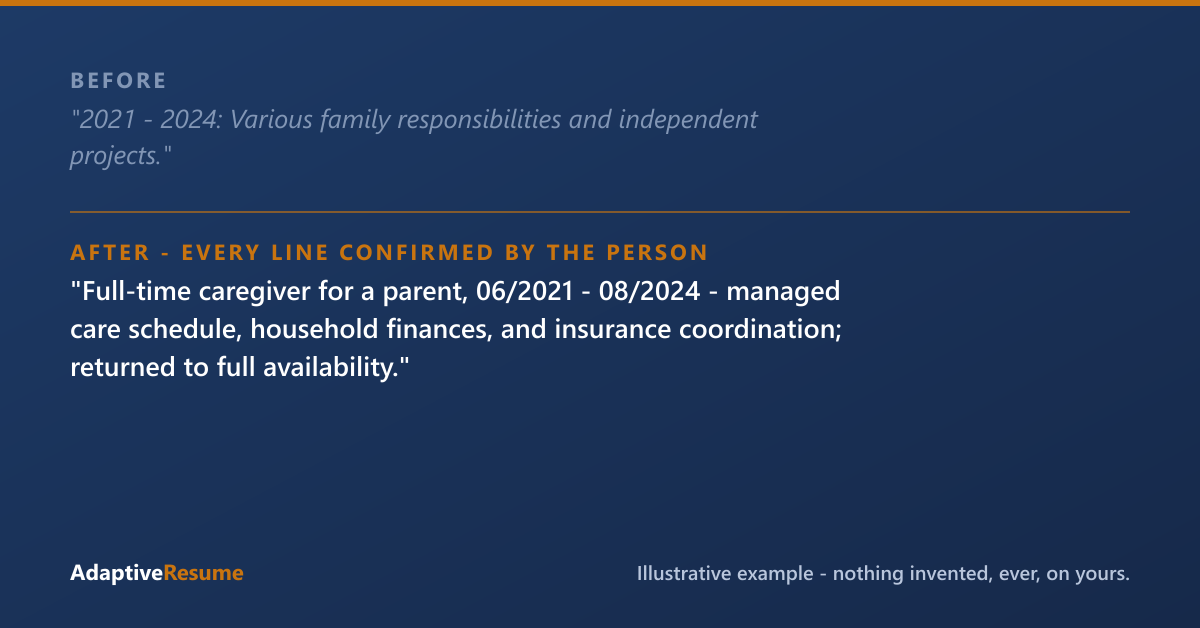
Illustrative example. On your resume, every line comes from your real history - proposed as a question, added only when you confirm it.
Before: “2021 – 2024: Various family responsibilities and independent projects.”
After: “Full-time caregiver for a parent, 06/2021 – 08/2024 — managed care schedule, household finances, and insurance coordination; returned to full availability.”
No new facts — the caregiving, the finances, the coordination were all already true. The rewrite just states plainly what the vague version was mumbling, and adds the one thing the reader actually needs: available now.
How we handle gaps
When we build your resume with you, gaps get treated as part of your history, not a defect in it. We work backwards from what your work actually involved — including what filled the in-between time — and propose a plain, accurate line for anything a reader would wonder about. You decide what’s said and how; nothing lands on the page without your say-so, and nothing goes on it that isn’t true. The Gap-Explanation Phrasing Sheet below has the one-liners ready to adapt.
Common questions
Do I have to explain a gap of a few months?
Usually not on the resume itself. Short gaps between jobs are ordinary — normal job searches take months, and readers know it. Explain a gap when it's long enough or recent enough that the reader will wonder; a one-line answer beats leaving them to guess.
Should I use years-only dates to make a gap less visible?
Years-only dating is a real convention some people use, but be clear-eyed about the trade: it makes short gaps less prominent, and recruiters know that's often why it's chosen. Many will ask for months anyway. Whatever format you pick, the dates themselves must be accurate — softening visibility is a formatting choice; changing dates is a lie.
Will a gap automatically disqualify me?
No honest person can promise you how any employer weighs a gap. What's in your control: an accurate timeline, a calm one-line account of the time, and a resume that leads with what you're strong at. An explained gap is a detail; a discovered cover-up ends the process.
Gap-Explanation Phrasing Sheet
Pop your email in and the download unlocks right here — and being on the list before launch day locks in 25% off your first build. We'll also send the occasional useful note and tell you the moment AdaptiveResume goes live. No spam.
Download: Gap-Explanation Phrasing SheetThanks — you're on the launch list, your 25% is locked in, and your download is ready below.
That email didn't look right — mind trying it again?
Ready to do this on your own resume?
We'll find what you've left off and you approve every line — nothing made up.
Build your resume — $49Try the demo first — a sample review, no sign-up · See how the service works
Paid a resume service and got a template back? Start at Fix my resume.