Guides · For job seekers
Respiratory Therapist Resume: Credentials, Vents, and Setting
Respiratory therapist resumes are read credential-first, then for setting and acuity. How to write yours with your real NBRC credential, the units you've worked, and the vent and ABG experience that actually matters.
Published 08/30/2026
Respiratory therapist hiring is read in a specific order, and the order rarely changes: credential first, then setting and acuity, then the modalities you actually run. A therapist who lives on ventilated ICU patients and one who spends the day on floor treatments and PFTs are doing different jobs, and a resume that reads as generically “respiratory” competes badly against both. The single most useful thing you can do is make your NBRC credential and your unit unmissable in the first few lines.
The second most useful thing is putting your real experience on the equipment and the patients. Respiratory resumes are unusually vague about acuity — plenty say “provided respiratory care to patients” and never say ventilated or spontaneously breathing, ICU or floor, adult or neonate. Acuity and setting are exactly what a hiring manager is trying to figure out.
Lead with credential and setting
Under each employer, give the context in one line before the bullets — your credential, the units you staffed, the patient population, and the acuity.
Before: “Provided respiratory therapy and breathing treatments to patients as ordered.”
After: “RRT in a 24-bed medical/surgical ICU; managed [N] ventilated adults per shift, ran weaning protocols, drew and interpreted ABGs, and covered rapid responses and codes as the respiratory member.”
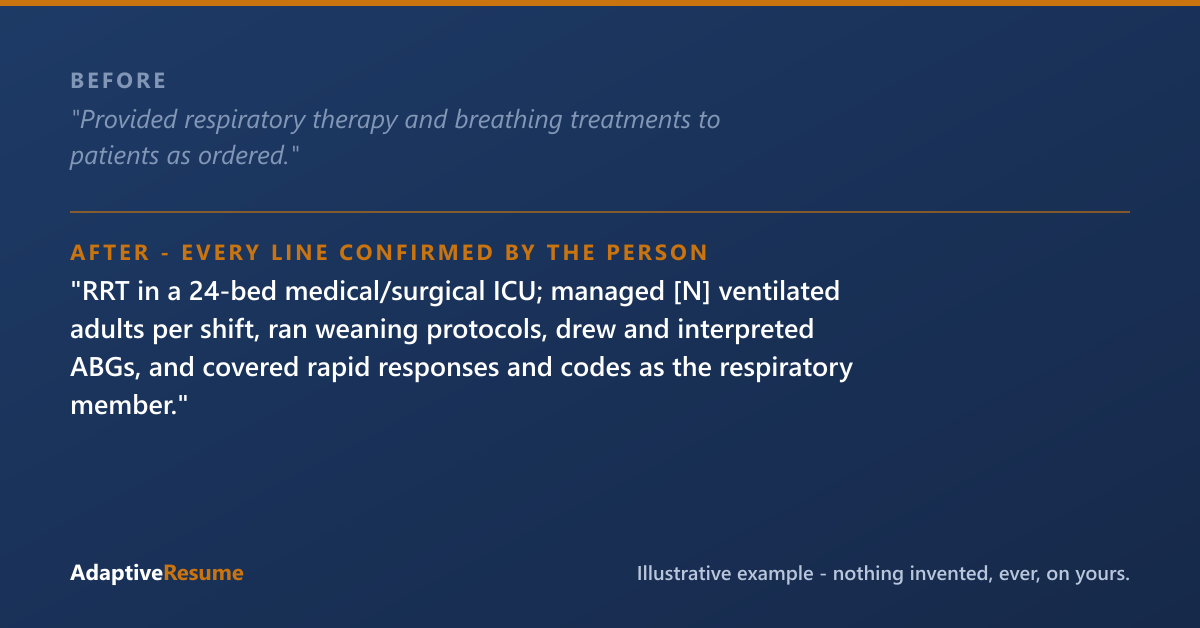
The second version is scannable in four seconds and answers what the first version leaves a reader guessing at. It also matches how hospitals describe their own needs in postings — they hire for a unit and an acuity, not for “respiratory therapy” in the abstract.
Lead with your NBRC credential, exactly as held
Your credential from the National Board for Respiratory Care is the first filter, so put it where it can’t be missed — after your name and in a clearly labeled credentials block.
The CRT (Certified Respiratory Therapist) and the RRT (Registered Respiratory Therapist) are the two core NBRC credentials. Many higher-acuity roles require the RRT; list the one you actually hold. If you’re a graduate testing toward the RRT, write it as RRT-eligible with your test timeline rather than claiming the credential early.
Specialty credentials are separate NBRC exams beyond the RRT, and holding one is a genuine distinction: the ACCS (Adult Critical Care Specialist) and the NPS (Neonatal/Pediatric Specialist). If you work PFTs or sleep, the CPFT/RPFT (pulmonary function technologist) and SDS (sleep disorders specialty) credentials exist too — name only what you’ve earned.
Then your state license. Nearly every state licenses respiratory therapists, and many issue the title RCP (Respiratory Care Practitioner). Use your state’s exact title, name the state, and keep the status current.
Life-support cards belong here as well: ACLS, PALS, and NRP (the Neonatal Resuscitation Program) — list the ones you hold, with current dates, because code and delivery-room coverage often depend on them.
The parts of the job that carry the most weight
Ventilator management is the center of an acute-care respiratory resume. Write the scope: invasive and non-invasive, the modes you run, initiation and titration, and daily assessment. If you weaned patients, say so — weaning protocols and spontaneous breathing trials are exactly the judgment employers are reading for.
Airway and non-invasive support deserve their own lines: BiPAP and CPAP setup and titration, high-flow nasal cannula, intubation assist, and airway management. In the ED and on rapid responses, this is often most of the job.
ABGs — drawing arterial blood gases, running the sample, and interpreting the result to adjust the plan — are a core competency worth stating plainly. Interpretation, not just the stick, is what separates candidates.
Codes and rapid responses. If you’re the respiratory member on the code team or rapid response team, that’s a responsibility line, not a duty line. Name it.
Assessments and therapies. Aerosolized medications, bronchial hygiene, chest physiotherapy, incentive spirometry, and patient/family teaching are legitimate lines — and in med-surg and pediatric floor work, they carry the day.
Setting notes
ICU / critical care: ventilated census, weaning, ABGs, and code coverage are your resume. Bed count and acuity are the shorthand a manager reads for competence.
NICU: neonatal ventilation, surfactant administration, delivery-room and resuscitation coverage (NRP), transport, and the acuity level of the unit. This is where the NPS credential earns its space.
Emergency department: intubation assist, non-invasive ventilation, nebs, ABGs, and fast turnover. Volume and the range of what you handle solo matter here.
Med-surg / floor: treatment volume, protocols, patient teaching, and coverage ratios. Naming your patient load honestly is not a weakness — floor managers know what that volume feels like.
PFT lab: the full study menu you run — spirometry, lung volumes, diffusion capacity, bronchodilator response, methacholine challenge — plus quality control and calibration.
Sleep lab: polysomnography setup and scoring, titration studies, and the SDS credential if you hold it.
Format notes
Length follows your history, not a page rule. The “keep it to one page” advice gets repeated far past the point where it helps. If you’ve worked more than one unit, held a specialty credential, precepted new hires, or came into respiratory from another clinical field — that’s the material that puts you ahead of the other candidates, and cramming it onto one page to satisfy a convention throws away your advantage.
The honest rule: two pages is normal and expected once you have more than one substantive role to describe. What matters is that every line earns its space. A tight two pages beats a padded one page. Cut duties everyone in the role shares; keep acuity, setting, modalities, credentials, and anything that shows judgment.
One genuine exception worth knowing: federal applications through USAJOBS cap at two pages as of the September 2025 OPM change. That’s a hard requirement, not a style preference — it matters for VA hospital roles especially.
Otherwise: reverse chronological, single column, a setting-and-acuity line under every employer, and a clearly labeled credentials-and-licensure block up top. Clinical hiring reads credentials as a proxy for how quickly you’ll be cleared to work. Skip the graphics.
A bullet bank you can adapt — keep only what’s true
- “Managed [N] ventilated [adult/neonatal] patients per shift in a [N]-bed [ICU/NICU]”
- “Ran weaning protocols and spontaneous breathing trials; [N] ventilator liberations per [month]”
- “Initiated and titrated BiPAP/CPAP and high-flow nasal cannula on [floor/ED/ICU] patients”
- “Drew and interpreted ABGs; adjusted [vent settings / oxygen therapy] based on results”
- “Served as respiratory member on the [code / rapid response] team across [N] units”
- “Covered deliveries and neonatal resuscitations under NRP; [transport / surfactant] as needed”
- “Performed [spirometry / lung volumes / DLCO] in the PFT lab; ran QC and calibration”
- “Precepted [N] new therapists and respiratory students on [ventilator management / unit workflow]“
What screening software looks for on a respiratory therapist resume
Filters commonly read for: respiratory therapist, RRT, CRT, RCP, mechanical ventilation, ventilator management, invasive and non-invasive ventilation, BiPAP, CPAP, high-flow nasal cannula, ABG, arterial blood gas, weaning, spontaneous breathing trial, intubation assist, airway management, ACLS, PALS, NRP, ICU, NICU, emergency department, pulmonary function testing, PFT, polysomnography, aerosol therapy, bronchial hygiene, and patient assessment. O*NET’s respiratory therapist profile has the full task list.
The highest-risk lines are the ones that overstate scope — a credential you’re testing toward but haven’t earned, ICU acuity you covered as a float but didn’t own, or a specialty exam you haven’t sat. Clinical employers verify credentials directly with the NBRC and your state board, so anything you claim there has to be exactly true.
The Role Skills Checklist below helps you inventory what your shifts actually prove, which is often considerably more than the resume currently says. Our build does it with you: we work backwards from your real units, credentials, and the modalities you run, propose the standards and equipment that work like yours normally involves, and ask you to confirm every line before it appears. We never add a credential, a unit, or a certification you didn’t tell us about.
Common questions
Do I need to be an RRT, or is CRT enough?
It depends on the employer and the setting. Both the CRT and the RRT are real credentials from the National Board for Respiratory Care (NBRC), and plenty of therapists work on the CRT. But many hospitals — especially for ICU and higher-acuity roles — require or strongly prefer the RRT, and some postings screen for it as a hard filter. List the credential you actually hold with its true status. If you're RRT-eligible and testing, say so; don't write RRT before you've earned it.
Should I list ACCS or NPS if I only have a little critical care experience?
List a specialty credential only if you actually hold it. The Adult Critical Care Specialist (ACCS) and Neonatal/Pediatric Specialist (NPS) are separate NBRC exams beyond the RRT — holding one is a real distinction, not a description of your comfort level. If you have ICU or NICU experience but not the credential, write the experience honestly (units, acuity, vent hours) and leave the credential line for what you've earned.
How do I show critical care experience if I've mostly floated?
Describe the units you've actually staffed and what you did there. Floating across the ICU, ED, and med-surg floors is a genuine strength — it shows range — so name the units, the acuity, and the modalities you ran in each. 'Floated ICU, ED, and step-down; managed ventilated and BiPAP patients across all three' says far more than 'provided respiratory care in various settings.'
Does my state license go on the resume, and what do I call it?
Yes — list your state respiratory care license with the state and its real status. Nearly every state licenses respiratory therapists, and many use the title Respiratory Care Practitioner (RCP). Use the exact title your state issues, include the state, and note the expiration if the posting asks. An active, unencumbered license in the state you're applying to is the first thing many employers check.
Role Skills Checklist
Pop your email in and the download unlocks right here — and being on the list before launch day locks in 25% off your first build. We'll also send the occasional useful note and tell you the moment AdaptiveResume goes live. No spam.
Download: Role Skills ChecklistThanks — you're on the launch list, your 25% is locked in, and your download is ready below.
That email didn't look right — mind trying it again?
Ready to do this on your own resume?
We'll find what you've left off and you approve every line — nothing made up.
Build your resume — $49Try the demo first — a sample review, no sign-up · See how the service works
Paid a resume service and got a template back? Start at Fix my resume.