Guides · For job seekers
Operating Room Nurse Resume: Circulating, Scrubbing, and Counts
Perioperative nursing hires on specifics: which services you cover, whether you circulate or scrub, and the counts and sterile technique behind every case. Write them in.
Published 08/11/2026
Operating room hiring runs on a specific kind of trust: in your room, the count is right, the field stays sterile, and the time-out actually happens. A resume that says “assisted with surgical procedures” tells a perioperative manager nothing. One that names your services, your circulating-versus-scrubbing split, and your counts and documentation habits tells them almost everything. Here’s how to write that version.
What hiring managers and screening software look for on an operating room nurse resume
Screening software searches for perioperative vocabulary, and the manager reads for the same terms plus the pattern behind them:
- Certifications: BLS and ACLS listed exactly as held. CNOR is the specialty’s board certification and leads the block when you hold it.
- Role split: circulating and scrubbing, stated plainly, with your real proportion. These are different jobs inside the same room, and managers staff around the difference.
- The safety spine: sterile technique, surgical counts, Universal Protocol time-outs, specimen handling, patient positioning. This is the vocabulary of what the role typically involves; on your page it should describe what you actually did, case after case.
- Service lines: general, orthopedics, neuro, cardiac, OB, robotics — whichever rooms you genuinely work. Robotic platform experience is worth naming specifically if you have it.
- Systems: Epic or Cerner by name; preference cards you maintain or update.
For the base occupation vocabulary, O*NET profiles this work under Registered Nurses (29-1141.00) — perioperative nursing is a specialty within the RN occupation rather than a separately coded job, so your case specifics have to say what the code can’t.
Circulating vs scrubbing: say which, and how much
The single most useful line on an operating room nurse resume is the one that states your actual role in the room:
Before: “Assisted surgeons during a wide variety of surgical procedures.” After: “Circulating RN across [general/ortho/neuro] services; scrub [share] of cases; owned counts, specimen handling, and time-out documentation in [Epic].”
Same facts, stated plainly. The vague version made a manager guess; the rewrite answers their first three screening questions before they ask.
A bullet bank you can adapt — keep only what’s true
- “Circulating RN, [service lines]; [N] rooms, [case types] including [robotic platform] cases”
- “Scrubbed [share] of assigned cases across [services]”
- “Performed surgical counts with the scrub team per policy; reconciled and escalated discrepancies before closing”
- “Maintained sterile field and technique through [long / complex / trauma] cases”
- “Ran Universal Protocol time-outs; documented in [Epic/Cerner]”
- “Handled and labeled specimens per policy, including frozen sections”
- “Positioned patients for [supine / prone / lateral] cases with pressure-injury precautions”
- “Updated surgeon preference cards for [service]”
- “Precepted [N] nurses through perioperative orientation”
- “On-call rotation: [frequency], including night and weekend cases”
Every one of these is a frame. Keep the ones that describe your actual practice, fill the brackets with your real numbers, and delete the rest.
How should an operating room nurse resume be formatted?
Two pages for experienced perioperative nurses, one for nurses entering the OR (federal applications through USAJOBS — VA hospitals, for example — cap at two pages as of the September 2025 OPM change). Certification block near the top in its own labeled section, then experience with a role line (circulate/scrub split plus service lines) atop each job. Single column, standard headings, no tables or graphics, because hospital screening systems parse plain layouts most reliably. If a Periop 101-style program is how you entered the specialty, name it in education or training; it’s a real credential managers recognize.
New to the OR
Coming from med-surg, the ER, or nursing school? The OR trains its own more than most specialties, so the honest move is to lead with what transfers — sterile awareness from procedures you’ve assisted, documentation discipline, comfort in high-stakes rooms — and label your status plainly: “seeking perioperative residency” or “completing [program].” What managers screen out isn’t inexperience; it’s the resume that dresses observation up as case ownership. “Observed [N] cases across [services]” is a legitimate, useful line for a nurse in transition.
Travel and contract OR nurses
Contract work lists the same way staff work does, with honest attribution per assignment: “[Agency] contract - [Facility], [services covered], [weeks], [Epic/Cerner].” The travel-specific skill is real and managers know it — walking into an unfamiliar OR and being safe in it within days — but it’s best shown through the run of completed contracts and the range of services covered, not claimed as an adjective. If a contract was circulating-only, say so; the split rule applies to every entry, not just permanent ones.
The before-and-after, at a glance
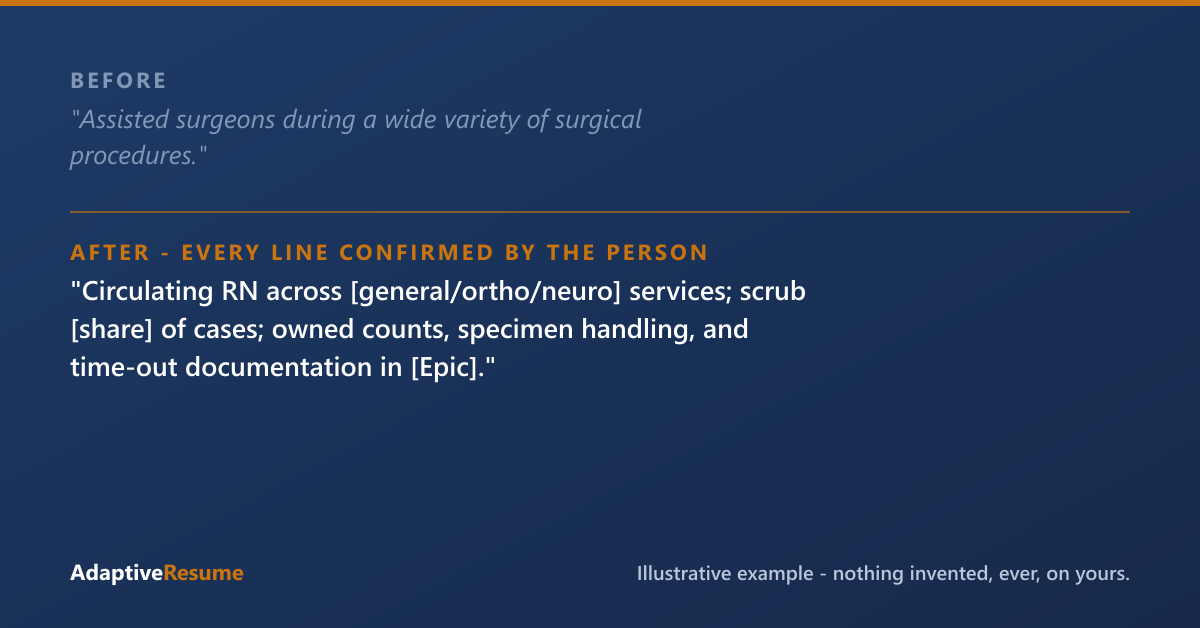
Illustrative example. On your resume, every line comes from your real history - proposed as a question, added only when you confirm it.
How AdaptiveResume helps
We work backwards from what your work actually involved. Tell us your rooms, your services, and your certifications, and we propose the lines your history supports — the circulate/scrub split, the counts, the call rotation — each offered as a question you can confirm, edit, or skip. Nothing lands without your say-so. In a specialty where your first shift reveals exactly what’s true, that’s not caution; it’s the only way a resume should be built. The Operating Room Nurse Resume Skeleton below gives you the structure to start from today.
Common questions
Should I say whether I circulate or scrub?
Yes, plainly and per role: 'circulating RN, scrub [share] of cases' or whatever your real split is. Managers staff rooms around that split, so a resume that hides it just forces the question in a phone screen.
Does CNOR matter on an operating room resume?
It's the specialty's board certification, so if you hold it, it leads your certification block. If you don't, BLS and ACLS listed exactly as held are the baseline; never list CNOR as 'in progress' unless an exam date exists.
How do I show my case experience without exaggerating?
Name your service lines and your real role in them: 'general and ortho; observed cardiac' is honest and useful. Padding service lines gets exposed on your first assignment, so accuracy is also self-protection.
Operating Room Nurse Resume Skeleton
Pop your email in and the download unlocks right here — and being on the list before launch day locks in 25% off your first build. We'll also send the occasional useful note and tell you the moment AdaptiveResume goes live. No spam.
Download: Operating Room Nurse Resume SkeletonThanks — you're on the launch list, your 25% is locked in, and your download is ready below.
That email didn't look right — mind trying it again?
Ready to do this on your own resume?
We'll find what you've left off and you approve every line — nothing made up.
Build your resume — $49Try the demo first — a sample review, no sign-up · See how the service works
Paid a resume service and got a template back? Start at Fix my resume.