Guides · For job seekers
Construction Worker Resume: Your Safety Cards, Your Tools, and the Work You Built
Construction worker resumes are read for safety training, the tools and equipment you can run, the kind of jobs you worked, and how reliably you showed up. Here's how to write yours with real projects, cards, and numbers.
Published 10/13/2026
A construction worker resume is read by a foreman, a superintendent, or a recruiter for a general contractor or a staffing company. They are looking for four things: whether you can work safely on their site, which tools and equipment you can handle, what kind of jobs you have worked, and whether you show up every day. A resume that says “hard-working laborer with construction experience” tells them none of that.
Construction work leaves a record: the cards in your wallet, the projects you were on, the equipment you were trained on, and the days you worked. Put that record on the page.
Lead with your cards, your work, and your reliability
Before: “Construction laborer responsible for site cleanup, carrying materials, and assisting tradesmen.”
After: “Construction laborer for a [commercial general contractor] on [3] projects, including a [4]-story steel-frame office building: concrete pours, forming and stripping, and site cleanup on a [12]-person crew; OSHA 10 ([year]), trained on the [skid steer] and [scissor lift]; [18] months with no missed days and no recordable injuries.”
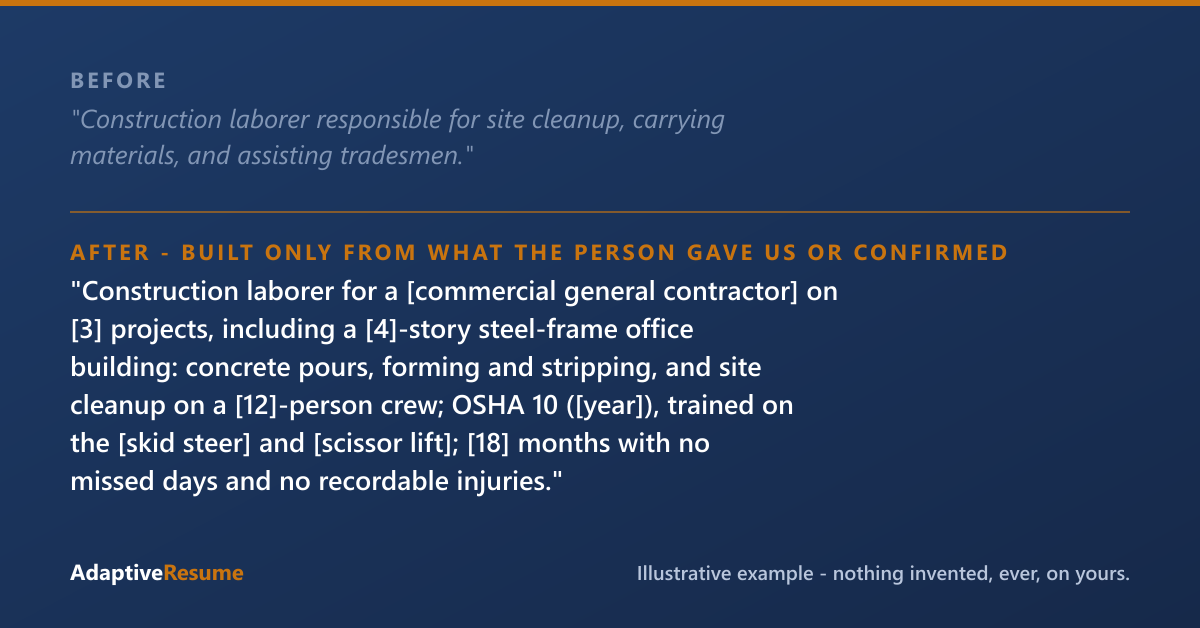
Illustrative example. Everything on your resume is yours: the experience you listed, plus the safety training, tools, and equipment your work already involved, each added only after you confirm it’s true.
The second version tells the foreman the type of contractor, the projects, the tasks, the crew size, the safety card, the equipment, and the attendance record in two lines.
Safety training, named exactly
OSHA outreach cards. The OSHA 10-hour and 30-hour construction courses are part of OSHA’s Outreach Training Program, which federal OSHA treats as voluntary. Some places make them mandatory. Nevada, for example, requires construction workers to get a 10-hour card and supervisors a 30-hour card within 15 days of being hired. New York City requires Site Safety Training (SST) cards with at least 40 hours of training for workers on many larger sites. Write the card, the year, and for an SST card, the expiration date.
Fall protection, scaffolds, and trenches. OSHA’s construction rules require fall protection where a worker on an unprotected edge could fall 6 feet or more to a lower level, and scaffolds have their own 10-foot rule. Any trench or excavation 5 feet deep or more needs a protective system, such as sloping, shoring, or a trench box, unless it is cut entirely in stable rock. If you were trained in fall protection, scaffold use, or trench safety, name the training. A contractor reads it as one less thing to teach.
Other cards worth listing. Flagger certification, first aid and CPR, forklift or aerial lift training, silica awareness, confined space entry, and hazard communication training all belong on the resume with the issuer and the year. List only what you completed.
Tools, equipment, and trades work
Equipment. Name what you can run: skid steers, mini excavators, compactors and rollers, concrete saws, jackhammers, power trowels, forklifts, scissor lifts, and boom lifts. Say whether you were trained and evaluated on it, because a foreman wants to know what they can hand you on day one.
Tools and tasks. Describe the work in the words the trades use: forming and stripping, rebar placement, concrete pours and finishing, demolition, framing support, drywall hanging, grading, trenching, pipe laying, and traffic control. If you helped a carpenter, an electrician, or a plumber, say which trade and what you did.
Types of jobs. Commercial, residential, road and bridge, utility, and industrial work are read differently. Name the type and the size when you know it, such as square footage, the number of stories, or the length of the road or pipe.
The numbers a foreman reads
Projects and crew. Give the number of projects, their type and size, and the size of your crew.
Attendance. Months without a missed day, early starts, and overtime worked show reliability, which a foreman weighs heavily.
Safety record. Write your months or years without a recordable injury and any safety recognition. If you served on a safety committee or did the morning stretch-and-flex or toolbox talks, say so.
Production. If your crew tracked it, write what you placed, poured, or installed in a day, such as cubic yards of concrete or feet of pipe.
Starting out with no construction experience
Many people come into construction from warehouse, landscaping, moving, factory, or military work. Those jobs show what a foreman needs: physical work on a schedule, safe use of equipment, and showing up on time. Write them with their numbers and the equipment you ran, then add the safety training you have completed. An OSHA 10 card, first aid and CPR, and a forklift evaluation are each a real line that tells a contractor you are ready for a job site. A pre-apprenticeship program or a union laborers’ training course belongs here too, with its name and dates.
Moving up
Lines that point upward matter even for an entry-level job: being made lead on a small crew, running a piece of equipment the crew depends on, training new laborers, or entering an apprenticeship. If you are moving toward a trade, our carpenter, heavy equipment operator, and journeyman electrician guides cover how those resumes are read.
Format notes
Length follows your history. A construction worker with one or two employers usually fits on one page. Two pages is normal and expected once you have more than one substantive job to describe, such as several contractors, a staffing history, or military construction work. Keep the cards, the equipment, the projects, and the numbers; cut the duties every site shares.
Use reverse chronological order and a single column, and leave out graphics and photos. Many large contractors and staffing companies run applications through hiring software, and a two-column template can scramble the read. Put your safety cards in their own section near the top, where a foreman sees them first.
Seasonal work and short gaps between projects are normal in construction. Write each job with its dates and give a gap one plain dated line.
Construction worker resume examples: a bullet bank you can adapt — keep only what’s true
- “Laborer on [N] [commercial/residential] projects for [contractor]; forming, stripping, and concrete pours on a [N]-person crew”
- “OSHA 10 construction ([year]); fall protection and scaffold training through [employer], [year]”
- “Ran a [skid steer/mini excavator] for grading and trenching; trained and evaluated by [employer], [year]”
- “Placed and finished about [N] cubic yards of concrete a week on slab and sidewalk work”
- “Flagger certified through [issuer], [year]; ran traffic control on [N] road projects”
- “Helped the [electrical/plumbing] crew pull wire or lay pipe on [N] projects”
- “[N] months with no missed days and no recordable injuries”
- “Made crew lead on [N] jobs; trained [N] new laborers”
What screening software looks for on a construction worker resume
Filters commonly read for: construction worker, construction laborer, general laborer, site work, concrete, forming, demolition, framing, drywall, grading, trenching, excavation, pipe laying, flagger, traffic control, OSHA 10, OSHA 30, SST, fall protection, scaffold, skid steer, excavator, forklift, aerial lift, power tools, blueprints, safety, and teamwork. O*NET’s profile for construction laborers has the full task list.
The highest-risk lines are the ones a contractor can check with one call or by asking to see your wallet: a card you never earned, equipment you were never trained on, or a project you were not on. Write what you actually did.
The Role Skills Checklist below helps you inventory what your construction history actually proves, which is usually more than the resume currently says. Our build does it with you: we work backwards from your real jobs, projects, and crews, and we ask you about the safety training, tools, and equipment that work like yours normally involves. Nothing goes on your resume that you didn’t give us or confirm, so a card, a machine, or a project you never told us about stays off the page.
Common questions
Is an OSHA 10 card required for construction work?
Federal OSHA does not require the 10-hour or 30-hour card; it calls the outreach program voluntary. Some states and cities do require it for some or all job sites, and many contractors require it as a condition of hire. If you hold a card, list it with the year it was issued. If you don't have one yet, earning it is one of the fastest ways to make your resume stronger for construction work.
I worked through a staffing agency on several job sites. How do I list that?
List the agency as the employer and name the contractors or projects you were assigned to under it, with dates. That keeps your history honest and shows the range of work you did. If one assignment was long or important, give it its own line with the numbers.
Should I list equipment I have only used a few times?
List equipment you can run safely on a job site without someone standing over you. If you were trained and evaluated on a piece of equipment, such as a skid steer or a forklift, name the training and the year. If you only watched or helped, leave it off or describe it as helping, because a foreman may hand you the keys on day one.
I'm a veteran with engineering or construction experience. How do I write it?
Translate the unit work into site language: the projects you built, the equipment you ran, the size of the crew, and the safety training you completed. Military construction often includes heavy equipment, concrete, and site work that civilian contractors need, so put the numbers and the equipment first and the military terms second.
Role Skills Checklist
Pop your email in and the download unlocks right here. Joining our list also takes 25% off your first purchase within 30 days of joining, when you create your account with this same email. We'll also send the occasional useful note. No spam.
Download: Role Skills ChecklistThanks, you're on our list, and your download is ready just above. Your 25% off a first purchase is good for 30 days from the day this email joined our list.
That email didn't look right — mind trying it again?
Ready to do this on your own resume?
We'll find what you've left off, and nothing goes on your resume that you didn't give us or confirm.
Get your resume build — $29Every purchase is one payment, and nothing renews. A single resume build can be used any time within 12 months of buying it, and AR Pass builds you don't use end when its 90 days end.
Try the demo first — a sample review, no sign-up · See how the service works
Paid a resume service and got a template back? Start at Fix my resume.