Guides · For job seekers
Telemetry Nurse Resume: Certs, Ratios, and Rhythms
Tele nursing is certification-dense and your resume should show it — ACLS, monitoring scope, ratios, and the honest way to write the step up to ICU.
Published 07/30/2026 · Updated 08/06/2026
Telemetry units run on credentials and scope — continuous cardiac monitoring, drips that need titration judgment, patients one deterioration away from the ICU. A tele resume that just says “provided patient care on a telemetry unit” throws that away. Nurse recruiters and unit managers scan for specifics: which certs, what ratio, what acuity, which rhythms you’re trusted with.
The telemetry nurse resume credentials block
License first — RN, state (or compact), unencumbered — then the certifications tele work implies, by their exact names: BLS, ACLS, and your dysrhythmia/telemetry course if you completed one. PCCN if you hold it, prominently — it’s the specialty’s dedicated credential and a genuine differentiator. NIH Stroke Scale certification belongs here too if your unit runs stroke patients. Every one of these is checkable, so exact names and current status only — an expired ACLS listed as current is the kind of claim that ends a hospital application.
The unit line: acuity in one sentence
The strongest single line on a tele resume describes the unit like a nurse would to another nurse:
Before: “Provided nursing care to patients on a telemetry floor.” After: “36-bed cardiac telemetry/step-down unit; typical ratio 1:4-5; continuous monitoring with titrated cardiac drips; frequent post-cath and CHF population.”
That one sentence answers acuity, scope, and trust level before the reader hits a single bullet.
Bullets that show tele judgment
The work that separates tele from med-surg is recognition and response — say it concretely: rhythm changes caught and escalated, rapid responses initiated, drips titrated per protocol, charge or preceptor duties, floating to other units (name them — floating is versatility evidence). Volume counts too: admissions/discharges per shift on a high-turnover unit is real workload evidence.
Writing the move to ICU or step-down
Tele-to-ICU is one of the most common moves in nursing, and the resume version of it is scope-forward, not aspiration-forward. Show the ICU-adjacent work you already did: step-down patients held on the unit, drips managed, codes participated in, CRRT/vent exposure if any. Claim what happened, not readiness adjectives — “assisted in 4 codes as recorder and compressor” outworks “ready for critical care.” If you’re mid-course on CCRN eligibility or an ECCO (critical care orientation) program, list it as in progress, clearly labeled.
Travel and float tele nurses
List each contract honestly — facility, unit type, weeks — rather than blurring it into one entry. Rapid-onboarding across systems is itself the skill; name the EMRs you charted in (Epic, Cerner, Meditech) because staffing software filters on them.
Format notes
Two pages is normal for an experienced RN; new grads hold to one (federal applications through USAJOBS — VA hospitals, for example — cap at two pages as of the September 2025 OPM change). Single column for the applicant tracking system (ATS), certs in a dedicated block (hospital parsers key on them), and the unit-description line at the top of each role.
A bullet bank you can adapt - keep only what’s true
- “Telemetry RN on a [N]-bed unit: typical [N]:1 ratios, [step-down/PCU] acuity”
- “Rhythm interpretation and titration of [cardizem/amiodarone/heparin - the drips you actually run]”
- “ACLS [+ PCCN if held] - exactly as held, with dates”
- “Charge nurse [N] shifts/week; rapid response participation [frequency]”
- “[Epic/Cerner] superuser; precepted [N] new hires to the monitor room and floor”
What screening software looks for on a telemetry nurse resume
Filters read for: telemetry, progressive care, step-down, cardiac monitoring, rhythm interpretation, drip titration, ACLS, PCCN, charge nurse, preceptor, Epic or Cerner, patient ratios. O*NET’s registered nurse profile covers the base vocabulary; the unit specifics are what tele recruiters actually read for.
The before-and-after, at a glance
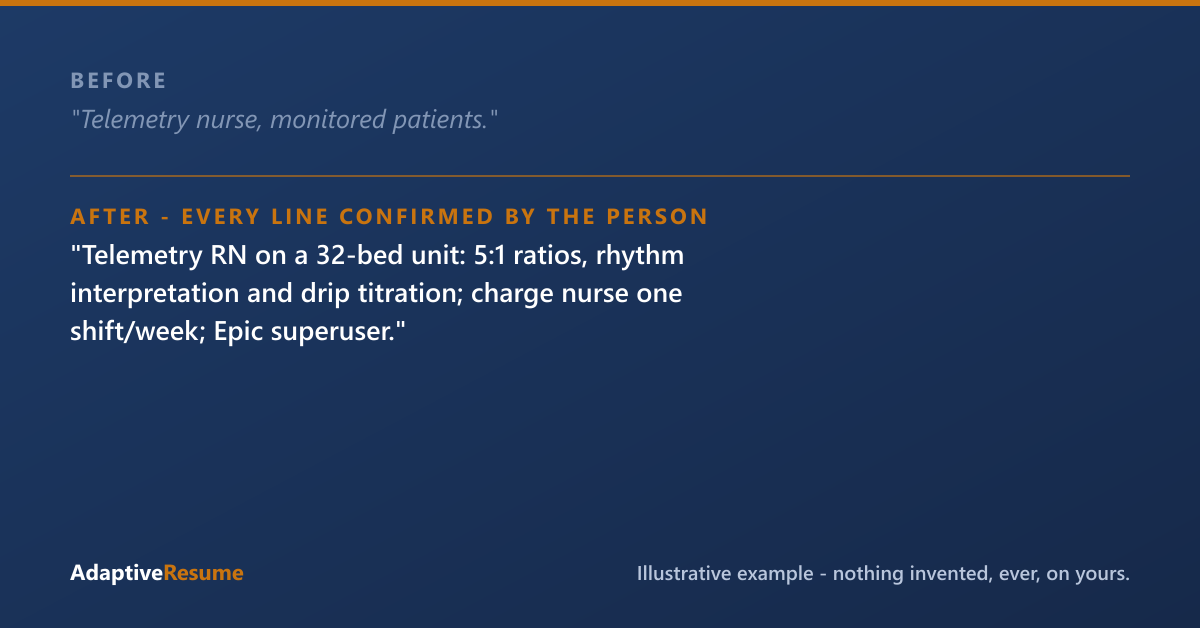
Illustrative example. On your resume, every line comes from your real history - proposed as a question, added only when you confirm it.
The Role Skills Checklist below helps you inventory what your unit time actually proves. Our build does it with you — it reads your history, proposes the certifications and scope it implies, and asks you to confirm each one. On a clinical resume, that ask-first step isn’t just honesty — it’s exactly how credentialing works.
Common questions
What distinguishes a telemetry resume from a med-surg one?
The monitoring competencies: rhythm interpretation, drip titration, and the acuity between med-surg and ICU. Name the unit size, your ratios, and the drips you actually titrate.
Is a PCCN worth listing before I have it?
Only what you hold goes in the credentials block. If you're scheduled to sit for it, a clearly separated 'PCCN exam scheduled [month]' line is honest; blending it into held credentials is not.
How do I show readiness for ICU or ER moves?
Charge shifts, rapid-response involvement, the highest-acuity assignments you take, and cross-training - stated as what happened, not as ambition adjectives.
Role Skills Checklist
Pop your email in and the download unlocks right here — and being on the list before launch day locks in 25% off your first build. We'll also send the occasional useful note and tell you the moment AdaptiveResume goes live. No spam.
Download: Role Skills ChecklistThanks — you're on the launch list, your 25% is locked in, and your download is ready below.
That email didn't look right — mind trying it again?
Ready to do this on your own resume?
We'll find what you've left off and you approve every line — nothing made up.
Build your resume — $49Try the demo first — a sample review, no sign-up · See how the service works
Paid a resume service and got a template back? Start at Fix my resume.