Guides · For job seekers
Police Officer Resume: POST, Report Writing, and Plain Proof
Law enforcement hiring reads for specifics: POST certification, field training, reports that hold up, and duties in plain language a screener outside your agency can parse.
Published 08/11/2026
Police hiring is a paperwork profession’s paperwork test. Whether you’re going lateral to another agency, putting in for a specialty unit, or stepping toward a civilian career, the person screening your resume is asking the same things a background investigator asks: is this specific, is it verifiable, and does it hold up? Vague duty statements (“performed law enforcement duties as assigned”) fail all three. Here’s how to write the version that holds up.
What hiring managers and screening software look for on a police officer resume
The vocabulary that matters, stated as what the job typically involves — and on your page, only as what yours actually did:
- POST certification: your state’s Peace Officer Standards and Training credential, listed exactly as issued, with the state and current status. For lateral moves this is the first thing checked.
- Academy and field training: academy completion (name and year) and your FTO phase, plus any instructor or FTO role you later held.
- Report writing: the skill agencies quietly weight heaviest. Reports feed charging decisions and court; if yours held up, your resume should say what kinds you wrote and who relied on them.
- The work itself: calls for service, traffic enforcement and collision investigation, arrests and case preparation, court testimony, evidence handling and chain of custody, community policing and problem-solving assignments.
- Training that screeners search for: de-escalation and crisis intervention (CIT), current firearms qualification, first aid/CPR, plus systems like CAD (computer-aided dispatch) and RMS (records management) by name.
O*NET’s Police and Sheriff’s Patrol Officers profile (33-3051.00) carries the occupation’s base vocabulary; your agency specifics and assignments carry everything beyond it.
Radio codes, jargon, and the plain-language rule
Here’s the honesty habit that doubles as a screening advantage: write your resume the way you’d write a report for someone outside your agency. Radio codes differ between departments, and screening software doesn’t parse them at all. A civilian HR screener — or an applicant tracking system (ATS) keyword search — sees “10-codes and signal calls” and matches nothing.
Before: “Responded to calls, wrote reports, and appeared in court as needed.” After: “Patrol officer, [agency]: answered calls for service across [beat/shift]; wrote incident and arrest reports relied on in charging decisions; testified in court on my own cases.”
Same career, zero new facts. The rewrite just states the work in language every reader — human or software — can actually process.
A bullet bank you can adapt — keep only what’s true
- “Patrol officer, [agency], [beat/district], [shift]; [N] years”
- “Answered calls for service including [collisions, domestic disturbances, welfare checks, alarms]”
- “Wrote incident and arrest reports; cases forwarded to [detectives/prosecutors] with my reports as the record”
- “Testified in [municipal/state] court on my own cases”
- “Conducted traffic enforcement and collision investigation; [DUI enforcement if true]”
- “Handled evidence per chain-of-custody policy, from collection through submission”
- “Completed crisis intervention (CIT) training; applied de-escalation on [call types]”
- “Worked community policing assignments: [foot patrol, school liaison, neighborhood meetings]”
- “Maintained current firearms qualification and in-service training hours”
- “Used [CAD/RMS system] for dispatch, records, and case documentation”
Fill brackets with your real agency and assignments. Anything you list can come up in a background call to your department, which is the best possible reason to list only what’s true.
How long should a police officer resume be, and what goes first?
One page if you’ve held one substantive role; two pages is normal once you have more than one to describe — a longer career, a supervisory record, or specialty assignments. Federal law-enforcement applications through USAJOBS cap at two pages as of the September 2025 OPM change. Order: certification and training block near the top (POST status first), then experience with agency, assignment, and dates, then education. If you’re moving toward a civilian role, the same page works with the emphasis shifted: lead with report writing, de-escalation, public contact, and testimony — the transferable core — and keep the plain-language rule absolute, because now none of your readers speak agency.
Specialty assignments and collateral duties
FTO, instructor certifications, K-9, traffic unit, detective rotations, honor guard, peer support — specialty and collateral assignments each earn their own line, with dates and the selection process named plainly if there was one (“selected as field training officer, [year]”). These lines do double duty: inside the profession they show trust earned, and outside it they translate cleanly into training, mentoring, and investigative skills. The same rule applies as everywhere else on the page: list the assignment as it actually was, including whether it was full-time or collateral, because the person across the interview table may well know your agency.
The before-and-after, at a glance
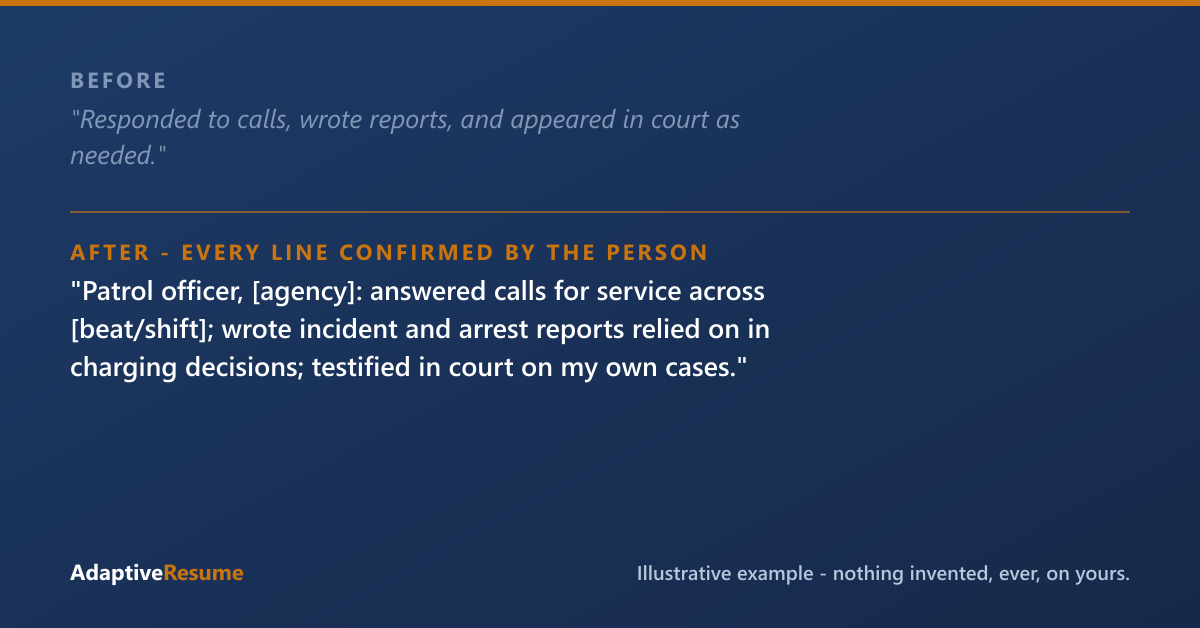
Illustrative example. On your resume, every line comes from your real history - proposed as a question, added only when you confirm it.
How AdaptiveResume helps
We work backwards from what your work actually involved. Tell us your agency, your assignments, and your training record, and we propose the plain-language lines that history supports — the calls, the reports, the court time, the community work — each one offered as a question for you to confirm, adjust, or skip. Nothing lands without your say-so, and nothing goes on the page that a background investigator couldn’t hear read back. That’s the standard your profession already holds you to; your resume should meet it too. The Police Officer Resume Skeleton below gives you the structure to start tonight after shift.
Common questions
Should I list radio codes and agency jargon on my resume?
No — translate them. Codes differ between agencies, and screening software doesn't parse them at all. 'Responded to calls for service including collisions and welfare checks' communicates; a string of 10-codes doesn't.
Does POST certification transfer between states?
Sometimes, through each state's reciprocity or waiver process, and the rules differ by state. List your certification exactly as issued — state and status — and check the receiving state's POST agency for their current requirements before you claim transferability.
How do I handle sensitive details from cases I worked?
Describe the work, not the case: types of calls, your role, the outcome category (report, arrest, referral). Never include names, case numbers, or details that aren't public. A resume is a public document; write it like one.
Police Officer Resume Skeleton
Pop your email in and the download unlocks right here — and being on the list before launch day locks in 25% off your first build. We'll also send the occasional useful note and tell you the moment AdaptiveResume goes live. No spam.
Download: Police Officer Resume SkeletonThanks — you're on the launch list, your 25% is locked in, and your download is ready below.
That email didn't look right — mind trying it again?
Ready to do this on your own resume?
We'll find what you've left off and you approve every line — nothing made up.
Build your resume — $49Try the demo first — a sample review, no sign-up · See how the service works
Paid a resume service and got a template back? Start at Fix my resume.