Guides · For job seekers
Plumber Resume: License, Codes, and Scope Written Honestly
Plumber hiring reads for what you can rough in, set, and pass inspection on. Here's how to write your license tier, apprenticeship, code experience, and real job scope so a foreman or service manager trusts it.
Published 09/08/2026
Plumber hiring runs on trust. The foreman or service manager reading your resume wants to know one thing: can they send you to rough in a building or run a service route, and trust the work to pass inspection and hold up without a callback (a return trip to fix your own work)? Generic language (“experienced plumber skilled in all aspects of residential and commercial plumbing”) doesn’t answer that. The specifics do — the license tier you hold, the code you build to, and the inspections you’ve passed.
The other thing that trips up plumber resumes is scope vagueness. Service plumbing, new-construction rough-in, remodel, and commercial work are related but different jobs, and a resume that just says “plumber” competes badly against one that names the license, the code, and the work.
The scope line: your work in one sentence
Under each role, give one line another plumber would recognize instantly.
Before: “Plumber responsible for installing and repairing plumbing systems in residential and commercial buildings.”
After: “Journeyman plumber, [state] license #[N]; roughed in DWV (drain-waste-vent) and PEX water supply for [N] units on a [4]-story multifamily build to the [IPC/UPC], set [N] fixtures and [N] water heaters, and passed [N] rough-in and final inspections with no re-inspections.”
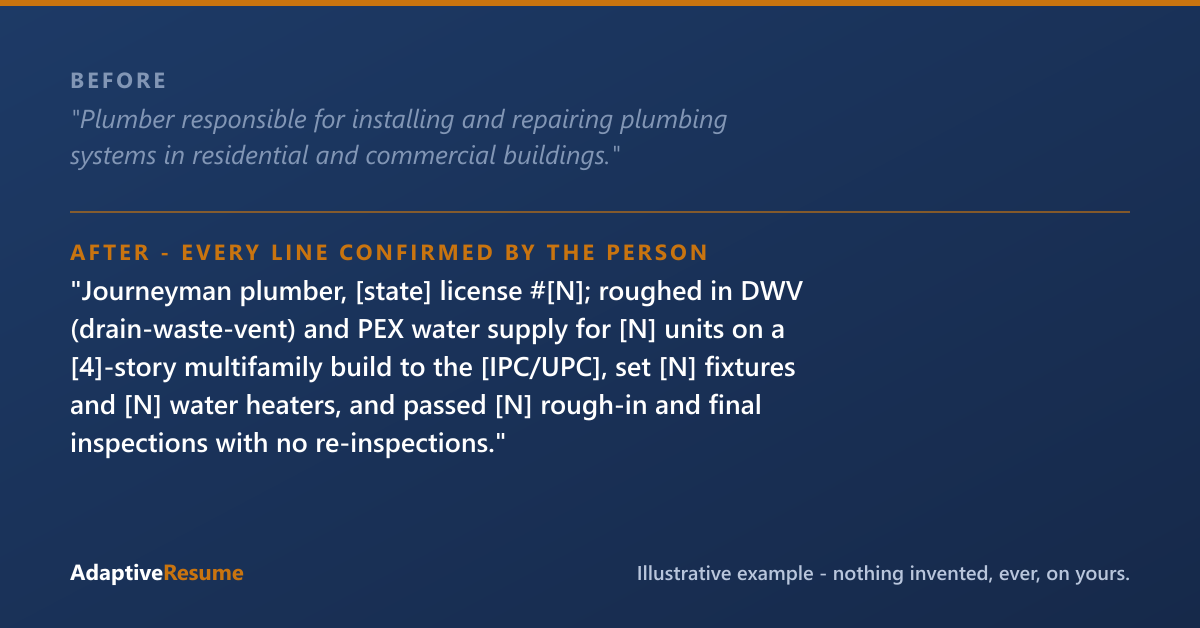
Illustrative example. On your resume, every line comes from your real history — proposed as a question, added only when you confirm it.
The second version is scannable in four seconds and answers what the first leaves a reader guessing at. Notice the rewrite invents nothing; it just says plainly what the vague version was hiding. Fill the brackets with your real numbers.
Credentials, exactly as held
Every item in this block gets checked against the state licensing board, so it has to be exactly right. Our guide on how to list certifications on a resume covers placement and format; here is what typically belongs in a plumber block:
- State license, at the tier you hold. Plumbing licensing is set by each state, and in some states by the city or county. The tiers are typically apprentice, journeyman, and master, and the exam and experience requirements vary by jurisdiction. Write the state, the tier, and the number: “[State] master plumber license #[N], current through [year].” Never write “licensed plumber” without the state and tier — that’s exactly what the reader will ask.
- Apprenticeship, union or non-union. The UA (United Association of Journeymen and Apprentices of the Plumbing and Pipe Fitting Industry of the United States and Canada) runs a five-year registered apprenticeship through its locals that tops out as a journeyman plumber; list your local and year: “UA Local [N], plumber apprentice, year [N] of 5.” On the non-union side, PHCC (the Plumbing-Heating-Cooling Contractors Association) offers PHCC Academy, the PHCC Educational Foundation’s online apprentice courses, approved state by state through PHCC chapters, and ABC (Associated Builders and Contractors) chapters in many areas run registered apprenticeships that include plumbing. Name the one that trained you.
- NCCER Plumbing. NCCER (National Center for Construction Education and Research) publishes a four-level Plumbing curriculum — from tools, materials, and pipe types in Level 1 through service plumbing, codes, and medical gas in the later levels. List the highest level you completed: “NCCER Plumbing, Level [N].”
- Backflow prevention assembly tester. The accepted tester credential varies by state and water purveyor. The ASSE International standard for testers is ASSE 5110 (Backflow Prevention Assembly Tester), part of the ASSE Series 5000 cross-connection control qualifications. Write what you hold and who issued it: “Backflow prevention assembly tester, ASSE 5110, [certifying body], current through [year].”
- ASSE 6010 Medical Gas Systems Installer, from ASSE International, where you install medical gas and vacuum piping in hospitals and clinics. Only list it if you hold it, with the date.
- OSHA 10-hour or 30-hour Construction. These are course-completion cards from the OSHA (Occupational Safety and Health Administration) Outreach Training Program. OSHA itself says the cards are not a certification, so list them as “OSHA 30-Hour Construction, [year]” — never as “OSHA certified.”
- EPA Section 608 technician certification, only if you also service equipment that holds refrigerant — HVAC or refrigeration work. The EPA (Environmental Protection Agency) requires it for technicians who maintain, service, repair, or dispose of that equipment. If you’re strictly a plumber, leave it off; it isn’t a plumbing credential.
List exactly what you hold, with real dates. A tier you haven’t tested for or an expired backflow certification written as current is the fastest way to lose ground in a trade where the license is checked before you’re on the payroll.
The parts of the job that carry the most weight
DWV rough-in. Drain, waste, and vent is the backbone of new-construction and remodel plumbing. Say what you’ve run: PVC (polyvinyl chloride), ABS (acrylonitrile butadiene styrene), or cast iron, underground and above ground; venting from plans; slope, cleanouts, and test. Name the building type and the count — “[N] fixture units across [N] apartments” beats “rough-in plumbing.”
Water supply. Copper (soldered and press), PEX (cross-linked polyethylene; expansion or crimp), and CPVC (chlorinated PVC). Name the material and the joining method you’re actually fluent in.
Fixtures and trim. Setting and trimming out water closets, lavatories, tubs and showers, and commercial fixtures — flush valves, wall-hung carriers, ADA (Americans with Disabilities Act) accessible installs. Give a count per job.
Water heaters. Tank and tankless, gas and electric. Venting, expansion tanks, T&P (temperature and pressure relief) discharge, and gas connections where your license covers gas.
Gas piping. Only where you’re licensed or endorsed for it. Black iron, CSST (corrugated stainless steel tubing), pressure testing, and appliance connections. Name the endorsement that covers it.
Service and diagnosis. Service plumbers should give this its own line: calls per day, the mix of jobs (leaks, stoppages, water heater replacements, repipes), camera inspection, cable and hydro-jet drain cleaning, and customer-facing work — quoting and explaining options.
Codes and inspections. The code you build to — IPC (International Plumbing Code, from the ICC) or UPC (Uniform Plumbing Code, from IAPMO), with state amendments — and your inspection record: rough-in, top-out, and final inspections passed, and how often you needed a re-inspection. A clean inspection record is a real, nameable strength; say it with numbers. Specialty systems — backflow assemblies, grease interceptors, medical gas — get their own line.
Format notes
Length follows your history, not a page rule. Two pages is normal and expected once you have more than one substantive role to describe; one page is right for apprentices in the first year or two. Order matters more than length: license and certification block near the top in its own labeled section (screening software keys on it), then experience with a scope line atop each job.
One genuine exception worth knowing: federal applications through USAJOBS cap at two pages as of the September 2025 OPM change. That’s a hard requirement, not a style preference.
Otherwise: reverse chronological, single column, standard headings, real text rather than graphics or tables — contractor and service-company hiring systems parse plain layouts most reliably. Skip the graphics.
A bullet bank you can adapt — keep only what’s true
- “Journeyman plumber, [state] license #[N]; [residential/commercial/multifamily] work on [N] projects over [N] years”
- “Roughed in DWV ([PVC/cast iron]) and [PEX/copper] water supply for [N] units on a [N]-story [multifamily/commercial] build to the [IPC/UPC]”
- “Set and trimmed [N] fixtures per [project/week], including [flush valves/wall-hung carriers/ADA installs]”
- “Installed [N] [tank/tankless] water heaters per [month/year], including venting, expansion tanks, and gas connections under [state] gas endorsement”
- “Ran [N] service calls per day: leak repair, drain cleaning ([cable/hydro-jet]), camera inspection, and water heater replacement”
- “Passed [N] rough-in and final inspections with [N] re-inspections across [N] projects”
- “Installed and tested [N] backflow prevention assemblies as an ASSE 5110 tester, [certifying body]”
- “Led a crew of [N] plumbers and apprentices; scheduled inspections and coordinated with [GC (general contractor)/other trades]”
Each bullet is a frame, not a claim. If a line isn’t true of your work, it doesn’t go on your page — an interviewer’s first follow-up question will find it.
What screening software looks for on a plumber resume
Contractor and service-company filters read for the vocabulary of the trade, and a human reads for the same words minutes later. The terms that typically matter: plumber, journeyman, master plumber, apprentice, license, DWV, rough-in, water supply, PEX, copper, CPVC, cast iron, fixtures, water heater, tankless, gas piping, backflow, ASSE 5110, medical gas, ASSE 6010, IPC, UPC, inspections, drain cleaning, camera inspection, service calls, OSHA 30, NCCER, and UA.
One honesty note on job codes: O*NET profiles this work under Plumbers, Pipefitters, and Steamfitters (47-2152.00). The three trades share one code, so your license line and the code, systems, and inspections you name have to carry what the occupation code can’t. If your work overlaps other trades, our guides for pipefitters, HVAC technicians, and journeyman electricians cover them the same honest way.
The highest-risk lines are the ones that overstate scope — a license tier you haven’t tested for, gas work written without the endorsement that covers it, or a code you’ve heard of but never built to. Plumbing is a small world, and the board and the contractor check.
The Role Skills Checklist below helps you inventory what your field work actually proves, which is often considerably more than the resume currently says. Our build does it with you: we work backwards from your real jobs, systems, and licenses, propose the lines and credentials that history supports — each one offered as a question, not a decision made for you — and ask you to confirm every item before it appears. We never add a license, a code, or a system you didn’t tell us about.
Common questions
Do I need a license to put 'plumber' on my resume?
Licensing is set by your state, and in some states by the city or county, with apprentice, journeyman, and master tiers whose exam and experience requirements vary from place to place. Write exactly the tier you hold, with the state and number: '[State] journeyman plumber license #[N].' If you're a registered apprentice, say so with your year. A title above your real tier is the fastest way to lose a job offer, because the license gets checked before you're on the payroll.
Should I put the plumbing code on my resume?
Yes, the one your jurisdiction actually adopted. Most of the country works under either the IPC (International Plumbing Code, published by the ICC, the International Code Council) or the UPC (Uniform Plumbing Code, published by IAPMO, the International Association of Plumbing and Mechanical Officials), sometimes with state amendments. Name the code you built to and the inspections you passed under it. Don't list both codes unless you've genuinely worked under both.
How do I show service plumbing experience versus new construction?
They're different jobs, so write them differently. Service work is call volume, diagnosis, drain cleaning, water heater replacements, leak repair, and customer-facing skills — give the calls per day and the kinds of jobs. New construction is rough-in from plans, fixture counts, unit counts, and inspections passed. If you've done both, give each its own line under the right employer rather than blending them into 'all aspects of plumbing.'
I'm an apprentice. What goes on the page when I haven't tested yet?
Your program and your year, honestly: 'Registered plumbing apprentice, [UA Local N / ABC chapter / PHCC Academy], year [N] of [N].' Then the hands-on work you've actually done under a journeyman — DWV rough-in, PEX and copper water supply, fixture setting, water heater installs, drain cleaning. An apprentice resume that names real tasks and real systems reads far stronger than one that hides the apprentice status behind vague language.
Role Skills Checklist
Pop your email in and the download unlocks right here — and being on the list before launch day locks in 25% off your first build. We'll also send the occasional useful note and tell you the moment AdaptiveResume goes live. No spam.
Download: Role Skills ChecklistThanks — you're on the launch list, your 25% is locked in, and your download is ready below.
That email didn't look right — mind trying it again?
Ready to do this on your own resume?
We'll find what you've left off and you approve every line — nothing made up.
Build your resume — $49Try the demo first — a sample review, no sign-up · See how the service works
Paid a resume service and got a template back? Start at Fix my resume.