Guides · For job seekers
Aircraft Mechanic Resume: A&P, IA, and What You Fixed
Aircraft mechanic resumes get read for your certificate first, then for what you actually worked on. How to state your A&P and IA honestly, name the operation you worked under, and show real return-to-service work — without inflating a rating you don't hold.
Published 08/30/2026
Aircraft maintenance hiring runs on one question before any other: what are you certificated to sign off? A resume that leads with “10 years of aircraft maintenance experience” and buries the A&P three lines into the education section is answering the second question before the first. The certificate is the gate, and it belongs where it can’t be missed.
The second thing a maintenance manager reads for is what you actually worked on — the operation you worked under, the aircraft types, and whether you did return-to-service work or handed it up the chain. Generic maintenance resumes lose here because they describe tasks everyone in the shop shares and skip the specifics that separate a line mechanic from someone who signs the logbook.
Lead with the certificate, then the work
Put your certificate status in the first lines, stated exactly, then give the context of each job before the bullets — the operation, the aircraft, and your scope.
Before: “Experienced aircraft mechanic responsible for maintenance, repairs, and inspections on various aircraft.”
After: “A&P certificated (Airframe & Powerplant, 14 CFR Part 65); IA held. Part 145 repair station line and heavy maintenance on [Boeing 737NG] and [CRJ700]; performed and signed return-to-service entries, AD compliance research, and [C-check] tasks.”
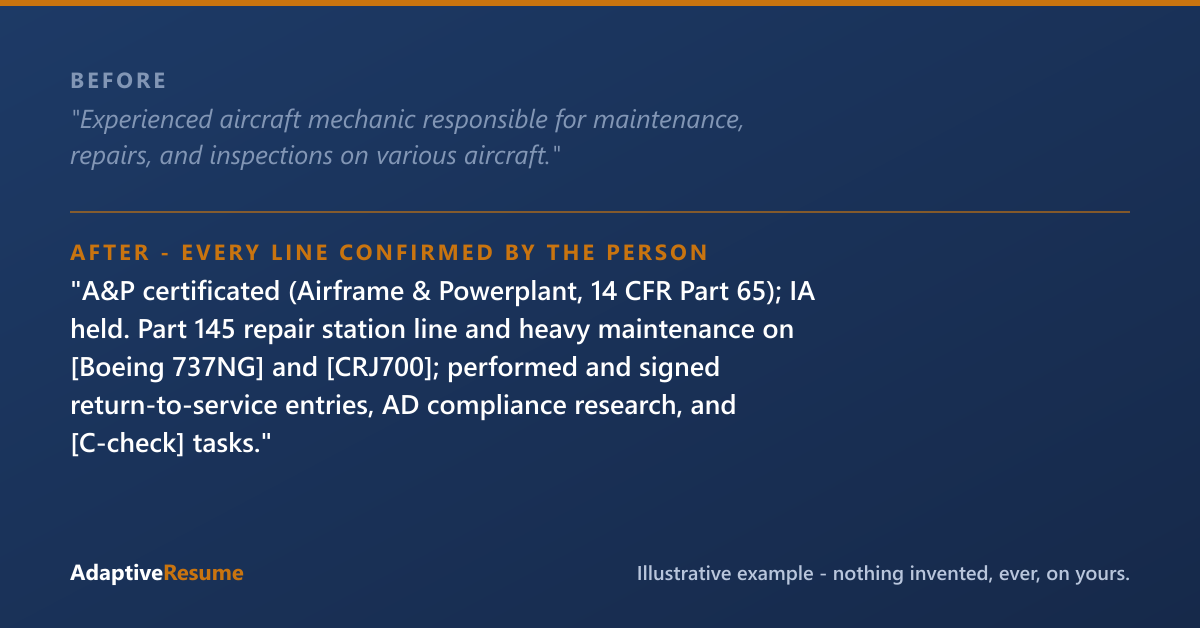
The second version answers in four seconds what the first leaves a reader guessing: what you’re certificated for, what environment you worked in, which aircraft, and whether you were trusted to return them to service. Naming the operating rule — Part 145, Part 121, or Part 135 — matters because a hiring shop describes its own work that way, and it tells them how your paperwork habits and oversight will translate.
State your certificate exactly as the FAA issued it
Your FAA mechanic certificate carries an Airframe rating, a Powerplant rating, or both. “A&P” means you hold both. If you hold only one, say so — “Airframe rating held; Powerplant in progress” is honest and still valuable. The certificate is issued under 14 CFR Part 65, which is worth naming once because it signals you know the framework rather than the slang.
If you hold an Inspection Authorization (IA), list it plainly. Eligibility for the IA is set under 14 CFR §65.91, and its privileges under §65.95 — the holder can inspect and approve major repairs and major alterations for return to service, and perform annual inspections. You must have held both ratings for at least three years, and been actively maintaining aircraft for at least the two years before you apply, just to qualify to test for it; the authorization then expires on March 31 of each odd-numbered year — so state that it’s current.
Be careful with the avionics line. Avionics technicians work on electrical, navigation, and communication systems, and many hold an FCC license or manufacturer certifications rather than an A&P. If your work is avionics, describe it as avionics; if it’s airframe and powerplant, keep it there. Blurring the two reads as either padding or confusion to someone who lives in these distinctions.
If your background is military — whatever your rating or specialty code called it, aviation maintenance technician (AMT) work is the same trade under a different banner — translate the airframes, engines, and maintenance level into civilian terms, and be straight about whether you’ve converted your experience into an FAA certificate yet.
Show return-to-service and airworthiness work
The line between a mechanic and a signing mechanic is return-to-service authority, and your resume should make clear which side you were on.
Logbook and return-to-service entries. If you made and signed maintenance record entries and returned aircraft to service, that’s a high-trust responsibility — write it. If you performed the work and a certificated mechanic signed it off, describe your work accurately without claiming the signature.
Airworthiness Directive (AD) compliance. Researching applicable ADs, performing the required action, and documenting compliance is exactly the paperwork discipline a maintenance manager is trying to hire for. Name it. The same goes for service bulletins and manufacturer maintenance manual tasks.
Inspections. Say which ones: annual, 100-hour, progressive, phase checks, or heavy-check inputs (A-check, C-check). If you hold an IA and performed annuals, that’s your headline.
Troubleshooting and run-up. Diagnosing a squawk, running an engine, and clearing a discrepancy shows you can find the fault, not just swap the part on the card. Borescope inspection of engines belongs here too.
Name the systems and materials you actually worked
Maintenance is broad, and the specifics are what get you screened in. Keep only what’s true:
- Airframe and structures: sheet metal repair, riveting, corrosion control, composites (repair and inspection), flight controls, landing gear.
- Powerplant: reciprocating and turbine engines, engine change, run-up and troubleshooting, borescope inspection, propeller and rotor work if applicable.
- Systems: hydraulics, pneumatics, fuel, electrical, environmental/pressurization.
- Aircraft types worked: name them. “737NG,” “A320 family,” “King Air,” “CRJ,” “Sikorsky S-76” — type experience is one of the hardest filters in this field, and it’s the fastest way for a shop to picture you on their floor.
Only claim inspection methods you’re qualified in. Borescope is common line work. Formal non-destructive testing (NDT) — eddy current, ultrasonic, dye penetrant, magnetic particle — is often a separate qualification, so list an NDT method only if you’re actually certified or trained in it.
Format notes
Length follows your history, not a page rule. The old “one page” advice wastes the very experience that makes you hireable. If you’ve worked heavy maintenance and line, held roles at a repair station and an airline, or carried a lead or crew-chief role, that’s the material that puts you ahead — don’t crush it to fit a convention.
The honest rule: two pages is normal and expected once you have more than one substantive role to describe. Every line still has to earn its space. Cut the generic duties every mechanic shares; keep certificates, aircraft types, return-to-service scope, and anything that shows judgment.
One real exception: federal applications through USAJOBS cap at two pages as of the September 2025 OPM change — a hard requirement, not a style preference. That matters for FAA, DoD, and depot-level roles.
Otherwise: reverse chronological, single column, a clearly labeled certificates block up top, and a systems/aircraft-types block that reads at a glance. Conservative formatting is the right call — skip the graphics and columns that trip up applicant tracking systems.
A bullet bank you can adapt — keep only what’s true
- “Held FAA A&P certificate (Airframe & Powerplant, 14 CFR Part 65); [IA held, renews [MM/YYYY]]”
- “Performed and signed return-to-service entries on [aircraft type] under Part [145/121/135]”
- “Researched and documented AD compliance on [N] aircraft; [zero] repeat discrepancies”
- “Completed [annual / 100-hour / phase / C-check] inspections on [aircraft type]”
- “Troubleshot and cleared [system] squawks; performed engine run-up and borescope inspection”
- “Executed sheet metal / composite repairs per [manufacturer maintenance manual / SRM]”
- “Removed and installed [turbine/reciprocating] engine; [rigged flight controls / serviced landing gear]”
- “Maintained maintenance records in [logbook system / CAMP / TRAX]; [no audit findings over N years]“
What screening software looks for on an aircraft mechanic resume
Filters commonly read for: A&P, airframe, powerplant, Inspection Authorization, IA, return to service, airworthiness directive, AD compliance, 14 CFR, Part 145, Part 121, Part 135, repair station, sheet metal, composite repair, corrosion control, hydraulics, pneumatics, turbine engine, reciprocating engine, borescope, troubleshooting, engine run-up, annual inspection, 100-hour inspection, C-check, NDT, and specific aircraft types by name. O*NET’s Aircraft Mechanics and Service Technicians profile has the full task and technology list.
The highest-risk lines are the ones that overstate the certificate — claiming an A&P you don’t hold, an IA that’s lapsed, or return-to-service authority for work you performed but didn’t sign. Aviation is a documented, audited field and employers verify certificates against FAA records. Accuracy isn’t just honest here; it’s the thing that keeps you hireable.
The Role Skills Checklist below helps you inventory what your maintenance history actually proves — which, for most mechanics, is more than the resume currently says. Our build does it with you: we work backwards from your real certificates, aircraft, and shop experience, propose the systems and standards that work like yours normally involves, and ask you to confirm every line before it appears. We never add a certificate, a rating, or an aircraft type you didn’t tell us about.
Common questions
Do I need my A&P to put 'aircraft mechanic' on a resume?
You can describe the maintenance work you've actually done regardless of what you hold — plenty of people work as apprentices, helpers, or under supervision before certification, and the military produces highly skilled mechanics who haven't yet converted to civilian certificates. What you cannot do is claim the FAA Airframe & Powerplant certificate if you don't hold it. State your real status: A&P held, one rating held, in progress at an FAA-approved maintenance school (an AMTS), or eligible by experience. Employers verify certificates, so accuracy here is not optional.
What's the difference between an A&P and an avionics technician?
An A&P (Airframe & Powerplant) mechanic is certificated under the FAA to maintain the airframe and engines. Avionics technicians work on the electrical, navigation, and communication systems, and many are not A&P-certificated — they may hold an FCC license or manufacturer training instead. The jobs overlap but they aren't the same, and postings usually ask for one or the other. Describe what you actually do rather than blurring the two.
Is the IA worth listing if I only got it recently?
Yes. The Inspection Authorization is the highest maintenance credential short of an airline's own release authority, and it takes years of A&P experience just to qualify to test for it. List it with the truth: that you hold it, and if it's recent, your day-to-day return-to-service and annual-inspection work will speak for how you use it. The IA expires on March 31 of each odd-numbered year, so keep the status current on the resume too.
How do I write a military maintenance background for a civilian resume?
Translate the aircraft, systems, and scope into civilian terms, and be honest about the certificate gap if there is one. Name the airframes and engines you worked, the level of maintenance (line, phase, depot-level), and inspections you performed or supervised. If you're pursuing your A&P through the military experience pathway, say so. The skills transfer; the wording just needs to match how a repair station or airline reads a resume.
Role Skills Checklist
Pop your email in and the download unlocks right here — and being on the list before launch day locks in 25% off your first build. We'll also send the occasional useful note and tell you the moment AdaptiveResume goes live. No spam.
Download: Role Skills ChecklistThanks — you're on the launch list, your 25% is locked in, and your download is ready below.
That email didn't look right — mind trying it again?
Ready to do this on your own resume?
We'll find what you've left off and you approve every line — nothing made up.
Build your resume — $49Try the demo first — a sample review, no sign-up · See how the service works
Paid a resume service and got a template back? Start at Fix my resume.