Guides · For job seekers
Welder Resume: Processes, Positions, and Real Certs
Welder resumes get read for processes, positions, and what you're actually certified to weld. How to write yours with your real SMAW/GMAW/GTAW/FCAW experience, position qualifications, and certs stated honestly — because a cert is specific to a process, position, and material, not a general badge.
Published 08/30/2026
Welding is one of the few trades where a resume can be checked against a plate in the time it takes to run a weld test — many shops give one before they hire. That doesn’t make the resume less important. It decides whether you get called in for the test at all, and it tells the shop which test to set up. A resume that just says “certified welder, 8 years experience” makes both of those harder than they need to be.
The thing that carries the most weight is specificity. Welding certifications are not general badges — a certification names a process, a position, a material, and a thickness range, and it’s tied to a Welding Procedure Specification or a code. A welder who knows this and writes it out reads as someone who has actually been through qualification. A welder who leaves it vague reads, fairly or not, like someone who hasn’t.
Lead with your processes and positions
Under each job, give the shop the picture in one line before the bullets: what you welded, on which processes, in which positions, on what materials.
Before: “Experienced welder responsible for welding and fabrication on various projects.”
After: “Structural steel fabrication; SMAW and FCAW, plate and structural shapes, carbon steel 1/8” to 1”; qualified 3G and 4G; read shop drawings and weld symbols daily.”
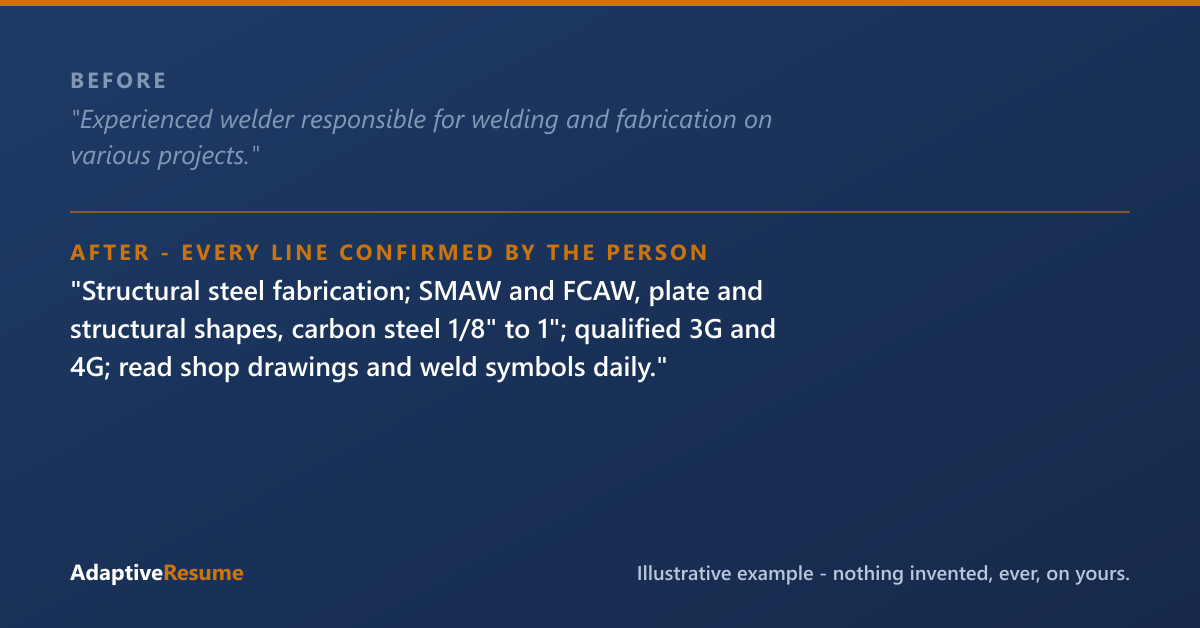
The second version is scannable in a few seconds and answers what the first leaves a hiring welder or shop foreman guessing at. It uses the exact terms shops write into their own postings — process abbreviations, position designations, material — so it matches how the job was described in the first place.
Processes, stated by how you actually run them
The four processes shops screen for are worth naming individually, with the trade nicknames, because both show up in postings:
- SMAW (stick) — the code and field-repair workhorse. Common on structural, pipe, and heavy repair.
- GMAW (MIG) — high-deposition production welding; short-circuit, spray, and pulse variants if you know them.
- GTAW (TIG) — precision work, thin material, stainless and aluminum, pipe roots.
- FCAW (flux-cored) — self-shielded and gas-shielded; heavy structural and out-of-position production.
Say which of these you can be productive on, and be honest about depth. There is a real difference between running production MIG every shift and having tried TIG in school. If a process is limited, write it plainly — “SMAW and FCAW production; GTAW basic.” The weld test finds the gap fast, so setting the expectation on the page costs you nothing and builds trust.
Positions and materials — use the code language
Positions have standard designations, and using them signals you’ve been qualified rather than just “welded a lot.” Plate groove positions are 1G (flat), 2G (horizontal), 3G (vertical), and 4G (overhead). Pipe adds 5G (fixed horizontal pipe) and 6G (fixed 45-degree pipe) — 6G is the demanding all-position pipe test, and if you’ve passed it, it belongs high on the page. Say which positions you’re qualified in and on which process, because qualification is position- and process-specific: “6G pipe, GTAW root with SMAW fill and cap” tells a pipe shop exactly what you can do.
Materials matter as much as process. Carbon steel, stainless, and aluminum weld differently and shops hire for the ones they run. Name what you’ve actually welded, and add thickness range where you know it — thin-gauge sheet and one-inch structural plate are different jobs.
Certifications — specific, with real status
This is where honesty matters most, and where the detail helps you rather than hurting you. A welder certification is not one thing. The AWS Certified Welder program, run by the American Welding Society, tests welders to real production procedures. A qualification under a code like AWS D1.1 (Structural Welding Code — Steel) is tied to a specific process, position, material, and thickness range — not a blanket “certified.”
There’s an honest distinction to draw, and drawing it makes you look like you understand your own trade:
- Being qualified on a specific WPS at a given shop means you passed a weld test on that shop’s procedure — a real, valuable thing, but tied to that procedure.
- Holding a credential like AWS Certified Welder or a qualification to a published code is broader, but still names a process, position, and material.
So write the detail. “AWS Certified Welder” alone is fine, but “AWS Certified Welder — SMAW, 3G/4G, carbon steel” is stronger and truer. If you were qualified on an employer’s WPS rather than an external credential, say that: “qualified on company WPS, GMAW, 2G/3G, [material].” Many welder qualifications lapse if you go a period without welding on the process, so note current status where it applies rather than implying a cert is permanent.
Reading, inspection, and the skills shops assume
The parts of the job beyond the arc are worth their own lines, because they separate a welder from someone who only lays bead:
- Blueprint and weld-symbol reading — following shop drawings, interpreting weld symbols, and welding to spec. Shops assume it and are relieved to see it stated.
- Fit-up and prep — joint preparation, bevels, tacking, and fixturing. On many jobs this is half the work.
- Visual inspection (VT) — checking your own welds against acceptance criteria. If you have awareness of nondestructive testing — RT (radiographic), UT (ultrasonic), MT (magnetic particle), or PT (dye penetrant) — say “familiar with,” not “perform,” unless you actually hold the inspection credential.
If you hold an inspector credential such as AWS CWI (Certified Welding Inspector), that’s a separate and significant line — list it explicitly rather than folding it into general “inspection experience.”
Format notes
Trades resumes are usually one page, and that’s genuinely fine here — but the certification and position detail is what earns the space, so don’t cut it to hit a page count. If you’ve held several roles across structural, pipe, and fabrication, a tight two pages is normal and expected once you have more than one substantial job to describe. What matters is that every line earns its place. A clear certifications block, a processes-and-positions summary, and real work history beat a padded page of duties every welder shares.
One exception worth knowing: federal applications through USAJOBS cap at two pages as of the September 2025 OPM change. That’s a hard requirement, not a style preference.
Otherwise: reverse chronological, single column, a clearly labeled certifications block, and a short processes/positions summary near the top. Shops read that summary as a proxy for how fast you’ll be productive. Skip the graphics and photos — the plate test is the demo.
A bullet bank you can adapt — keep only what’s true
- “Welded [SMAW/GMAW/GTAW/FCAW] on [carbon steel / stainless / aluminum], [thickness range]”
- “Qualified [1G/2G/3G/4G] plate and [5G/6G] pipe on [process]”
- “AWS Certified Welder — [process], [position], [material]” (or “qualified on company WPS — [process], [position]”)
- “Read shop drawings and weld symbols; welded to spec on [structural / pipe / pressure] work”
- “Performed fit-up, bevels, and tacking on [assemblies / weldments]”
- “Passed [N]% of radiographed welds on [pipe / structural] jobs” (only if you know the number)
- “Ran [MIG / flux-cored] production at [deposition / footage] on [product]”
- “Performed visual inspection to [AWS D1.1 / project] acceptance criteria; familiar with [RT/UT/MT/PT]“
What screening software looks for on a welder resume
Filters and foremen commonly read for: SMAW, GMAW, MIG, GTAW, TIG, FCAW, flux-cored, stick, AWS, AWS D1.1, certified welder, WPS, welder qualification, structural welding, pipe welding, 6G, 3G, 4G, all-position, carbon steel, stainless steel, aluminum, blueprint reading, weld symbols, fit-up, fabrication, visual inspection, VT, and NDT. O*NET’s profile for welders, cutters, solderers, and brazers has the full task and tool list.
The highest-risk lines are the ones that overstate scope — a position you weren’t qualified in, a process you barely ran, or a cert stated as permanent when it’s lapsed. In welding this gets found in one weld test, so it’s the wrong place to stretch. Accurate detail is stronger than inflation because it survives the plate.
The Role Skills Checklist below helps you inventory what your work actually proves — which is often more, and more specific, than the resume currently says. Our build does it with you: we work backwards from your real processes, positions, materials, and certs, propose the standards and terms work like yours normally involves, and ask you to confirm every line before it appears. We never add a certification, a position, or a process you didn’t tell us about.
Common questions
What certifications should a welder put on a resume?
List what you actually hold, with the detail that makes it real. A welder certification is specific — it names a process, a position, a material, and a thickness range, and it's tied to a Welding Procedure Specification (WPS) or a code like AWS D1.1. 'AWS Certified Welder' or 'certified to AWS D1.1, SMAW, 3G and 4G, carbon steel' says far more than 'certified welder.' If a cert has an expiration or a maintenance requirement, note its status honestly.
Do I need to be AWS certified to get a welding job?
It depends on the shop and the work. Structural, pipe, and code jobs often require a specific certification or a passed weld test on their own WPS before you start. Plenty of fabrication and production jobs test you in-house instead. List the certs you hold, and if a shop qualifies you on their own procedure, that counts too — say what you passed and on what process and position.
How do I list welding positions on a resume?
Use the standard code designations, because that's the language shops read in. Plate groove positions are 1G (flat), 2G (horizontal), 3G (vertical), and 4G (overhead); pipe adds 5G and 6G. Say which you're qualified in and on which process — '6G pipe, GTAW root and SMAW fill/cap' tells a pipe shop exactly what you can do.
Should I list processes I've only used a little?
Be honest about depth. There's a real difference between running production MIG all day and having touched TIG in school. List the processes you can actually be productive on, and if a process is limited, say so plainly — 'SMAW and FCAW production; GTAW basic.' A weld test in the shop will find the gap fast, so it's better to set the expectation on the page.
Role Skills Checklist
Pop your email in and the download unlocks right here — and being on the list before launch day locks in 25% off your first build. We'll also send the occasional useful note and tell you the moment AdaptiveResume goes live. No spam.
Download: Role Skills ChecklistThanks — you're on the launch list, your 25% is locked in, and your download is ready below.
That email didn't look right — mind trying it again?
Ready to do this on your own resume?
We'll find what you've left off and you approve every line — nothing made up.
Build your resume — $49Try the demo first — a sample review, no sign-up · See how the service works
Paid a resume service and got a template back? Start at Fix my resume.