Guides · For job seekers
Security Guard Resume: Your Post, Your State Credential, and What You Actually Did on Shift
A security company or a facility reads a security guard resume for three things: the state credential written exactly right, the post you held and what it covered, and the incidents and reports that prove you did the job. Here's how to write yours honestly.
Published 09/26/2026 · Updated 10/30/2026
A security company or a facility reads a security guard resume in a few seconds, and it reads for three things. Is your state credential written the way the state issues it, and is it current? What post did you hold, what did it cover, and were you armed? And do the reports, incidents, and systems on the page match what a supervisor would confirm if someone called? “Reliable security professional with a strong work ethic” answers none of that. The specifics do.
The other thing that sinks security resumes is leaving off the work. Officers do a great deal that never makes the page: access control for hundreds of people a shift, hourly patrols with checkpoints, camera monitoring, medical calls, de-escalation, and a daily activity report at the end of every shift. Almost all of it is what the account manager is screening for, and this guide is about getting it on the page without inflating a single line.
The post line: your scope in one sentence
Under each job, give one line another officer or an account manager would recognize instantly.
Before: “Security guard responsible for patrolling the premises and monitoring security cameras.”
After: “Security Officer, [Georgia] Board weapon permit (armed, active); [120,000]-sq-ft distribution center, [night] shift, solo post; access control for [200] employees and [40] trucks a night, [hourly] foot and vehicle patrols, [Genetec] camera wall; DARs (daily activity reports) and incident reports in [TrackTik].”
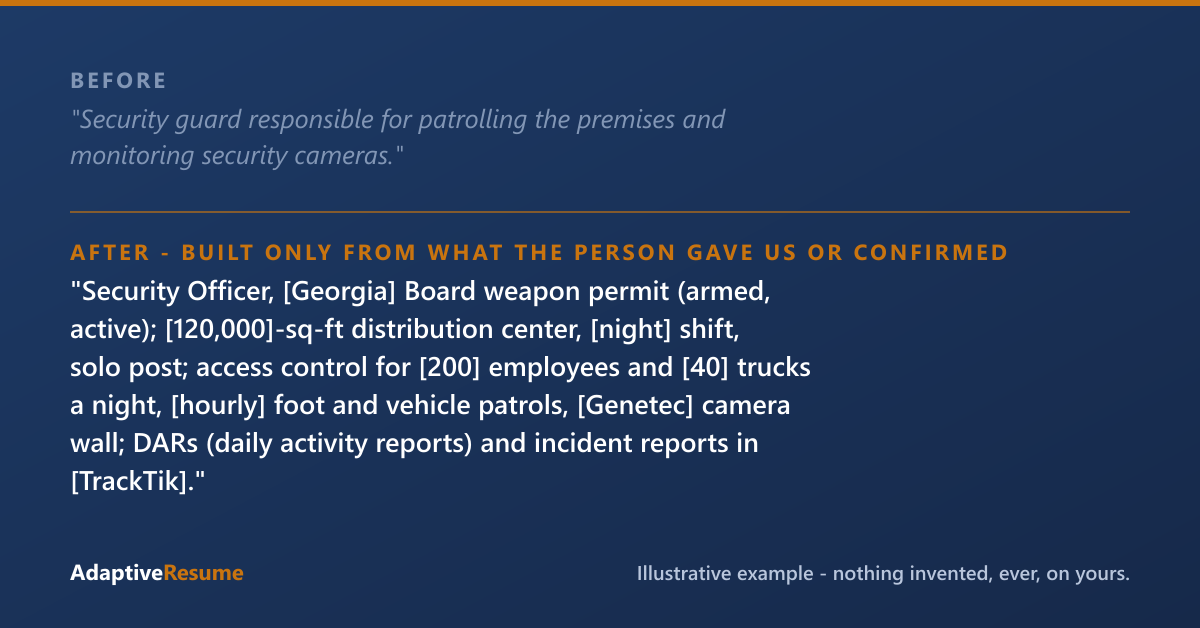
Illustrative example. Everything on your resume is yours: the experience you listed, plus the skills, tools, responsibilities, and credentials your work already involved, each added only after you confirm it’s true.
The second version answers, in one line, what the first leaves a reader guessing at: what you hold, where you stood post, whether you were armed, what the post covered, and what system you reported in. It invents nothing. Fill the brackets from your real posts and the incidents you actually handled, not from what a “typical” officer does.
Credentials, exactly as held
Private security is licensed state by state, and the names differ enough that writing the wrong one reads as not knowing your own credential. Our guide on how to list certifications on a resume covers placement; here is what belongs in yours.
- Your state registration or license, by its real name. Most states require security guards to be licensed or registered by the state they work in, usually with a minimum age of 18, a background check, and a training course. Write the credential the way the state prints it, with status and expiration. Georgia’s Board of Private Detective and Security Agencies requires a 24-hour basic training course for security employees under its Rule 509-3-.02, and armed officers hold a Board weapon permit behind a 15-hour handgun course under Rule 509-3-.10. California’s Bureau of Security and Investigative Services issues the guard card after an eight-hour Power to Arrest and Appropriate Use of Force course and a Live Scan background check. It then requires 32 more hours of security officer skills training within the first six months, 16 of them within the first 30 days, and eight hours of continuing training every year. The exposed firearm permit and the baton permit are separate. Texas registers officers through the Department of Public Safety’s Private Security Program as noncommissioned (unarmed, after the Level II training course) or commissioned (armed, after the Level III course, which runs at least 45 hours and includes a course of fire). Florida’s Department of Agriculture and Consumer Services issues the Class D security officer license. Any officer who carries a firearm must also hold the Class G statewide firearm license, which requires 28 hours of classroom and range training and four hours of requalification every year. New York’s Department of State registers guards after the eight-hour pre-assignment course. The 16-hour on-the-job course is due within 90 days of hire, and an eight-hour in-service course is due every year after that. Armed guards add a 47-hour firearms course, an eight-hour annual firearms course, and a pistol license under Penal Law 400.00. If you hold more than one state’s credential, list each.
- Armed status, stated plainly. If you’re armed, say so in the credential line with the permit and the qualification date: “armed, [state] permit, qualified [month year].” If you’re unarmed, say “unarmed” once; it’s a category the company staffs separately, not a shortcoming.
- CPR (cardiopulmonary resuscitation), first aid, and AED (automated external defibrillator), by issuer and course name. Write the card exactly as it reads: “Heartsaver First Aid CPR AED, American Heart Association, current through [month year]” or “Adult First Aid/CPR/AED, American Red Cross.” Don’t write BLS (Basic Life Support) unless you hold the healthcare-provider course.
- Site-specific certificates. Some posts require a credential of their own. A TWIC (Transportation Worker Identification Credential) for ports and maritime facilities. A fire guard certificate of fitness where a city fire department issues one. A federal contract post may require a background investigation or a clearance; write the level you were granted and the date, nothing more. Each with the issuer and the year.
- Professional certifications. The Certified Protection Officer credential from the International Foundation for Protection Officers requires six months of full-time protection officer experience, or a year part-time, and recertification every two years. ASIS International’s Certified Protection Professional is a management credential that requires several years of experience with time in charge of a security function; its Physical Security Professional certification covers physical security assessment and systems. Write whichever you actually hold, with the year. A course you took is training, not a certification.
List exactly what you hold, with real status. A lapsed registration written as active is the first thing the company’s compliance file will catch, because it has to register you with the state before your first shift.
The parts of the job that carry the most weight
The post and its scope. The address type, the size, the shift, and whether you were alone. “[120,000]-sq-ft distribution center, night shift, solo post” and “[22]-story corporate tower, lobby post, day shift, [3]-officer team” are both honest and both tell a manager what you’ve handled. Contract or in-house matters too: a contract officer has an account manager and post orders written by a client; an in-house officer works for the facility. Say which.
Access control. How many people and vehicles, what you checked, and what system you used. “Access control for [200] employees and [40] trucks a night: badge checks, visitor log, vehicle inspections at the gate; [Lenel OnGuard] badge system.” The counts matter, because a post that clears 40 trucks a night is a different job from a lobby that greets 40 visitors a day.
Patrols. Foot or vehicle, how often, and how they were verified. “[Hourly] foot patrols across [6] checkpoints, verified by [guard tour app]; [2] vehicle perimeter patrols per shift.” If you found things on patrol, say what: unsecured doors, leaks, fire hazards, trespassers.
Camera and console work. The number of cameras, the system, and what you did with them. “Monitored a [64]-camera wall in [Genetec Security Center]; dispatched patrol officers by radio; pulled and preserved footage for [N] investigations.” Console work and patrol work are different postings; if you did both, say so.
Incident response and reporting. The count, the categories, and what you handed off. “[45] incident reports in [year], mostly trespass, medical calls, and alarm responses; [8] handed off to police.” Medical calls belong here with the training behind them: “responded to [N] medical calls; provided CPR and AED once, patient transported.” Say how you documented: daily activity reports, incident reports, and the system they went into, such as TrackTik, Silvertrac, or a client’s own form.
De-escalation and use of force. Write what you were trained in and what you did, in your state’s words. “Use-of-force and de-escalation training per [state] requirements; de-escalated [N] confrontations without physical contact in [year]” is a real line. Physical detentions get counted, described by policy, and handed off: “detained [N] suspects under store policy and turned each over to responding officers.”
Fire and life safety. Fire panel monitoring, fire watch, evacuation drills, and the certificate behind them where a city issues one. Facilities that run a fire watch post look for it specifically.
Loss prevention, if that was the post. Retail loss prevention is its own specialty with its own vocabulary: floor observation, shrink, apprehensions under company policy, case reports, and civil recovery. If your work was loss prevention, write it in those terms and name the retailer’s policy on apprehensions; a security company reads “detained per policy” differently from “caught shoplifters.”
Supervision, if you had it. Post assignments, scheduling, training new officers on post orders, inspections, and client meetings. “Site supervisor for a [12]-officer contract; wrote post orders, ran monthly client reviews, trained [N] new officers” is the line a manager looks for when staffing the next tier.
Notice what isn’t in this list: arrests, investigations you weren’t assigned, and any authority a security officer doesn’t have in your state. Security work is observe, report, and hand off, and the resume should read that way. If you came from a uniformed background, our military-to-civilian resume guide and police officer resume guide cover those pages; this one covers your security credential and post.
Security guard resume skills: the list, and how to make it true
Put a skill on a security guard resume only if you did it on a real post and could walk a site supervisor through it. Here are the ones postings name most, in their own words: access control, badge and visitor management, foot and vehicle patrol, CCTV (closed-circuit television) monitoring, alarm response, incident reporting, daily activity reports, radio communication, de-escalation, use of force, emergency response, CPR and first aid, fire and life safety, crowd control, loss prevention, report writing, customer service, and the systems you used.
Two rules keep it honest. First, list only what you’ve done, not what your training covered; an eight-hour course on use of force is not the same as a post where you used it. Second, put the post next to the skill where it changes the meaning: crowd control at a stadium and crowd control at a hospital emergency entrance are the same words in very different nights.
Format notes
Length follows your history, not a page rule. One page is right for a new officer or for a few years on one or two posts. Two pages is normal once you have more than one substantive post to describe, an armed post and a console post, say, each with its own scope and systems. Order matters more than length: your state credential, armed status, and CPR card near the top in their own labeled section, because screening software keys on them, then experience with a post line atop each role.
There is one hard exception. Since the Office of Personnel Management (OPM) change that took effect on September 27, 2025, USAJOBS accepts resumes of two pages or fewer, and federal security guard postings run through USAJOBS. If that is where you are headed, two pages is the limit.
Otherwise: reverse chronological, single column, standard headings, real text rather than graphics or tables; applicant systems parse plain layouts most reliably. Security companies hire fast and by phone, so put the city you can reach for posts next to your name.
Security guard resume examples: a bullet bank you can adapt — keep only what’s true
- “Security Officer, [state credential, status]; [armed / unarmed]; [post type], [shift], [solo / N-officer team]”
- “Ran access control for [N] employees and [N] vehicles per shift: badge checks, visitor log, gate inspections; [Lenel OnGuard] badge system”
- “Completed [hourly] foot patrols across [N] checkpoints and [N] vehicle perimeter patrols per shift; verified in [guard tour app]”
- “Monitored a [N]-camera wall in [Genetec Security Center]; dispatched patrol by radio; preserved footage for [N] investigations”
- “Wrote [N] incident reports in [year], mostly [trespass, medical calls, alarm responses]; [N] handed off to police; daily activity reports in [TrackTik]”
- “De-escalated [N] confrontations without physical contact; detained [N] suspects under [client] policy and turned each over to responding officers”
- “Site supervisor for a [N]-officer contract: post orders, scheduling, monthly client reviews, trained [N] new officers”
Each bullet is a frame, not a claim. If a line isn’t true of your posts, it doesn’t go on the page; your former site supervisor is the reference.
What screening software looks for on a security guard resume
Company filters read for the vocabulary of guard work, and an account manager reads for the same words minutes later. The terms that typically matter: security officer, security guard, armed, unarmed, guard card, state license, access control, badge, visitor management, patrol, CCTV, camera monitoring, alarm response, incident report, daily activity report, DAR, radio, de-escalation, use of force, emergency response, CPR, first aid, AED, fire watch, loss prevention, crowd control, post orders, and the names of the systems you used.
One honesty note on job codes: O*NET profiles this work under Security Guards (33-9032.00), and its own sample titles include Armed Security Officer, Campus Security Officer, Hotel Security Officer, Loss Prevention Officer, Security Officer, and Security Guard. Its listed tasks are patrolling, answering alarms and investigating disturbances, monitoring entrances and departures, and writing reports of daily activities and irregularities. That is exactly why writing your state’s title plus “security guard” once covers you on every posting.
The highest-risk lines overstate standing or authority: a lapsed registration written as active, “armed” without the permit behind it, an arrest that was a detention, or a police power a security officer doesn’t hold. Private security is licensed state by state and every registration is public; each of those claims is one board lookup or one call to a site supervisor away from being checked.
The Role Skills Checklist below helps you inventory what your training and your posts actually prove, which is often considerably more than the resume currently says; our skills you forgot, by trade guide is built around exactly that problem. Our build does it with you: we work backwards from your real posts, credentials, the systems you used, and the reports you wrote, propose the lines that history supports, each one offered as a question rather than a decision made for you, and ask you to confirm every item before it appears. We never add a credential, a number, or a skill you didn’t tell us about.
Common questions
Do I write 'security guard' or 'security officer'?
Write the title your employer and your state used, and put the other one beside it once. Most companies post 'security officer,' most state credentials say 'security guard' or 'security officer' depending on the state, and screening software reads for both. 'Security Officer (unarmed security guard), [Company]' costs nothing and covers both ways postings are written. Don't upgrade yourself to 'security specialist' or 'protection agent' unless that was the title on your badge.
I'm licensed in one state and applying in another. What goes on the resume?
The credential you hold, named by the state that issued it, with its status and expiration. 'Florida Class D Security Officer License, active through [month year]' is a real line. Don't write 'licensed security guard' with no state, because the hiring company has to file your registration with its own state's board and will ask which one you mean. If you've already applied in the new state, write 'application pending' with the date, and nothing more.
I was a police officer, an MP, or a corrections officer. How does that go on a security resume?
As the job it was, written in civilian terms, with the parts that transfer named: patrol, access control, report writing, use-of-force training, de-escalation, court testimony, firearms qualification. Then the private security credential you now hold, or the training you've completed toward it, because a police certification is not a guard registration in most states and the company will still need to register you. Our military-to-civilian and police officer guides cover the translation; this page covers the security credential block.
How do I describe incidents without sounding like I'm claiming arrests I didn't make?
Write what you did and what you handed off. 'Detained a shoplifting suspect under store policy and turned him over to responding officers' is honest. 'Arrested' usually isn't, because in most states a security officer has no police powers. What you have is the authority any private person has in your state, plus whatever the store's own right to detain a suspected shoplifter extends to its guards, and most post orders tell you to detain and hand off. Write 'detained' unless your state, your employer, and your post orders gave you more and you used it. Give the count and the category, not the drama: '[N] incident reports in [year], mostly trespass and medical calls; [N] handed off to police.' A security manager reads that as someone who knows the limits of the job.
Role Skills Checklist
Pop your email in and the download unlocks right here. Joining our list also takes 25% off your first purchase within 30 days of joining, when you create your account with this same email. We'll also send the occasional useful note. No spam.
Download: Role Skills ChecklistThanks, you're on our list, and your download is ready just above. Your 25% off a first purchase is good for 30 days from the day this email joined our list.
That email didn't look right — mind trying it again?
Ready to do this on your own resume?
We'll find what you've left off, and nothing goes on your resume that you didn't give us or confirm.
Get your resume build — $29Every purchase is one payment, and nothing renews. A single resume build can be used any time within 12 months of buying it, and AR Pass builds you don't use end when its 90 days end.
Try the demo first — a sample review, no sign-up · See how the service works
Paid a resume service and got a template back? Start at Fix my resume.