Guides · For job seekers
CDL Truck Driver Resume: Class, Endorsements, Miles, and a Clean Record
Truck driver resumes are screened for the CDL class, the endorsements, and the record before anyone reads a sentence. Here's how to write yours with the exact license line, real miles and freight, and the DOT facts a recruiter checks.
Published 10/05/2026
Truck driver resumes are screened by license line before anything else. A recruiter, or the software in front of them, looks for the class, the endorsements, and the years, and only then reads what you hauled and how safely. A resume that buries the license in a skills list at the bottom, or writes it vaguely (“CDL holder”), loses the reader before the work history is read.
The second thing they read is the record: miles, freight, equipment, and safety. Most driver resumes say “delivered freight safely and on time” and never say how many miles, what kind of trailer, or how many roadside inspections came back clean. Those numbers are what a fleet safety manager is trying to find, and they are the numbers you already know.
Lead with the license line, written exactly
Put the license line in the top third of the page, above the work history, and write it the way the DMV and the FMCSA write it.
Before: “CDL holder with tanker and hazmat, clean record, DOT certified.”
After: “CDL Class A, Georgia, expires [month/year]. Endorsements: H (hazardous materials), N (tank), T (doubles/triples). DOT medical certificate current through [month/year]. FMCSA Drug and Alcohol Clearinghouse registered. Entry-Level Driver Training completed [year], [provider].”
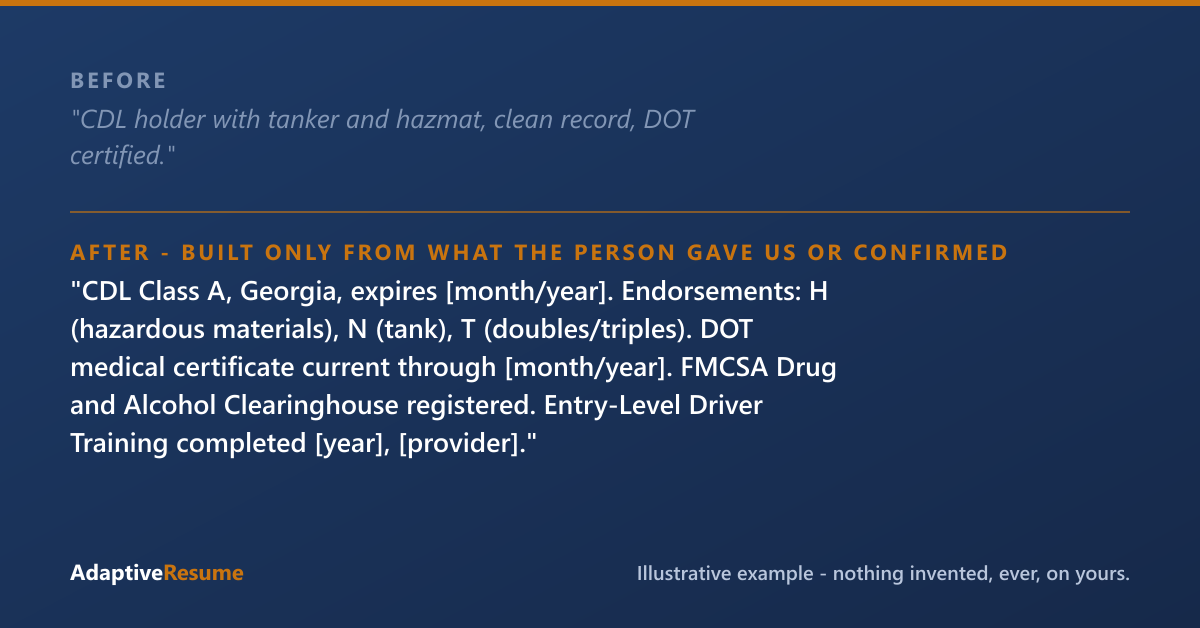
Illustrative example. Everything on your resume is yours: the experience you listed, plus the endorsements, cards, and safety facts your work already involved, each added only after you confirm it’s true.
The second version answers every screening question at once and matches the vocabulary in the posting. If you hold the X endorsement (tank and hazmat combined), write X rather than N and H separately. Write only what your license shows; a hazmat endorsement requires a Transportation Security Administration threat assessment and is one of the first things a carrier verifies.
The parts of the job that carry the most weight
Miles and years, stated plainly. Give your total miles or average miles per year, your years of Class A driving, and how much of it was over-the-road, regional, or local. “About 120,000 miles a year, over-the-road, 48 states” says more than any adjective.
Freight and equipment. Name the trailer types and freight you have run: dry van, reefer, flatbed, tanker, doubles, intermodal containers, or LTL. For flatbed, name load securement under the federal cargo securement rules (49 CFR Part 393) and the load types: steel, lumber, machinery, oversize with permits. For reefer, name temperature-controlled loads and the reefer units you ran. For tanker, name the product class and whether it was food grade or hazmat.
Safety record, in checkable numbers. Write accident-free miles, years without a preventable accident, roadside inspections passed, and your Compliance, Safety, Accountability (CSA) history if it helps you. Carriers check your motor vehicle record, and many pull your Pre-Employment Screening Program report, so the resume should agree with both.
Hours of service and logs. Name the electronic logging device systems you have used (Samsara, Motive, Omnitracs, or whatever your fleet ran), your hours-of-service compliance under 49 CFR Part 395, and your pre-trip and post-trip inspection routine. A driver who can say “zero hours-of-service violations across [N] years on ELDs” is answering the question every safety manager asks.
Customer and dock work. Show your on-time delivery rate, drop-and-hook or live-unload work, lumper coordination, and any customer-facing accounts. Local and dedicated postings care about this more than over-the-road postings do.
Endorsements, cards, and training, as held
List every endorsement by its letter and name: H (hazardous materials), N (tank vehicles), X (tank and hazmat combined), T (doubles and triples), P (passenger), S (school bus). List restrictions honestly if you have one that matters, such as an automatic-transmission restriction, because the carrier will see it on the license anyway.
Add the cards and registrations a carrier checks: the DOT medical certificate with its expiration, the FMCSA Drug and Alcohol Clearinghouse registration, and a Transportation Worker Identification Credential (TWIC) if you run ports. If you completed Entry-Level Driver Training, list the provider and the date; if your license class and endorsements were all issued before February 7, 2022, it does not apply, and claiming it is the kind of detail a verification catches.
Defensive driving and company safety programs (for example, the Smith System) are worth a line each, with the year. So is forklift training and evaluation under OSHA 29 CFR 1910.178 if you loaded your own freight at customer sites.
Owner-operators and specialized freight
If you have run under your own authority, write the business facts as facts: years operating, equipment owned, lanes and freight booked, revenue per mile if you know it, and the compliance you managed yourself (registration, inspections, IFTA fuel tax reporting, insurance). A carrier hiring you as a company driver reads that as a driver who understands the cost of every mile.
Specialized freight earns its own lines: oversize and overweight with escort coordination, auto transport, livestock, tanker with hazmat, or team driving. Name the freight, the equipment, and the permit type. If you are moving into passenger work, our bus driver resume guide covers the P and S endorsements.
Format notes
Length follows your history, not a page rule. A driver with twelve years across three carriers and two freight types has more that matters than one page holds. Two pages is normal and expected once you have more than one substantive job to describe. What matters is that every line earns its space: miles, freight, equipment, safety numbers, and endorsements stay; duties every driver shares go.
Use reverse chronological order and a single column, put the license line above the work history, and leave out graphics and photos. Many carriers run applications through screening software before a recruiter sees them, and a two-column template or a photo can scramble the read. One exception worth knowing: federal applications through USAJOBS cap at two pages as of the September 2025 OPM change, and federal motor-vehicle-operator postings ask for details a carrier application does not.
Gaps get one plain dated line. A carrier will see the gap on the DOT employment history anyway (the regulations require them to verify the previous three years of driving employment), so the resume should say what the DOT history will say.
A bullet bank you can adapt — keep only what’s true
- “CDL Class A, [state], endorsements [H/N/X/T]; DOT medical certificate current through [month/year]”
- “[N] years over-the-road, about [N] miles per year, [N] states; [N] accident-free miles”
- “Hauled [dry van/reefer/flatbed/tanker] freight: [load types]; secured flatbed loads under 49 CFR Part 393”
- “[N] roadside inspections with no out-of-service orders; zero hours-of-service violations on [ELD system]”
- “On-time delivery rate of [N]% across [N] loads per week on a [dedicated/regional] account”
- “Completed Entry-Level Driver Training, [provider], [year]; hazmat endorsement with TSA threat assessment [year]”
- “Owner-operator [years]: [N] trucks, [lanes], IFTA and DOT compliance managed in-house”
- “Trained [N] new drivers on pre-trip inspection and load securement”
What screening software looks for on a truck driver resume
Filters commonly read for: CDL Class A, Class B, hazmat, tanker, doubles/triples, TWIC, DOT medical card, ELD, hours of service, pre-trip inspection, over-the-road, regional, local, dedicated, flatbed, reefer, dry van, LTL, drop and hook, load securement, defensive driving, clean MVR, and the specific ELD and dispatch systems the carrier runs. O*NET’s profile for heavy and tractor-trailer truck drivers has the full task list.
The highest-risk lines are the ones a carrier verifies in minutes: an endorsement you do not hold, a medical card that has lapsed, training you did not complete, or a safety record that disagrees with your motor vehicle record. Write what the license and the record show.
The Role Skills Checklist below helps you inventory what your driving history actually proves, which is usually more than the resume currently says. Our build does it with you: we work backwards from your real freight, equipment, and years, and we ask you about the endorsements, systems, and safety facts that work like yours normally involves. Nothing goes on your resume that you didn’t give us or confirm, so an endorsement, a card, or a mile you never told us about stays off the page.
Common questions
Do I put my CDL number on my resume?
No. Put the class, the state, the endorsements, and the expiration month and year. The number itself goes on the application and the DOT paperwork, not on a document you email to strangers. The same goes for your DOT medical card: list that you hold a current medical certificate and its expiration, not the certificate number.
How do I handle an accident or a violation on my record?
Do not hide it and do not lead with it. A carrier will check your motor vehicle record and the Drug and Alcohol Clearinghouse, and many also pull your Pre-Employment Screening Program report, so the resume is not where the record gets decided. Write your safe-driving facts accurately (accident-free miles, clean roadside inspections, years without a preventable accident) and be ready to explain the rest plainly in the interview.
I'm an owner-operator moving to company driving. What changes?
Your resume gains a business line most drivers cannot write: freight you booked, lanes you ran, revenue per mile, maintenance you managed, and your own DOT compliance. Keep your authority and truck details factual (your USDOT or MC number, years operating, equipment owned) and write the driving record the same way any company driver would.
What is ELDT, and does it belong on my resume?
Entry-Level Driver Training is the federal training standard, in effect since February 2022, for anyone getting a Class A or Class B CDL for the first time, upgrading from B to A, or adding a hazmat, passenger, or school bus endorsement for the first time. If you completed it through a registered provider, list the provider and the date. If your license class and every endorsement you hold were issued before February 7, 2022, it does not apply to you, and you should not claim it.
Role Skills Checklist
Pop your email in and the download unlocks right here. Joining our list also takes 25% off your first purchase within 30 days of joining, when you create your account with this same email. We'll also send the occasional useful note. No spam.
Download: Role Skills ChecklistThanks, you're on our list, and your download is ready just above. Your 25% off a first purchase is good for 30 days from the day this email joined our list.
That email didn't look right — mind trying it again?
Ready to do this on your own resume?
We'll find what you've left off, and nothing goes on your resume that you didn't give us or confirm.
Get your resume build — $29Every purchase is one payment, and nothing renews. A single resume build can be used any time within 12 months of buying it, and AR Pass builds you don't use end when its 90 days end.
Try the demo first — a sample review, no sign-up · See how the service works
Paid a resume service and got a template back? Start at Fix my resume.