Guides · For job seekers
Bus Driver Resume: The P and S Endorsements, Passengers, and a Safe Record
Bus driver resumes are read for the CDL class and the passenger or school bus endorsement first. Here's how to write yours with the exact license line, real passenger and route numbers, and the safety facts a transit agency or school district checks.
Published 10/05/2026
A bus driver resume is read in a particular order. The endorsement comes first: a transit job calls for the P endorsement, a school bus job calls for the S endorsement on top of it, and an employer that does not train new drivers will not look past a missing one. Next comes the record, because a driver responsible for forty passengers or sixty children is hired on safety before anything else. After that, the reader looks at the routes, the passengers, and the equipment.
Most bus driver resumes get this order backward. They open with “responsible for transporting passengers safely” and leave the reader to hunt for the license, the endorsement, and the numbers. Put the license line at the top, written exactly, and put real numbers on the work.
Lead with the license line, written exactly
Before: “CDL driver with passenger endorsement, experienced with school buses and transit.”
After: “CDL Class B, Georgia, expires [month/year]. Endorsements: P (passenger), S (school bus). Air brake restriction: none. DOT medical certificate current through [month/year]. Georgia Department of Education school bus driver training completed [year]; CPR and first aid current through [month/year].”
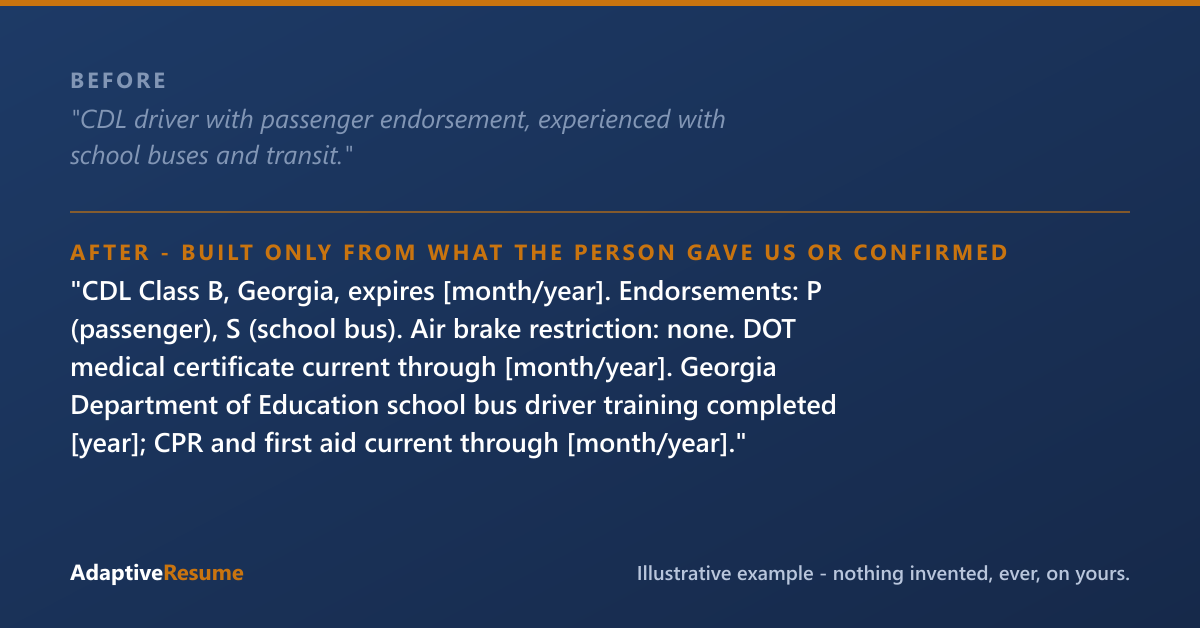
Illustrative example. Everything on your resume is yours: the experience you listed, plus the endorsements, training, and safety facts your work already involved, each added only after you confirm it’s true.
The second version answers the screening questions in one block and uses the words the posting uses. Write only what the license shows. The S endorsement requires its own knowledge and skills tests, and since February 2022, a first-time P or S endorsement also requires Entry-Level Driver Training through a registered provider. If you completed it, list the provider and the date. If you were endorsed before then, it does not apply, and you should not claim it.
The parts of the job that carry the most weight
Routes and passengers, in numbers. Give your daily routes, stops, passengers per day, and route type: fixed-route transit, paratransit, school routes with the grade levels, motorcoach charters with the trip lengths, or airport and campus shuttles. “Two school routes, 110 students a day, kindergarten through eighth grade” tells a transportation director exactly what you have handled.
Equipment. Name the buses you have driven, such as conventional and transit-style school buses, 35- and 40-foot transit buses, articulated buses, motorcoaches, or cutaway shuttles. Name the fuel if the posting cares (diesel, CNG, hybrid, or battery-electric), and name the wheelchair lift or ramp systems you have operated and secured.
Safety record, in checkable facts. Write years without a preventable accident, trips without a passenger injury, clean state or roadside inspections, and your pre-trip and post-trip inspection routine. A driver who can write “[N] years, zero preventable accidents, zero passenger injuries” has written the line a safety manager is looking for.
Passenger management. On school routes, show student management, discipline reporting, special-needs transportation with securement and individualized plans, and communication with parents and the school. On transit and paratransit, show fare handling, wheelchair securement and stop announcements under the Americans with Disabilities Act (ADA), de-escalation, and incident reporting. On charters, show itineraries, luggage, and passenger communication over multi-day trips.
Compliance you drove under. Name the drug and alcohol testing program that covered you (Federal Motor Carrier Safety Administration rules for CDL drivers, Federal Transit Administration rules at transit agencies), the hours-of-service or agency scheduling rules you followed, and any electronic logging or fleet telematics system the employer ran.
Credentials and checks, as held
List every credential with its true status and date: the CDL class and endorsements, the DOT medical certificate, the state school bus certificate or training program, CPR and first aid, and passenger-assistance or defensive-driving training with the program name. Background check and fingerprint clearance are conditions of the job rather than resume lines, but if a posting asks for them, one line stating they are current is fine.
Do not list a school bus or passenger endorsement you have not yet earned as if you hold it. If you are enrolled in training, write it as in progress with the expected date.
Moving between bus jobs
School to transit, transit to motorcoach, and shuttle to paratransit are common moves, and the resume should show the overlap and name the gap honestly. A school bus driver moving to transit already has the P endorsement, the medical card, and the safety record. A driver whose license is Class C will need a Class B upgrade, with Entry-Level Driver Training, to drive a full-size transit bus, and the rest of what changes is fare handling, ADA securement on a lift-equipped transit bus, and a different testing program. Write the parts you have done, and let the interview cover the training the new employer provides. Inflating a shuttle job into transit experience, or a P endorsement into an S, is the kind of claim a licensing check catches immediately.
Moving into passenger work from trucking. A Class A or Class B truck driver already has the license class, the medical card, and years in a federal drug and alcohol testing program, and the miles and the safety record carry over directly. What a passenger employer still needs is the endorsement: P for transit and motorcoach work, and S as well for school routes, each with its own knowledge test and a skills test in a vehicle of the right type, plus the Entry-Level Driver Training described above. Some school districts and transit agencies pay for that training. If a posting says it does, write the truck experience in full and say in your summary that you hold the license class and are ready to add the endorsement; list the endorsement as in progress only once you are enrolled, with the expected date. Then add the passenger-facing work you already have, such as customer deliveries on a dedicated account or an earlier service job, because handling people is the part of the job a truck license cannot show. Our CDL truck driver resume guide covers the freight side of that history.
Format notes
Length follows your history, not a page rule. A driver with ten years across a school district, a transit agency, and a charter company has more that matters than one page holds. Two pages is normal and expected once you have more than one substantive job to describe. Keep the routes, passengers, equipment, safety numbers, and credentials; cut the duties every driver shares.
Use reverse chronological order and a single column, put the license line above the work history, and leave out graphics and photos. School districts and transit agencies often run applications through screening software, and a two-column template can scramble the read. One exception worth knowing: federal applications through USAJOBS cap at two pages as of the September 2025 OPM change.
Gaps get one plain dated line. An employer verifying your driving employment history will see the gap, so the resume should say what the history says.
A bullet bank you can adapt — keep only what’s true
- “CDL Class [B/A], [state], endorsements P and S; DOT medical certificate current through [month/year]”
- “Drove [N] daily routes serving [N] passengers a day on [route type]; [N] years without a preventable accident”
- “Operated [35-foot/40-foot/articulated/motorcoach] buses; wheelchair lift and securement on every ADA trip”
- “Kept the assigned bus defect-free through [N] state inspections; completed pre-trip and post-trip inspections every shift”
- “Transported [N] students with individualized transportation plans; documented incidents per district policy”
- “Handled fares and passenger counts on fixed-route service; [N] complaint-free months”
- “Completed [state] school bus driver certification [year]; CPR and first aid current through [month/year]”
- “Trained [N] new drivers on route procedures and student management”
What screening software looks for on a bus driver resume
Filters commonly read for: CDL Class B, Class A, passenger endorsement, school bus endorsement, DOT medical card, air brakes, pre-trip inspection, student management, special needs transportation, ADA, wheelchair lift, paratransit, fixed route, fare collection, defensive driving, CPR, first aid, clean MVR, and the dispatch or telematics systems the employer runs. O*NET’s profile for transit and intercity bus drivers has the full task list, and school bus drivers have their own profile.
The highest-risk lines are the ones a school district or transit agency confirms before your first route: an S or P endorsement you do not hold, a medical card that has lapsed, a district training program you did not finish, or an accident history your motor vehicle record contradicts. Match every one of them to the license and the record.
The Role Skills Checklist below helps you inventory what your driving history actually proves, which is often more than the resume currently says. Our build does it with you: we work backwards from your real routes, equipment, and years, and we ask you about the endorsements, training, and safety facts that work like yours normally involves. Nothing goes on your resume that you didn’t give us or confirm, so an endorsement, a certificate, or a passenger count you never told us about stays off the page.
Common questions
Which CDL class do I list for bus driving?
List the class your license shows. Full-size school and transit buses are Class B vehicles (a single vehicle rated at 26,001 pounds or more), and a Class A license also covers them. Smaller buses designed for 16 or more passengers, including the driver, are Class C vehicles. What every CDL bus job screens for is the endorsement: P for passenger vehicles, and S for school buses, which requires the P endorsement plus its own knowledge and skills tests. Write the class, the endorsements, and the expiration exactly as printed on the license.
Does a school bus driver need anything beyond the S endorsement?
Usually yes, and it varies by state and district: a state school bus driver certificate or training program, a background check and fingerprinting, a DOT medical certificate, and often CPR and first aid. List each one you hold with its date. If your district trained you in student management or special-needs transportation, say so with the program name.
I drove a shuttle or a church bus without a CDL. Is that worth listing?
It is worth listing if it is true and stated accurately. A vehicle designed for 15 or fewer passengers, including the driver, does not need a CDL unless it is rated at 26,001 pounds or more or hauls placarded hazardous materials, and that experience still shows passenger handling, route work, and a driving record. Write the vehicle type and capacity honestly and do not describe it as CDL experience.
How do I show a safe record without sounding like every other driver?
Use numbers a safety manager can check: years without a preventable accident, passenger trips or miles without an injury, clean roadside or state inspections, and the drug and alcohol testing program you drove under. Employers will pull your motor vehicle record, so the resume should agree with it.
Role Skills Checklist
Pop your email in and the download unlocks right here. Joining our list also takes 25% off your first purchase within 30 days of joining, when you create your account with this same email. We'll also send the occasional useful note. No spam.
Download: Role Skills ChecklistThanks, you're on our list, and your download is ready just above. Your 25% off a first purchase is good for 30 days from the day this email joined our list.
That email didn't look right — mind trying it again?
Ready to do this on your own resume?
We'll find what you've left off, and nothing goes on your resume that you didn't give us or confirm.
Get your resume build — $29Every purchase is one payment, and nothing renews. A single resume build can be used any time within 12 months of buying it, and AR Pass builds you don't use end when its 90 days end.
Try the demo first — a sample review, no sign-up · See how the service works
Paid a resume service and got a template back? Start at Fix my resume.