Guides · For job seekers
Journeyman Electrician Resume: License, Scope, and Code Proof
A journeyman electrician resume gets read for three things: exactly which license you hold and where, the conduit-and-panel scope you've actually run, and whether you work to code. How to put all three on paper honestly.
Published 09/04/2026
There is no such thing as a generic journeyman electrician license, and that fact should shape the whole resume. Licensing is done by states — and in some places by cities or counties — so “licensed journeyman electrician” with no issuing authority tells a contractor almost nothing. The single most useful thing you can do is state the license exactly as issued: the classification, the authority that issued it, and its status.
The second most useful thing is scope. Electrician resumes lean hard on duty lines — “installed and maintained electrical systems” — that could describe an apprentice’s first month or a foreman’s last decade. What an estimator or general foreman is actually trying to read is the size of work you’ve run: what conduit, what panels, what services, what settings, and whether anyone worked under you.
Lead with license, scope, and setting
Under each employer, give the picture in one line before the bullets — the setting, the systems, and the scale.
Before: “Journeyman electrician responsible for installing and maintaining electrical systems on commercial job sites.”
After: “Journeyman electrician ([state] license); commercial build-outs and service upgrades; bent and ran EMT and rigid conduit, installed [N] panels and [N]-amp services, led [N] apprentices; work to the NEC edition adopted in [jurisdiction].”
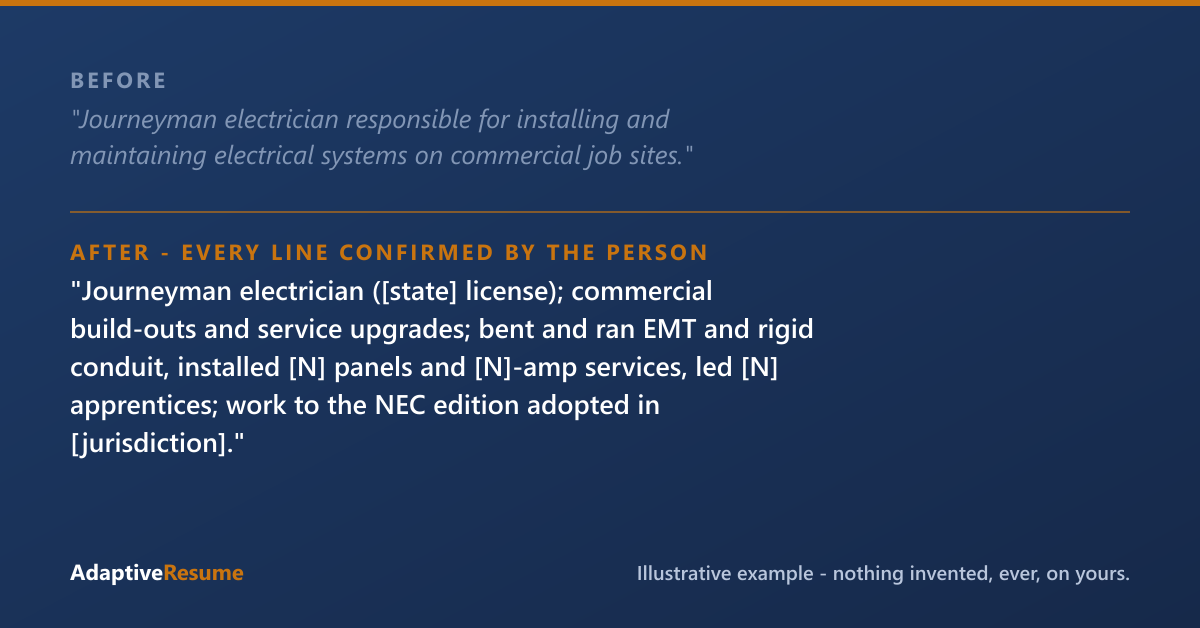
Illustrative example. On your resume, every line comes from your real history — proposed as a question, added only when you confirm it.
The second version reads in a few seconds and answers what the first leaves a hiring contractor guessing at. It names the license, the setting, the raceway types, the service size, and the crew scope — the exact language contractors write into their own postings.
Your license, exactly as issued
Write the license the way the issuing authority writes it: the classification (journeyman, journey-level, or your jurisdiction’s wording), the state or local board that issued it, and its current status. If you hold licenses in more than one state, list each one — reciprocity between states is uneven, so a contractor working across state lines reads multiple licenses as a direct advantage.
Two honest details strengthen this block:
- The path that got you there. A registered apprenticeship is documented, supervised experience — commonly around 8,000 on-the-job hours over four to five years, plus classroom instruction. If you came up through an IBEW/NECA program — the International Brotherhood of Electrical Workers and the National Electrical Contractors Association jointly run apprenticeships through local Joint Apprenticeship and Training Committees (JATCs), under the electrical training ALLIANCE — name the local and the program (Inside Wireman is the common classification). A state-registered or employer apprenticeship is worth naming the same way.
- What the license does not cover. In many states, low-voltage, fire-alarm, and alarm-system work is licensed separately from the journeyman electrical license. If you hold one of those endorsements or separate licenses, list it as its own line; if you don’t, don’t imply it.
The work that carries the weight
Conduit is the first thing a field resume gets read for. Name the raceway types you’ve bent and run — EMT (electrical metallic tubing), rigid, IMC (intermediate metal conduit), and PVC conduit — and the bending you actually do: hand bending, mechanical benders, hydraulic or electric benders on larger sizes. “Bent and ran EMT through [size]” is a real line; “ran conduit” is not much of one.
Panel and service work deserves its own lines: panel installs and changeouts, service upgrades with the amperage, distribution and subpanels, breaker and load work, terminations, and grounding and bonding. Amperage is the number that carries the information — a [N]-amp residential service and an [N]-amp commercial service are different jobs, and the reader knows it.
Troubleshooting is where experience shows. Say what you diagnose and with what: meters, megohmmeter testing if you do it, tracing faults in live systems under lockout/tagout procedures.
Prints are assumed but still worth stating plainly: blueprint reading, electrical drawings, and — for commercial and industrial work — one-line (single-line) diagrams. A journeyman who reads a one-line comfortably reads as someone who understands the system, not just the circuit in front of them.
Residential, commercial, industrial — say which world
The three settings hire for different evidence, so name yours and write to it.
Residential: services and panel changes, remodels and additions, new construction rough-in and trim, generator and EV-charger installs if you do them. Volume is honest proof here — homes wired, services upgraded.
Commercial: tenant build-outs, three-phase distribution, lighting and lighting controls, EMT everywhere, working from one-lines and panel schedules, coordination with other trades on schedule.
Industrial: this is where controls knowledge separates candidates. Motor controls — starters, contactors, overloads, control circuits — plus variable frequency drives (VFDs): installing, wiring, and basic parameter setup if you do it. If you troubleshoot around programmable logic controllers (PLCs), state your real depth: reading I/O, following a ladder-logic print to find a failed input, working alongside a controls tech. “PLC troubleshooting basics — traced faults to failed I/O and field devices” is a strong, true line for a journeyman; “PLC programmer” is a different job, so don’t write it unless it’s yours.
Code and safety — the block contractors check first
The NEC. The National Electrical Code — NFPA 70, published by the National Fire Protection Association — is revised every three years; the 2026 edition is the newest as of this writing, but states and local jurisdictions adopt editions on their own schedules, so the code enforced on your jobs may be an earlier one. The honest, useful line is “work to the NEC as adopted in [jurisdiction],” adding a specific edition year only if you’ve genuinely worked or trained to it — say, a code-update class for an exam.
NFPA 70E — the Standard for Electrical Safety in the Workplace — is the arc-flash and electrical-safety standard. If you’ve had 70E training, list it with the year: arc-flash boundaries, PPE categories, and energized-work permits are exactly what industrial and larger commercial employers screen for.
OSHA cards. OSHA 10 and OSHA 30 are completion cards from the Occupational Safety and Health Administration’s Outreach Training Program — 10-hour and 30-hour construction safety courses. List the one you hold with the year. Add lockout/tagout, aerial lift or scissor-lift training, confined space, and first aid/CPR as plain lines if you have them.
Format notes
Length follows your history, not a page rule. One strong page is genuinely fine for a journeyman with one or two employers — the license block and the scope detail are what earn the space, so keep those even when the page is tight. If you’ve run work across residential, commercial, and industrial settings, held a lead role, or carried licenses in more than one state, two pages is normal and expected once you have more than one substantive role to describe. Cut the duty lines every electrician shares (“followed safety procedures”) before you cut an amperage, a raceway type, or a license.
One exception worth knowing: federal applications through USAJOBS cap at two pages as of the September 2025 OPM change. That’s a hard requirement, not a style preference.
Otherwise: reverse chronological, single column, a clearly labeled license-and-certifications block near the top, and skip the graphics. A contractor wants to find your license and your scope fast, not admire a layout.
A bullet bank you can adapt — keep only what’s true
- “Journeyman electrician license — [issuing state/board], [status/year]”
- “Bent and ran [EMT/rigid/IMC/PVC] conduit through [size] on [commercial/industrial] jobs”
- “Installed [N] panels and completed [N] service upgrades to [N] amps”
- “Wired [single-phase/three-phase] distribution; terminated and labeled [N]-circuit panels”
- “Installed and wired motor controls and VFDs on [equipment]; traced control-circuit faults”
- “Troubleshot faults under lockout/tagout; tested with [meter/megohmmeter]”
- “Read blueprints, panel schedules, and one-line diagrams on [project type]”
- “Led [N] apprentices; laid out work from prints and coordinated with [trades/GC]“
What screening software looks for on an electrician resume
This part applies to every electrician resume, journeyman or not. Filters commonly read for: journeyman electrician, licensed electrician, NEC, National Electrical Code, conduit, EMT, rigid conduit, conduit bending, panel installation, service upgrade, three-phase, single-phase, transformers, motor controls, VFD, PLC, troubleshooting, lockout/tagout, NFPA 70E, arc flash, OSHA 10, OSHA 30, blueprint reading, one-line diagrams, grounding and bonding, low voltage, fire alarm, rough-in, and trim. O*NET’s profile for electricians has the full task and tool list.
The highest-risk lines are the ones that overstate what you’re licensed or qualified to do — an endorsement you don’t hold, energized work you weren’t qualified for, or “industrial controls” depth that’s really a few service calls. License claims are checkable against a state board in minutes, and the trade is small enough that scope claims get checked informally too. Accurate detail is stronger than inflation, because it holds up.
The Role Skills Checklist below helps you inventory what your field work actually proves — which is often more, and more specific, than the resume currently says. Our build does it with you: we work backwards from the settings you’ve worked, the systems you’ve run, and the license you actually hold, propose the code, safety, and scope language work like yours normally involves, and ask you to confirm every line before it appears. We never add a license, a certification, or a scope you didn’t tell us about.
Common questions
Is a journeyman electrician license the same in every state?
No. There is no national journeyman electrician license — licensing is handled by states, and in some places by cities or counties. Requirements differ, and so does whether one state accepts another's license (reciprocity). That's why your resume should name the exact issuing authority: 'Journeyman Electrician, [state licensing board]' tells a contractor precisely what you hold and where it's good.
How should I list my apprenticeship on a resume?
As real work history, because it is. Name the program — an IBEW/NECA Joint Apprenticeship and Training Committee (JATC) program, a state-registered apprenticeship, or an employer program — with the dates and the hours if you know them. Registered apprenticeships commonly run around 8,000 on-the-job hours over four to five years, and a completed one reads as documented, supervised experience, not as schooling.
Do I need to say which NEC edition I know?
It can help, stated honestly. The National Electrical Code (NEC) is revised every three years, but each state or local jurisdiction adopts an edition on its own schedule, so the code enforced where you work may not be the newest one. 'Work to the NEC as adopted in [jurisdiction]' is always true. If you've studied a specific edition for an exam or code update class, you can name that year.
I'm mostly residential — can I apply for commercial or industrial work?
Yes, and the honest way to do it is to write your real scope and let the overlap show. Conduit bending, panel work, and code-compliant terminations carry across settings. What doesn't carry automatically — three-phase distribution, motor controls, higher-voltage gear — shouldn't be implied. A contractor would rather see 'residential service and remodel; some light commercial' than a vague line that falls apart in the first week.
Role Skills Checklist
Pop your email in and the download unlocks right here — and being on the list before launch day locks in 25% off your first build. We'll also send the occasional useful note and tell you the moment AdaptiveResume goes live. No spam.
Download: Role Skills ChecklistThanks — you're on the launch list, your 25% is locked in, and your download is ready below.
That email didn't look right — mind trying it again?
Ready to do this on your own resume?
We'll find what you've left off and you approve every line — nothing made up.
Build your resume — $49Try the demo first — a sample review, no sign-up · See how the service works
Paid a resume service and got a template back? Start at Fix my resume.