Guides · For job seekers
Dental Hygienist Resume: Your License, Your Patients, Your Numbers, and Your Permits
Dental offices read a hygienist resume for the license first, then the patients you see, the procedures you perform, and the permits your state allows. Here's how to write each one exactly, including the numbers an office manager looks for.
Published 10/28/2026
Dental offices read a hygienist resume in a set order: the license first, then the patients you see and the care you give, then the permits your state allows and the software you use. A resume that opens with “responsible for cleanings and patient education” leaves the license hunt to the reader and says nothing about how much care you deliver in a day.
The fix is a short licenses section at the top, then one line per job with the practice type and your schedule, then the procedures and numbers an office manager or dentist looks for.
Lead with your license and your schedule
Before: “Dental hygienist responsible for cleanings, X-rays, and patient education.”
After: “Registered Dental Hygienist (RDH), Ohio. General practice, 3 dentists: see 8 to 9 patients a day, including periodontal maintenance and scaling and root planing; take and review full-mouth and bitewing radiographs; and kept a 92% reappointment rate across 2025.”
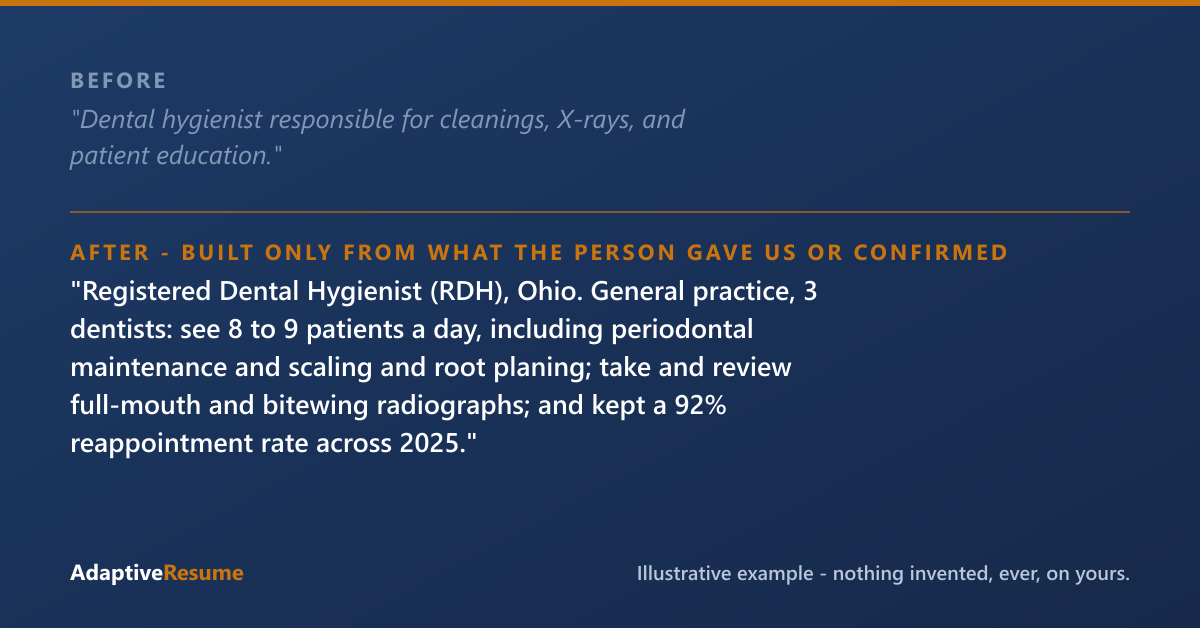
Illustrative example. Everything on your resume is yours: the experience you listed, plus the license, permits, and procedures your work already involved, each added only after you confirm it’s true.
The second version answers the office’s first question, which is whether you are licensed and where, then shows the size of the practice, the daily schedule, the procedures, and a number that shows patients come back.
Summary example: “Registered Dental Hygienist (RDH), [State], with 6 years in general and periodontal practice. See 8 to 9 patients a day, give local anesthesia under a [State] permit, and chart in Dentrix.” Name your license, your years, your setting, and one or two things an office cannot teach quickly.
Your license, written exactly
Every state requires dental hygienists to be licensed, and the rules vary by state. In most states, licensure means graduating from an accredited dental hygiene program and passing written and clinical exams. The written exam is usually the National Board Dental Hygiene Examination, which the Joint Commission on National Dental Examinations says is intended to fulfill or partially fulfill the written examination requirement for licensure in all states.
On the resume:
- Write the credential and the state: “Registered Dental Hygienist (RDH), Ohio.” Some states use a different title, such as Licensed Dental Hygienist, so use the one on your license.
- List each state if you hold more than one license.
- Show each license’s status honestly, and keep up the continuing education your state requires to renew it. If a license has lapsed, leave it off or write its status the way your state board shows it, such as “expired 2024” or “inactive.”
- The license number is optional. Offices verify licenses through the state dental board.
- Write the clinical exam by its full name and the testing agency that gave it, as your state dental board lists it, rather than “clinical exam” alone.
Permits and certifications your state allows
What a hygienist may do beyond cleanings depends on the state, and the permits you hold are worth a line each:
- Local anesthesia. The American Dental Hygienists’ Association’s state-by-state local anesthesia chart, revised December 2025, lists every state and the District of Columbia as allowing hygienists to give local anesthesia, but the rules differ: the course hours, whether an exam is required, the level of dentist supervision, and in some states the types of injections. Texas, for example, began allowing it in 2023 and allows infiltration only. A few states authorized it only recently, such as Delaware in 2025, where the board’s rules were still pending in December 2025, so check your state dental board for the current rule.
- Nitrous oxide, if your state allows hygienists to give or monitor it and you hold the permit.
- Radiography, if your state issues a separate certificate.
- Restorative or other expanded functions, in states that allow them after added training, written exactly as your state names the permit.
- CPR. Many jobs require current CPR certification, often a healthcare provider course such as BLS. Our guide on how to list BLS and CPR shows the exact format.
Write each one by the name your state board uses, with the state: “Local Anesthesia Permit, [State] Board of Dentistry.”
The care you give, with numbers
- Patients per day on a typical schedule, and whether you work out of one or two operatories.
- Procedures you perform most: prophylaxis, periodontal maintenance, scaling and root planing, sealants, fluoride, and anything specialized, such as laser-assisted care where your state allows it.
- Periodontal work: full-mouth periodontal charting, and the share of your schedule that is periodontal patients, if you know it.
- Radiographs: the types you take, such as bitewings, full-mouth series, and panoramic images, and whether you use digital sensors.
- Patient education: home care plans, tobacco cessation talks, or nutrition counseling, described with what you actually do.
- Office numbers, only if your office tracks them and shares them with you: reappointment or recall rate, hygiene production per day, or treatment your patients accept.
Never put a patient’s name, photo, or case details on a resume.
Software and equipment
Name the practice management software you chart in, such as Dentrix, Eaglesoft, or Open Dental, because many postings name one. Add the equipment you use daily: ultrasonic scalers, intraoral cameras, digital radiography sensors, and lasers if your state and training allow them.
The practice you work in
Write the setting next to each employer, because the work differs:
- General practice, with a mix of recall patients, children, and adults.
- Periodontal practice, with heavier periodontal therapy and maintenance.
- Pediatric practice, with sealants, fluoride, and young patients.
- Group practices and dental service organizations, often with production goals and several offices.
- Public health, school sealant programs, community clinics, and long-term care, with screenings, outreach, and patients who are harder to reach.
New graduates and career changers
New graduates should lead with the license status, then the program and its clinical work: “Dental Hygiene, A.A.S., [College], 05/2026, a program accredited by the Commission on Dental Accreditation. Clinic: [number] patients, including [number] periodontal cases.” Add rotations, community screenings, and research projects.
Dental assistants who became hygienists should keep the assisting years, because they show chairside experience, radiographs, and office systems. Our dental assistant resume guide covers how to write that work.
Temporary and per diem hygienists can group the offices they covered under one entry: “Per Diem Dental Hygienist, 14 offices in the Columbus area, 2024 to present.” If you worked through a staffing service, list the service as the employer.
Format notes
- Put a licenses and certifications section near the top, right under your name or summary.
- Use the title on your license and the practice type for each job.
- Keep it plain, with standard headings and no tables, so screening software reads every line.
- Leave out photos. Many US employers prefer resumes without them.
- Add professional memberships, such as the American Dental Hygienists’ Association, and continuing education that matches the posting, such as a laser or periodontal course.
- One page is usually enough for a new graduate or a few years in one or two offices, in our view; a second page is reasonable once you have several practices, specialties, or a public health role to describe.
Dental hygienist resume bullets you can adapt — keep only what’s true
- “See [number] patients a day in a [practice type] with [number] dentists.”
- “Perform periodontal maintenance and scaling and root planing for [number] patients a week.”
- “Take and review [radiograph types] with digital sensors.”
- “Kept a [X]% reappointment rate over [period].”
- “Give local anesthesia under a [State] permit for [procedures].”
- “Chart in [Dentrix / Eaglesoft / Open Dental]; build home care plans for every periodontal patient.”
What screening software looks for on a dental hygienist resume
Filters commonly read for: dental hygienist, registered dental hygienist, RDH, license, prophylaxis, periodontal maintenance, scaling and root planing, SRP, periodontal charting, radiographs, bitewings, full-mouth series, panoramic, sealants, fluoride, local anesthesia, nitrous oxide, ultrasonic scaling, intraoral camera, patient education, home care, infection control, OSHA, HIPAA, BLS, CPR, Dentrix, Eaglesoft, and Open Dental. O*NET’s profile for dental hygienists has the full task list.
The lines an office can check fastest are the ones most worth getting right: a license that has lapsed, a permit your state does not issue, or a procedure you have not been trained to perform. Write what you actually do.
The Certification Section Cheat-Sheet below shows the format for your license and each permit. Our build does the rest with you: we work backwards from the practices you worked in and the care you gave, and we ask you about the permits, procedures, and numbers that work like yours normally involves. Nothing goes on your resume that you didn’t give us or confirm, so a permit, a procedure, or a number you never told us about stays off the page.
Common questions
How should I list my dental hygiene license on a resume?
Write the credential and the state, such as "Registered Dental Hygienist (RDH), Ohio," and add each state if you are licensed in more than one. The license number is optional, because offices verify it with the state dental board. Put it near the top, right under your name or in its own licenses section, because it is the first thing an office checks.
What numbers belong on a dental hygienist resume?
The patients you see in a typical day, the procedures you perform most, such as periodontal maintenance and scaling and root planing, the radiographs you take, and any numbers your office tracks, such as reappointment rate or hygiene production. Use the figures you know from your own work, such as your usual schedule or numbers your office shared with you. Never copy reports or patient records out of the practice's software, and never include a patient's name or details.
Do I list local anesthesia and nitrous oxide on my resume?
Yes, if your state allows them and you hold the permit or certification. The American Dental Hygienists' Association's chart, revised December 2025, lists every state as allowing hygienists to give local anesthesia in some form, though Delaware's board rules were still pending then. The course, any exam, the supervision required, and the types of injections allowed all differ by state. Write the permit by the name your state board uses, with the state.
I just graduated. What goes on my resume before I have a license?
Your program, its accreditation, your expected or actual graduation date, and where you are in the exams, such as "National Board Dental Hygiene Examination passed, 05/2026; [clinical exam name and testing agency] scheduled 07/2026; license pending." Add the patient experience from your school clinic and any rotations, with numbers.
How do I show I'm good with patients without saying it?
Use what you can count or describe: the patients who rebook with you, the anxious or special-needs patients you are trusted with, the languages you speak with patients, and the home care plans you explain. Specifics persuade an office manager in a way that "excellent chairside manner" cannot.
Certification Section Cheat-Sheet
Pop your email in and the download unlocks right here. Joining our list also takes 25% off your first purchase within 30 days of joining, when you create your account with this same email. We'll also send the occasional useful note. No spam.
Download: Certification Section Cheat-SheetThanks, you're on our list, and your download is ready just above. Your 25% off a first purchase is good for 30 days from the day this email joined our list.
That email didn't look right — mind trying it again?
Ready to do this on your own resume?
We'll find what you've left off, and nothing goes on your resume that you didn't give us or confirm.
Get your resume build — $29Every purchase is one payment, and nothing renews. A single resume build can be used any time within 12 months of buying it, and AR Pass builds you don't use end when its 90 days end.
Try the demo first — a sample review, no sign-up · See how the service works
Paid a resume service and got a template back? Start at Fix my resume.