Guides · For job seekers
Dental Assistant Resume: DANB, Radiography, and Chairside Scope
A dental practice reads your resume for the credential and the permit written exactly as your state issues them, the procedures you've actually assisted, and whether you can run the sterilization room and the schedule. Here's how to write yours honestly.
Published 09/18/2026 · Updated 09/29/2026
A dental practice reads a dental assistant resume in a few seconds, and it reads for three things. Are your credential and your radiography permit written exactly as your state issues them? Which procedures have you actually assisted on, and at what pace? And can you run the sterilization room and, if needed, the front desk? A resume that says “assisted the dentist and kept the office running” answers none of that. The specifics do.
The complication with this role is that the rules differ by state more than in almost any other clinical job. DANB’s CDA is national; what your state requires to take an x-ray or perform an expanded function is not. A resume that writes those lines loosely reads as either overstated or uninformed, and neither helps. This guide is about writing them exactly.
The chairside line: your scope in one sentence
Under each role, give one line another assistant or an office manager would recognize instantly.
Before: “Dental assistant responsible for assisting the dentist and keeping the office running.”
After: “CDA (DANB), [general practice], [2] dentists, [12]-[16] patients per day; four-handed chairside for restorative, endo, and extractions; [state] radiography certificate, digital sensors and [CBCT]; autoclave and weekly spore testing; scheduling and treatment plans in [Dentrix].”
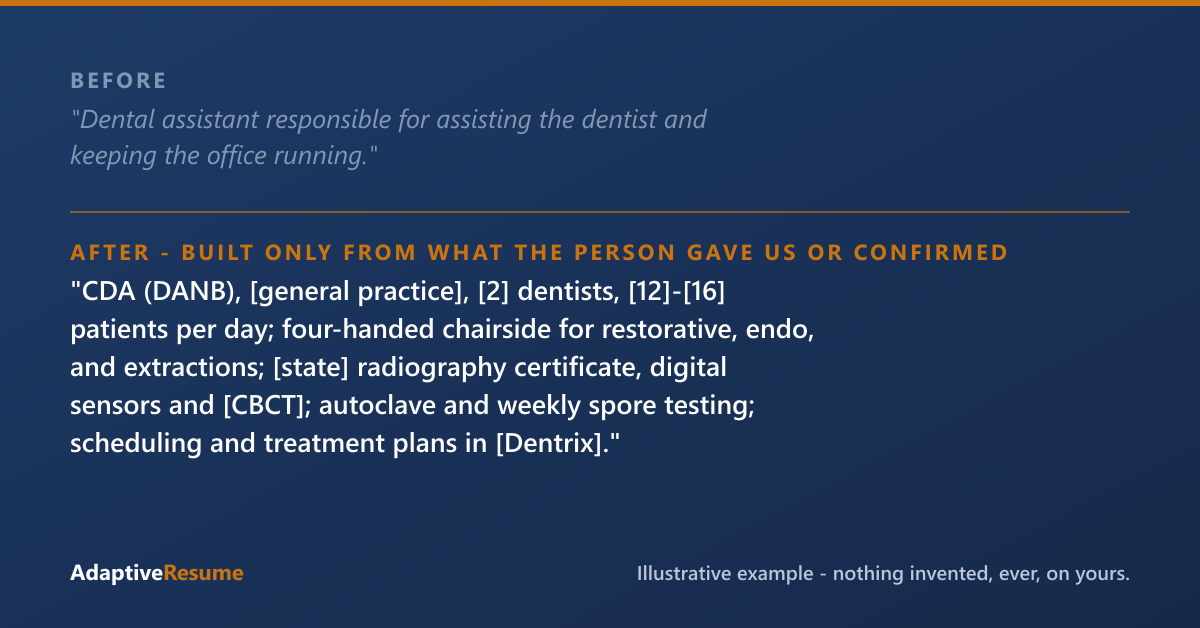
Illustrative example. Everything on your resume is yours: the experience you listed, plus the skills, tools, responsibilities, and credentials your work already involved, each added only after you confirm it’s true.
The second version answers what the first hides: the credential and its body, the practice type and size, the daily pace, the procedures, the imaging you’re permitted to take, the sterilization responsibility, and the software. It invents nothing. Fill the brackets from your real schedule and your real duties, not from a job description.
Credentials, exactly as held
Our guide on how to list certifications on a resume covers placement; here is what belongs in a dental assistant’s block, and how each one is named.
- CDA (DANB) — Certified Dental Assistant, from DANB (the Dental Assisting National Board). It’s earned by passing three component exams: GC (General Chairside Assisting), RHS (Radiation Health and Safety), and ICE (Infection Control). If you’ve passed some components but not all, write exactly which: “DANB RHS and ICE passed, [year]; GC scheduled [month year].” That’s honest and it still counts for something in states that accept the RHS exam for radiography.
- State radiography permit or certificate — required in many states before you may position or expose dental x-rays, and named differently almost everywhere. California requires a board-approved radiation safety course; Massachusetts accepts DANB’s RHS exam as one route; Texas requires registration as an RDA (Registered Dental Assistant) with its State Board of Dental Examiners before you take x-rays — the registration is the x-ray credential. Write your state’s exact title and the year.
- Expanded functions — DANB reports 38 states with an expanded-functions dental assistant level, under about 25 different titles (EFDA — Expanded Functions Dental Assistant; EDDA — Expanded Duty Dental Assistant; RDA — Registered Dental Assistant; and others), each with its own allowed duties. Write the title your state issued and the year, then list the functions you actually perform.
- Coronal polishing and sealant certificates — where your state issues them separately, each gets a line.
- Program — the school, and whether it’s accredited by CODA (the Commission on Dental Accreditation). Many states and employers look for it.
- Infection control and safety training — OSHA (Occupational Safety and Health Administration) bloodborne pathogens training, and any infection-control course your state requires, with the year.
- BLS — Basic Life Support, with the issuer (American Heart Association or American Red Cross) and the current-through date; some states, Texas among them, require a hands-on course rather than an online one, so write which it was.
Write each line as the issuing body wrote it. A practice in a strict state checks the state board’s lookup before the interview, and “x-ray certified” with no state behind it is the first thing they’ll question.
The parts of the job that carry the most weight
The practice and the pace. General, pediatric, orthodontic, oral surgery, periodontal, endodontic, or a DSO (dental service organization) group. Number of dentists and hygienists, operatories, and patients per day. “[Pediatric], [3] dentists, [6] operatories, [40] patients per day” is a real line; “fast-paced office” is not.
Chairside. Four-handed assisting — instrument transfer, retraction, suction, and anticipating the next step — across the procedures you supported. Name them: restorative, crown and bridge, endodontics, extractions, implant placement, periodontal therapy, orthodontic adjustments, pediatric restorative. A practice hiring for oral surgery wants to see extractions and implants; a general practice wants breadth.
Radiography and imaging. Bitewings, periapicals, full-mouth series, panoramic, and cephalometric films; digital sensors, phosphor plates, intraoral scanners, and CBCT (cone beam computed tomography) where you’ve operated it. Write what you’re permitted to take and what you actually took, and keep the permit line honest.
Sterilization and infection control. Instrument processing from chairside to storage: ultrasonic cleaning, packaging, autoclave operation and cycle logs, weekly biological (spore) testing (the CDC’s minimum), and operatory turnover between patients. If you ran the sterilization room, say so — it’s a responsibility, not a chore.
Impressions, temporaries, and lab work. Alginate and digital impressions, bite registrations, provisional crowns, whitening trays, and lab case coordination. These are the hands-on skills a practice can’t easily teach on the job.
Expanded functions. Where your state permits and you’ve done them: coronal polishing, sealants, placing and finishing restorations, taking final impressions, and more. List only what’s legal in your state and on your record.
Software and the front desk. Name the practice management system — Dentrix, Eaglesoft, Open Dental, or another — and the imaging software. If you covered scheduling, treatment plan presentation, insurance check, or claims, give the volume. Screening software keys on product names, not on “familiar with dental software.”
Specialty depth. Orthodontic assistants who place and remove wires and take alignment records, oral surgery assistants who monitor sedated patients under the surgeon’s direction and run the surgical setup, and pediatric assistants who manage behavior and parents each have a vocabulary the posting will use. Use it.
Dental assistant resume skills: the list, and how to make it true
A skill belongs on the list if you’ve done it on a real patient and could show a dentist how. What postings ask for, in their own words: four-handed dentistry, chairside assisting, instrument transfer, rubber dam placement, digital radiography, bitewings and periapicals, panoramic imaging, intraoral scanning, CBCT, impressions, provisional crowns, sterilization, autoclave, spore testing, infection control, OSHA compliance, coronal polishing, sealants, patient education, treatment coordination, scheduling, insurance check, and your practice software by name.
Keep it honest two ways: performed, not observed or covered in class; and state-specific marked as state-specific — “sealants (per [state] expanded functions)” tells a reader you know where the line is.
Format notes
Length follows your history, not a page rule. One page is right for a new graduate or for a few years in one practice. Two pages is normal and expected once you have more than one substantive role to describe — a general practice and an oral surgery office, say, each with its own procedures and systems. Order matters more than length: certification, radiography credential, and expanded-functions title near the top in their own labeled section (screening software keys on them), then experience with a chairside line atop each role.
One genuine exception worth knowing: federal applications through USAJOBS cap at two pages as of the September 2025 OPM (Office of Personnel Management) change. VA (Department of Veterans Affairs) and military dental clinic postings run through USAJOBS, so if that’s where you’re headed, that’s a hard requirement.
Otherwise: reverse chronological, single column, standard headings, real text rather than graphics or tables — applicant systems parse plain layouts most reliably. Skip the graphics.
A bullet bank you can adapt — keep only what’s true
- “CDA (DANB), [year]; [state] radiography certificate; [general / pediatric / oral surgery] practice with [N] dentists and [N] operatories, [N] patients per day”
- “Provided four-handed chairside assisting for [restorative, endodontic, crown and bridge, and extraction] procedures”
- “Took [bitewing, periapical, and panoramic] images with [digital sensors / phosphor plates]; operated [intraoral scanner / CBCT]”
- “Ran the sterilization room: ultrasonic, packaging, autoclave cycles with logs, and weekly spore testing with [zero] failed tests in [N] months”
- “Fabricated provisional crowns and took [alginate / digital] impressions for [N] cases per week; coordinated lab cases”
- “Performed [coronal polishing / sealants] under [state] expanded-functions authorization”
- “Scheduled and presented treatment plans in [Dentrix / Eaglesoft / Open Dental]; checked insurance for [N] patients per day”
Each bullet is a frame, not a claim. If a line isn’t true of your practice, it doesn’t go on the page — a dental office is small enough that the dentist calls your last one.
What screening software looks for on a dental assistant resume
Practice filters read for the vocabulary of chairside work, and an office manager reads for the same words minutes later. The terms that typically matter: dental assistant, CDA, DANB, RHS, ICE, radiography, x-ray certification, EFDA, expanded functions, RDA, four-handed, chairside, sterilization, autoclave, infection control, OSHA, impressions, provisional, digital radiography, intraoral scanner, CBCT, Dentrix, Eaglesoft, Open Dental, treatment coordination, BLS, and the specialty by name.
One honesty note on job codes: O*NET profiles this work under Dental Assistants (31-9091.00), and its own sample titles include Certified Dental Assistant, Expanded Functions Dental Assistant, and Orthodontic Assistant — which is exactly why your state’s title and your specialty belong on the page, not just “dental assistant.” If you’re not sure a number is real, our quantify your resume bullets guide shows how to find the figure you can stand behind.
The highest-risk lines overstate a permit or a function — an x-ray credential you don’t hold in that state, an expanded function your state doesn’t allow, a CDA written when only one component was passed. Dental boards publish lookups, and practices use them.
The Role Skills Checklist below helps you inventory what your chairside and sterilization work actually proves, which is often considerably more than the resume currently says — our skills you forgot, by trade guide exists for exactly that gap. Our build does it with you: we work backwards from your real practice, procedures, permits, and systems, propose the lines that history supports — each one offered as a question, not a decision made for you — and ask you to confirm every item before it appears. We never add a credential, a permit, or a procedure you didn’t tell us about.
Common questions
I'm a CDA. Is that the same as being 'certified' in my state?
Not necessarily, and the resume should keep them separate. CDA is DANB's national certification — Certified Dental Assistant, earned by passing its General Chairside, Radiation Health and Safety, and Infection Control exams. What your state requires to work as a dental assistant, take x-rays, or perform expanded functions is set by your state's dental board and may or may not use DANB exams. Write both lines as issued: 'CDA (DANB), [year]' and '[State] dental radiography certificate, [year]'.
How do I write my x-ray permit when every state calls it something different?
Use your state's exact wording and add 'radiography' once so screening software finds it: '[State] Dental Radiography Certificate' or '[State] Radiation Safety Course, [year]'. Some states issue a permit, some a certificate, some accept DANB's RHS exam, and some require a board-approved course. Don't write 'x-ray certified' with no state behind it — a practice in a strict state will ask which credential you mean.
I do expanded functions. What title goes on the resume?
The one your state issued. DANB counts 38 states with an expanded-functions level and about 25 different titles for it — EFDA (Expanded Functions Dental Assistant), EDDA (Expanded Duty Dental Assistant), RDA (Registered Dental Assistant), and others — and what you're allowed to do varies with the state. Write the title as your state wrote it, then list the specific functions you actually perform: coronal polishing, sealants, placing restorative material, whatever your state permits and you've done. That's more useful to a reader than the acronym alone.
I just finished a dental assisting program and have no work experience. What goes on the page?
Your program first — the school, whether it's CODA-accredited, the hours, and the clinical or externship site with what you did there. Then any DANB exams passed and your state radiography credential if you have it. Then prior work that shows you're reliable with people and precise with your hands. One page. Don't list procedures you only watched; list the ones you assisted on.
Role Skills Checklist
Pop your email in and the download unlocks right here. Joining our list also takes 25% off your first purchase within 30 days of joining, when you create your account with this same email. We'll also send the occasional useful note. No spam.
Download: Role Skills ChecklistThanks, you're on our list, and your download is ready just above. Your 25% off a first purchase is good for 30 days from the day this email joined our list.
That email didn't look right — mind trying it again?
Ready to do this on your own resume?
We'll find what you've left off, and nothing goes on your resume that you didn't give us or confirm.
Get your resume build — $29Every purchase is one payment, and nothing renews. A single resume build can be used any time within 12 months of buying it, and AR Pass builds you don't use end when its 90 days end.
Try the demo first — a sample review, no sign-up · See how the service works
Paid a resume service and got a template back? Start at Fix my resume.