Guides · For job seekers
Machinist Resume: Tolerances, Controls, and GD&T Proof
Machinist resumes get read for the specifics you might not think to write down — the tolerances you hold, the controls you run, and whether you set up or just operate. How to put your real bench skill on paper.
Published 08/30/2026
Machining is one of the trades where the resume routinely undersells the person. A skilled machinist knows in their hands what tolerance they can hold and which controls they can walk up to cold — but that knowledge often never makes it onto paper, because on the floor nobody asks you to spell out GD&T or list the finishes you can hit. The resume is the one place it has to be written down, and a vague one loses ground to people who are, honestly, less capable.
The single most useful thing you can do is put real numbers and real names on the work: the tolerances you hold, the controls you run, the materials you cut, and whether you set up or operate. Those four things are what a shop is trying to read, and a resume that says “operated CNC machines to produce parts” tells them none of it.
Lead with tolerance, control, and material
Under each shop, give the context in one line before the bullets — the machines and controls you ran, the tolerances you held, and what you cut.
Before: “Operated CNC machines to produce parts according to blueprints.”
After: “3- and 4-axis CNC mills, Haas and Mazak controls; held ±0.0005” on production aerospace parts in 6061 aluminum and 17-4 stainless; ran setup and first article, verified with micrometers, calipers, and CMM.”
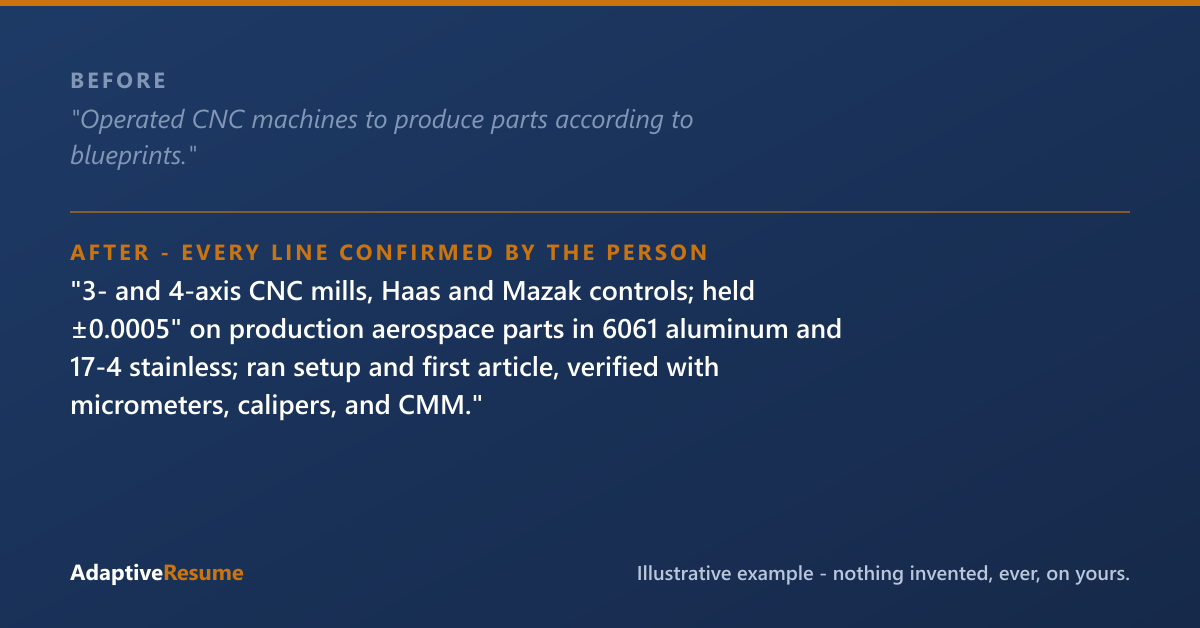
The second version is readable in a few seconds and answers what the first version leaves a shop guessing at. It names the control (Haas, Mazak), the real tolerance (±0.0005”), the material (6061, 17-4), the scope (setup and first article, not just cycle start), and how the work was checked. Every one of those is a hard filter in a good shop’s hiring, and every one is something you either did or didn’t — so it stays honest.
Setup vs. operation — draw the line honestly
This is the distinction that decides machinist interviews, so it’s worth getting exactly right on the resume.
Setup means you dial the job in: work holding and fixturing, tool table and offsets, edge finding and work coordinates, proving out the program, running and buying off the first article. Operation means you run parts on a machine someone else set up — load, cycle, deburr, gauge, keep the run going. Both are legitimate, paid, needed work. But they are different jobs, and a shop hiring for one does not want the other by surprise.
Say which you did, and if you did both, say that. “Set up and ran” is a stronger line than “operated” precisely because it claims more — so only write it if it’s true. Claiming setup you don’t actually do is the fastest way to lose a working interview, and machinists interview by making parts.
Controls, code, and CAM — name them
Shops filter hard on the specific control and software, because it maps straight to how fast you’ll be productive.
Controls: name the ones you’ve actually run — Haas, Mazak, Okuma, Fanuc are the common ones, and they don’t cross over one-for-one, so a shop reads the specific name. If you’ve run Fanuc-based controls across brands, say so.
Code: if you write or edit at the control, say G-code and M-code and be specific about what you do — edit offsets and feeds at the machine, or write programs from scratch. “Comfortable editing G-code at the control to correct for tool wear” is a true, useful line; “expert programmer” without detail is not.
CAM: if you program offline, name the package — Mastercam is the common one. Say what you program: 2.5-axis, 3-axis, multi-axis, mill or lathe. If you post from CAM and prove out at the machine, that’s the full loop and worth stating.
Prints, GD&T, and metrology
This is the block that separates a machinist from a button-pusher on paper, and it’s the part many people leave off.
Blueprint reading is table stakes but still worth a line — orthographic views, sections, and revision control. GD&T (geometric dimensioning and tolerancing, per ASME Y14.5) is worth naming directly if you read and hold it: position, flatness, perpendicularity, profile, datums. A shop that runs tight prints reads “GD&T per ASME Y14.5” as shorthand for competence.
Metrology — say how you check your own work. Micrometers, calipers, height gauges, bore gauges, pin gauges, thread gauges, and CMM if you run or program one. First-article inspection deserves its own mention if you do it: filling out the report, buying off the first part before a run, and catching the problem before you make a hundred bad ones. That’s the responsibility a shop most values and most fears getting wrong.
Credentials and materials, exactly as held
List any NIMS (National Institute for Metalworking Skills) credentials you actually hold, by their real name — Milling, Turning, CNC, Measurement/Materials/Safety, and so on. NIMS is recognized industry-wide, and a screener can match it to a posting instantly. If you don’t hold NIMS, don’t invent it; your parts are the credential.
Name the materials you’ve cut, because they carry real information: aluminum grades (6061, 7075), stainless (303, 304, 17-4), tool steels, titanium, Inconel, brass, and plastics all machine differently, and a shop reads the list as your range. Add finishes if you hold them — surface finish callouts, Ra values you can hit. Include safety training plainly — forklift operator training and evaluation (under OSHA’s 29 CFR 1910.178; there is no national forklift license), lockout/tagout, and the like.
Format notes
Length follows your history. Trades resumes are often one page, and if you’ve held one substantive role, one strong page is the right call — but the reason is that a machinist’s history is often one long run or a few shops, not that detail should be cut. Keep the skill detail: tolerances, controls, materials, and inspection are exactly what earns you the interview, so they stay even when the page is tight. Cut the generic duty lines everyone shares (“followed safety procedures,” “worked in a team environment”) before you cut a real tolerance.
If you’ve run many shops, held a lead or setup role, or crossed from manual into CNC and programming, two pages is fine once you have more than one substantial role to describe. A tight two pages beats a padded one. One genuine exception worth knowing: federal applications through USAJOBS cap at two pages as of the September 2025 OPM change — that’s a hard requirement, not a style preference.
Otherwise: reverse chronological, single column, a clearly labeled machines-and-controls block, and skip the graphics. A screener wants to find your controls and tolerances fast, not admire a layout.
A bullet bank you can adapt — keep only what’s true
- “Set up and ran [3-/4-/5-axis] CNC [mill/lathe] on [Haas/Mazak/Okuma/Fanuc] controls”
- “Held [±0.0005”/±0.001”] on [feature] in [material]; verified with [micrometer/CMM/bore gauge]”
- “Read and held GD&T per ASME Y14.5 — [position/flatness/profile] on [part type]”
- “Programmed [2.5-/3-/multi-axis] toolpaths in [Mastercam]; posted and proved out at the machine”
- “Edited G-code and offsets at the control to correct for tool wear and hold size over a run”
- “Performed first-article inspection and buy-off on [part/run]; completed FAI reports”
- “Machined [aluminum/stainless/titanium/Inconel] to [finish/Ra]; [N]-part production runs”
- “Held NIMS [Milling/Turning/CNC] credential; forklift-trained and evaluated under 29 CFR 1910.178; [lockout/tagout] trained”
What screening software looks for on a machinist resume
Filters commonly read for: CNC, manual machining, mill, lathe, 3-axis, 4-axis, 5-axis, Haas, Mazak, Okuma, Fanuc, G-code, M-code, setup, first article, GD&T, ASME Y14.5, tolerances, blueprint reading, Mastercam, CAM, micrometers, calipers, height gauge, bore gauge, CMM, metrology, first-article inspection, work holding, fixturing, offsets, deburring, aluminum, stainless, titanium, Inconel, and NIMS. O*NET’s machinist profile has the full task and skill list.
The highest-risk lines are the ones that overstate scope — setup you didn’t do, a tolerance you didn’t hold, or a control you’ve only watched someone run. Machinists interview by making parts, so overstatement gets found in the first hour. Accurate detail is both safer and stronger.
The Role Skills Checklist below helps you inventory what your bench work actually proves, which is often far more than the resume currently says. Our build does it with you: we work backwards from the machines you ran, the tolerances you held, and the parts you made, propose the controls, standards, and inspection language work like yours normally involves, and ask you to confirm every line before it appears. We never add a control, a credential, or a tolerance you didn’t tell us about.
Common questions
Do I need NIMS certification to get a machinist job?
No. Many shops hire on demonstrated skill, not paper — a good part off your machine says more than a card. That said, NIMS (National Institute for Metalworking Skills) credentials are recognized and worth listing if you hold them, because a screener can match them to a posting instantly. List exactly the NIMS credentials you've earned and skip the ones you haven't; a hiring shop will test you on the floor either way.
Should I say I run CNC if I mostly load parts and hit cycle start?
Describe the real work. There's a large, honest difference between operating a machine someone else set up and doing the setup yourself — offsets, tool table, work holding, first article. Both are real jobs. Say which one you did. Claiming setup you didn't do falls apart in the first hour of a working interview, and shops know it.
How do I show tolerances without a part in front of me?
Name the tightest tolerances you routinely held and how you verified them. 'Held ±0.0005" on bore diameters, verified with bore gauge and CMM' tells a shop your comfort zone in one line. Don't inflate it — if you lived at ±0.001", say ±0.001". The number is the whole point, so it has to be true.
Manual or CNC — which should lead my resume?
Lead with what the shop you're applying to runs, but never bury the other. Manual skill on a Bridgeport or an engine lathe still matters for one-offs, rework, and fixturing, and it signals you understand what the CNC is actually doing. If you have both, that's a strength — put CNC controls up top and keep a real manual line below it.
Role Skills Checklist
Pop your email in and the download unlocks right here — and being on the list before launch day locks in 25% off your first build. We'll also send the occasional useful note and tell you the moment AdaptiveResume goes live. No spam.
Download: Role Skills ChecklistThanks — you're on the launch list, your 25% is locked in, and your download is ready below.
That email didn't look right — mind trying it again?
Ready to do this on your own resume?
We'll find what you've left off and you approve every line — nothing made up.
Build your resume — $49Try the demo first — a sample review, no sign-up · See how the service works
Paid a resume service and got a template back? Start at Fix my resume.