Guides · For job seekers
Firefighter Resume: Certifications, Apparatus, and the EMS Half
Fire hiring reads a certification block first: Firefighter I/II, EMT or paramedic, HazMat, driver/operator. Then it looks for the shift work behind the certs. Write both in.
Published 08/11/2026
Fire service hiring is a certification-block profession. Before anyone reads a bullet, a screener — human or software — checks the block: Firefighter I/II, EMT level, HazMat, driver/operator. But the block only opens the door. What separates candidates at the interview panel is the shift record behind the certs: the calls run, the apparatus operated, the station work owned. A firefighter resume needs both halves, each stated exactly.
What hiring managers and screening software look for on a firefighter resume
The vocabulary that matters, which is to say the vocabulary of what the job typically involves:
- Fire certifications: Firefighter I and II (the NFPA 1001-based standard that state fire-training agencies and the national accreditors, Pro Board and IFSAC, certify against), listed with the certifying body and dates. HazMat Awareness and Operations levels. Driver/operator or apparatus engineer qualifications where held.
- The EMS half: EMT-Basic, AEMT, or Paramedic, with current-through dates. Many departments run medical calls as a core part of the workload, and the EMS credential is often part of the screening filter itself.
- Incident command basics: ICS-100, ICS-200, and NIMS IS-700 completions — routinely required and easily listed exactly.
- The work: structure and vehicle fire response, SCBA operations, vehicle extrication, ladder and hose evolutions, pump operations, search, salvage and overhaul, fire prevention and public education, station and equipment readiness.
- Physical and process gates: CPAT completion where part of your record; wildland quals (S-130/S-190, red card) if you carry them.
O*NET’s Firefighters profile (33-2011.00) holds the occupation’s base vocabulary; your department specifics and qualifications carry the rest.
The EMS half of the job
If your department responds to medical calls, your resume should read like it. That means the EMS credential in the certification block, and at least one bullet that shows medical work as part of your normal shift: patient assessment and care at your certification level, working under local protocols, handoffs to transporting units or hospital staff. Candidates sometimes bury the EMS half because the fire half feels like the identity. Screeners read it the other way: a firefighter who documents both halves matches more of the posting.
A bullet bank you can adapt — keep only what’s true
- “Firefighter[/EMT or /Paramedic], [department], [career/volunteer], [shift schedule], [years]”
- “Responded to structure fires, vehicle fires, collisions, and medical calls across [district/coverage area]”
- “Operated as interior attack, search, and ventilation crew member under SCBA”
- “Qualified driver/operator on [engine/ladder]; pump operations at fire scenes”
- “Performed vehicle extrication with [hydraulic tools]”
- “Provided patient care at the [EMT/AEMT/Paramedic] level under [county/agency] protocols”
- “Completed daily apparatus, SCBA, and equipment checks; documented readiness”
- “Conducted fire prevention activities: [inspections, hydrant testing, public education, school visits]”
- “Completed ICS-100, ICS-200, and NIMS IS-700”
- “Maintained [station duties/training hours] per department requirements”
Fill the brackets with your department’s reality. Certification records get checked directly in fire hiring processes, so the block and the bullets must match what the certifying body would confirm.
How long should a firefighter resume be for a hiring process?
One page if you’ve held one substantive role; two pages is normal once you have more than one to describe — a longer career, an officer record, or instructor history. Federal fire jobs through USAJOBS (Forest Service, DoD) cap at two pages as of the September 2025 OPM change. Structure: certification block near the top with certifying bodies and current-through dates, then experience with a department line (department, role, career or volunteer, shift, years) atop each entry, then education and physical-ability completions. Single column, standard headings, no graphics. If you’re applying through a civil-service process with its own application form, the resume still matters — it’s what the interview panel holds while you talk.
Volunteer, part-time, and wildland time all count
List every kind of fire service honestly labeled: volunteer departments with real call volume, part-time or paid-on-call work, seasonal wildland assignments with crew type and quals. The fire service is one of the few fields where unpaid experience is fully respected — provided the label is exact. “Volunteer firefighter” presented as career time is the kind of inflation a background check turns up immediately; “Volunteer firefighter, [department], [N] years, [call types]” is a record departments hire from every year.
Promoting up: driver/operator and company officer
If you’re testing for driver/operator, engineer, or lieutenant, the resume the panel holds should already read one step up: apparatus qualifications with dates, pump operations at working fires, any acting-officer time labeled exactly as acting, training you’ve delivered at the station, and instructor certifications if held. Promotion panels know your department; the resume that helps you is the one that organizes your record cleanly, not the one that stretches it.
The before-and-after, at a glance
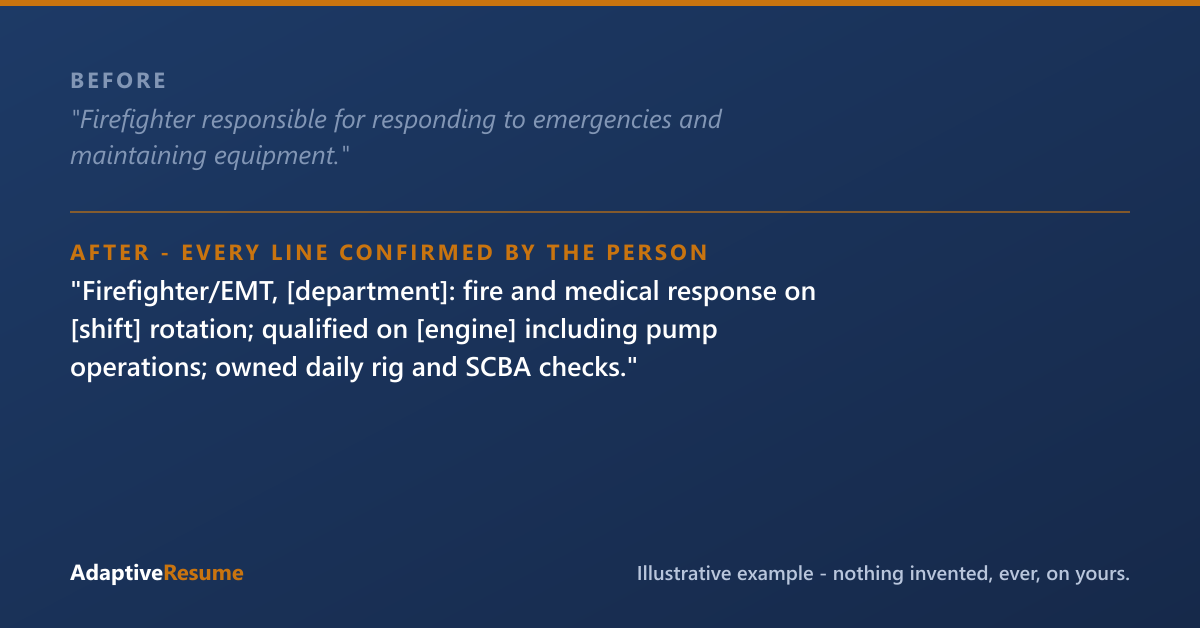
Illustrative example. On your resume, every line comes from your real history - proposed as a question, added only when you confirm it.
How AdaptiveResume helps
We work backwards from what your work actually involved. Tell us your departments, your certifications, and your shift record, and we propose the lines that history supports — both halves of the job, the apparatus quals, the station work — each one offered as a question for you to confirm, adjust, or skip. Nothing lands without your say-so, and nothing gets listed that a certification check wouldn’t confirm. In a hiring process built on verified records, that’s simply how the page has to be built. The Firefighter Resume Skeleton below gives you the structure to start from today.
Common questions
Does volunteer firefighting count as real experience on a resume?
Yes — list it exactly like career time, labeled honestly: department, role, years, certifications used, call types run. Departments hire from volunteer ranks constantly; what they check is that the label matches the record.
Should my EMT certification go on a firefighter resume?
Near the top. Fire and EMS certifications live in the same block because many departments run both kinds of calls, and an EMT or paramedic credential is often part of the screening filter itself. List level and current-through date.
How do I list certifications I've started but not finished?
Only with an honest label and a real date: 'Firefighter II — course in progress, completion scheduled [month/year].' Never list an in-progress credential as held; fire hiring processes check certification records directly.
Firefighter Resume Skeleton
Pop your email in and the download unlocks right here — and being on the list before launch day locks in 25% off your first build. We'll also send the occasional useful note and tell you the moment AdaptiveResume goes live. No spam.
Download: Firefighter Resume SkeletonThanks — you're on the launch list, your 25% is locked in, and your download is ready below.
That email didn't look right — mind trying it again?
Ready to do this on your own resume?
We'll find what you've left off and you approve every line — nothing made up.
Build your resume — $49Try the demo first — a sample review, no sign-up · See how the service works
Paid a resume service and got a template back? Start at Fix my resume.