Guides · For job seekers
Heavy Equipment Operator Resume: Machines, Certs, and Site Scope
Site superintendents hire operators by the machines they have actually run, the grade-control systems they know, and the safety training they hold. Here's how to write yours honestly, with a worked example.
Published 09/08/2026
Heavy equipment hiring is done by people who have run the machines themselves. The superintendent reading your resume wants to know one thing: can they put you in a [50]-ton excavator on a live utility trench tomorrow morning and trust the grade, the swing, and the judgment? Generic language (“operated heavy equipment on construction sites in a safe and efficient manner”) doesn’t answer that. The specifics do — which machines, what size, what grade-control system, what kind of work, and the safety training you hold.
The other thing that costs operators is scope vagueness. Site work, road building, utility trenching, demolition, and aggregate loading are related but different jobs, and a resume that just says “equipment operator” competes badly against one that names the machines and the work.
The machine line: your scope in one sentence
Under each role, give one line a fellow operator would recognize instantly.
Before: “Operated heavy equipment on construction sites and followed all safety procedures.”
After: “Excavator and dozer operator on [civil site-work] crews; ran [Caterpillar 336]-class excavators and [D6]-class dozers with [Trimble Earthworks] grade control; [N] cubic yards moved and [N] linear feet of storm pipe set per [month]; CDL Class A; incident-free since [year].”
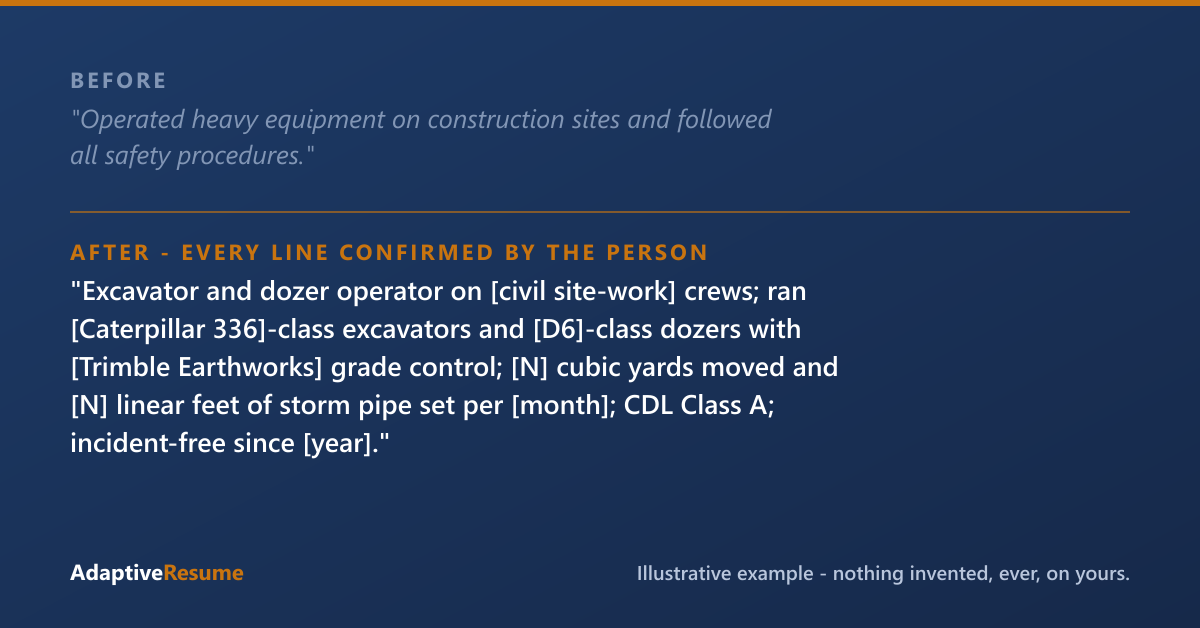
Illustrative example. On your resume, every line comes from your real history — proposed as a question, added only when you confirm it.
The second version is scannable in four seconds and answers what the first leaves a reader guessing at. Notice the rewrite invents nothing; it just says plainly what the vague version was hiding. Fill the brackets with your real machines and numbers.
Credentials and training, exactly as held
Every item in this block gets checked at onboarding. Our guide on how to list certifications on a resume covers placement and format; here is what typically belongs in an operator’s block:
- CDL Class A — the commercial driver’s license class for combination vehicles: a gross combination weight rating of 26,001 pounds or more with a towed unit rated over 10,000 pounds, under FMCSA (Federal Motor Carrier Safety Administration) rules. This is what lets you haul your own machine on a lowboy, and many contractors filter for it.
- OSHA 10-hour or 30-hour Construction — cards from the OSHA (Occupational Safety and Health Administration) Outreach Training Program. OSHA itself says the card is training, not a certification or license, so write it as “OSHA 30-Hour Construction card, [year]” and nothing grander.
- MSHA Part 46 or Part 48 training — required by the Mine Safety and Health Administration before you work at a mine. Part 46 covers sand, gravel, surface stone, and similar surface operations; Part 48 covers coal, underground mines, and surface metal mines. Name the part you actually trained under and the year of your latest annual refresher.
- NCCCO crane operator certification — only if you run cranes. On construction sites, OSHA’s 29 CFR 1926.1427 requires crane operators to be certified by an accredited testing organization, by crane type (or type and capacity), and the certification runs five years. NCCCO (National Commission for the Certification of Crane Operators) is the best-known of the accredited bodies; NCCER and the Operating Engineers Certification Program also certify. If you don’t run cranes, leave this off.
- NCCER Heavy Equipment Operations — the National Center for Construction Education and Research offers a three-level curriculum and credentials through its accredited training programs. List the level completed.
- IUOE apprenticeship — the International Union of Operating Engineers runs registered apprenticeship programs through its local training centers, leading to journey-level operating engineer. Name the local and the completion year.
- Manufacturer or dealer training — Caterpillar, Komatsu, John Deere, and Volvo courses, and dealer-run grade-control training. Name the course and machine family.
- Competent person training for excavations — under 29 CFR 1926 Subpart P, a competent person classifies the soil, inspects the trench daily, and has the authority to stop work. If you have been designated, say so with the year.
List exactly what you hold, with real status. Nothing you’re “about to take” unless it’s labeled that way — “NCCCO mobile crane, exam scheduled [month/year]” is honest and reads fine. A misnamed credential is the fastest way to lose ground in a trade where the safety manager checks every card before you’re allowed on site.
The parts of the job that carry the most weight
Machines and sizes. This is the center of the resume. Name each machine type and its size class: excavators by ton class, dozers by model class, wheel loaders by bucket size, plus graders, haul trucks, skid steers, backhoes, and compactors. Years on each matters more than a long list; a [30]-ton excavator and a mini excavator are different jobs.
Grade control and GPS. Machine-control systems are a hard filter on many crews now. Name the system by its real name — Trimble Earthworks, Topcon MC-X, or whatever your machine carried — and say whether you ran 2D or 3D, and whether you loaded models or just worked from them. Grade checking with a rover or laser is a separate skill worth its own line.
Trench safety and utility locates. Utility work is where operators get hurt. Say what you have actually done: worked inside protective systems (trench boxes, sloping, benching), potholed to expose marked lines, and worked under 811 locate tickets — 811 is the national call-before-you-dig number.
Production. Say what came out of the machine: cubic yards moved, linear feet of pipe set, tons loaded per shift, acres cleared, lifts placed and compacted. Write what you measured, the way the job measured it. If your crew didn’t track a number, don’t invent one.
Pre-shift inspections and maintenance. Daily walk-arounds, fluid checks, grease points, undercarriage checks, and the write-ups you turned in. Operators who keep machines running are worth more than operators who only run them.
Safety record. Incident-free hours or years, if your employer tracked them, and any toolbox talks you led. State it as your record, not as a promise.
Format notes
Length follows your history, not a page rule. Two pages is normal and expected once you have more than one substantive operating role to describe; one page is right for apprentices or people moving up from laborer. Order matters more than length: credential and training block near the top in its own labeled section (screening software keys on it), then experience with a machine line atop each role. If you’re trimming to fit, cut older non-operating detail before you cut a single machine or system.
One genuine exception worth knowing: federal applications through USAJOBS cap at two pages as of the September 2025 OPM change. That’s a hard requirement, not a style preference.
Otherwise: reverse chronological, single column, standard headings, real text rather than graphics or tables — contractor and staffing systems parse plain layouts most reliably. Skip the graphics.
A bullet bank you can adapt — keep only what’s true
- “Excavator operator, [N]-ton class ([Caterpillar/Komatsu]); [N] years on [utility trenching/mass excavation/demolition]”
- “Ran [Trimble Earthworks/Topcon MC-X] 3D grade control on [dozer/excavator]; finished subgrade to [tolerance] on [N] projects”
- “Moved [N] cubic yards of [cut/fill] on a [N]-acre site; set [N] linear feet of [storm/sanitary/water] pipe”
- “Worked inside trench boxes and sloped excavations under 811 locate tickets; designated competent person, [year]”
- “Loaded [N] haul trucks per hour with a [N]-yard wheel loader; MSHA Part 46 trained, refresher [year]”
- “Hauled own equipment on a lowboy between sites; CDL Class A, [state]”
- “Completed daily pre-shift inspections and reported [N] defects for repair”
- “Trained [N] new operators on [machine]; led weekly toolbox talks for a [N]-person crew”
Each bullet is a frame, not a claim. If a line isn’t true of your work, it doesn’t go on your page — a superintendent’s first follow-up question will find it.
What screening software looks for on a heavy equipment operator resume
Contractor filters read for the vocabulary of the trade, and a human reads for the same words minutes later. The terms that typically matter: heavy equipment operator, excavator, dozer, bulldozer, wheel loader, motor grader, backhoe, skid steer, haul truck, grade control, machine control, GPS, Trimble, Topcon, grade checking, trenching, trench box, competent person, utility locate, 811, cubic yards, site work, civil, demolition, aggregate, CDL Class A, OSHA 10, OSHA 30, MSHA Part 46, NCCCO, NCCER, and IUOE.
O*NET profiles this work under Operating Engineers and Other Construction Equipment Operators (47-2073.00). One honesty note: crane operators are coded separately, so if you split time between earthmoving and cranes, name both plainly and let the credential block carry the crane certification. If you also run forklifts in a yard or keep the fleet running yourself, our guides on the forklift operator resume and the diesel mechanic resume cover that work the same honest way.
The highest-risk lines are the ones that overstate scope — a machine you ran once written as one you run daily, an OSHA card written as a certification, a crane you helped rig written as a crane you operated. Construction is a small world, and employers check.
The Role Skills Checklist below helps you inventory what your seat time actually proves, which is often considerably more than the resume currently says. Our build does it with you: we work backwards from your real machines, systems, and training, propose the lines and credentials that history supports — each one offered as a question, not a decision made for you — and ask you to confirm every item before it appears. We never add a machine, a system, or a credential you didn’t tell us about.
Common questions
Do I need a certification to be a heavy equipment operator?
For most earthmoving machines, no single license is required by law the way a CDL is for driving. The exceptions are real: cranes on construction sites require operator certification under OSHA's 29 CFR 1926.1427, which NCCCO (National Commission for the Certification of Crane Operators) and other accredited bodies provide, and surface mines and quarries require MSHA (Mine Safety and Health Administration) Part 46 or Part 48 training before you work. An OSHA 10 or 30 card is training, not a certification — list it, but call it what it is.
How do I list the machines I've run?
By type and size class, with the manufacturer if it helps: 'excavators, [20]- to [50]-ton class (Caterpillar, Komatsu); dozers ([D6]-class); [wheel loaders]; [motor grader].' Machines you have run for real shifts, not machines you sat in once. A superintendent will ask which one you're weakest on, and the honest answer reads better than a padded list.
I run a loader and haul truck at a quarry. Is that a heavy equipment operator resume?
Yes. Aggregate and surface mining work is operating work, and it carries a credential most construction operators don't have: MSHA Part 46 new-miner training with annual refreshers. List it in your credential block with the year, then write your production the way the pit measured it — tons loaded per shift, trucks loaded per hour, plant feed kept running.
I learned on the job with no apprenticeship or school. What goes in the training section?
The training you actually have: OSHA 10 or 30, any manufacturer or dealer courses, the equipment your employer signed you off on, and your CDL if you hold one. Then let the experience lines do the work — machines run, years on each, the grade-control system you know, the jobs you finished. Nothing about a school you didn't attend.
Role Skills Checklist
Pop your email in and the download unlocks right here — and being on the list before launch day locks in 25% off your first build. We'll also send the occasional useful note and tell you the moment AdaptiveResume goes live. No spam.
Download: Role Skills ChecklistThanks — you're on the launch list, your 25% is locked in, and your download is ready below.
That email didn't look right — mind trying it again?
Ready to do this on your own resume?
We'll find what you've left off and you approve every line — nothing made up.
Build your resume — $49Try the demo first — a sample review, no sign-up · See how the service works
Paid a resume service and got a template back? Start at Fix my resume.