Guides · For job seekers
Claims Adjuster Resume: Claim Types, Authority, Caseload, and Your License
Claims managers read an adjuster resume for scope first: the claim types you handle, desk or field, your settlement authority, and your caseload. Here's how to write those, your licenses, and your estimating software, exactly.
Published 10/28/2026 · Updated 10/30/2026
Claims managers read an adjuster resume for scope before anything else: what kind of claims you handle, whether you work them from a desk or in the field, how much you can settle on your own, and how many files you carry. A resume that says “handled claims from first notice of loss to settlement” describes every adjuster at once, so it tells a hiring manager nothing about you.
The fix is a scope line at the top of each job, then the numbers your claims work is measured by, then your licenses and software named the way a recruiter searches for them.
Lead with your scope and your numbers
Before: “Claims Adjuster handling property claims from first notice of loss to settlement.”
After: “Property Field Adjuster (staff), homeowners claims: carried 110 to 130 open files, settled within $25,000 authority, held a 21-day average cycle time with estimates in Xactimate, and worked 2 catastrophe deployments after hail and wind events.”
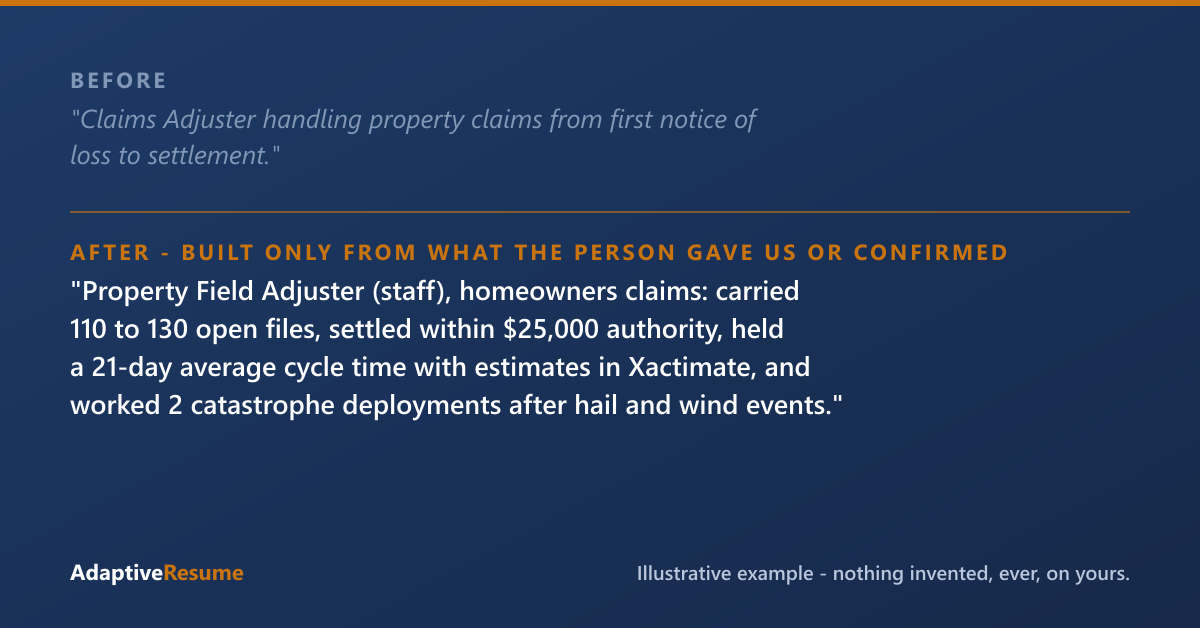
Illustrative example. Everything on your resume is yours: the experience you listed, plus the claim types, licenses, and software your work already involved, each added only after you confirm it’s true.
The second version answers a claims manager’s first four questions in one line: the claim type, field or desk, how you were employed, and how much you could settle. Then it gives caseload, cycle time, and catastrophe experience, which are the numbers a manager compares between candidates.
Write the scope line first
Every adjusting job is a mix of a few choices, and the scope line names yours:
- Claim type: property, auto physical damage, bodily injury, general liability, workers’ compensation, or commercial lines.
- Desk or field: inside adjusters work by phone and documents; field adjusters inspect the loss in person.
- How you were employed: staff with one insurer, independent through an adjusting firm, with a third-party administrator, or as a public adjuster working for policyholders.
- Personal or commercial lines, and the size of the losses you handled if it sets you apart.
“Auto Desk Adjuster, bodily injury, staff” and “Independent Field Adjuster, residential property” are two different jobs, and the scope line lets a recruiter tell them apart without reading further. Your summary can pull it together in one line, for example: “Independent property field adjuster licensed in 4 states, with 3 catastrophe deployments and Xactimate estimates up to $150,000.”
The numbers a claims manager reads
- Caseload. Your open claims at a typical point, or the range you carried.
- Closings. Claims you closed in a typical month.
- Settlement authority. The dollar amount you could settle without a supervisor’s approval. It is the quickest way to show how much an employer trusted your judgment.
- Cycle time. Your average days from first notice of loss to closing, or to first contact and first inspection if your employer tracked those.
- Quality. File audit scores, reinspection results, or compliance reviews, written the way your employer reported them.
- Recoveries. Subrogation or salvage recoveries, if you handled them.
- Catastrophe work. Each deployment, with the event type, the dates, and the claims you handled.
Use only figures you know from your own work, never reports copied out of an employer’s systems, and keep everything about a claim itself private: no claimant names, claim numbers, or details from a file.
Licenses, named exactly
Adjuster licensing is set by each state. Many states require a license and some do not, and adjusters who travel often hold licenses in several states. If you live in a state that does not license adjusters, another state can issue you a designated home state license. The Texas Department of Insurance, for example, describes its designated home state all-lines adjuster license as “the special non-resident license,” and says only residents of states that don’t license adjusters can apply.
Write your licenses in one compact line so a recruiter can scan them: “Adjuster licenses: Texas (designated home state, all lines), Florida, Georgia, Louisiana.” Many states also require continuing education to keep a license current, so check that each one is active before you list it. Public adjusters, who work for the policyholder, hold a separate public adjuster license in some states; Texas, for example, licenses public insurance adjusters under a separate chapter of its Insurance Code. Write that license by the name your state uses.
Designations and training
- AIC (Associate in Claims), from The Institutes, is a claims designation built around claims handling, with electives in areas such as auto, liability, property, and workers’ compensation. Write it the way your certificate prints it, or “AIC candidate, The Institutes” if you are working toward it.
- Estimating software training. Xactimate, from Verisk, is widely used for property estimates. If you have finished a training course or a certification level, name it as your certificate shows it.
- Carrier and firm training that ended in a certificate, such as a catastrophe readiness course or a line-specific program.
If you also work in underwriting, our underwriter resume guide covers that job, and our insurance agent resume guide covers the sales and service side.
Software and systems
Name the estimating tools and claim systems you used every day, because many postings ask for a specific one. Property adjusters usually name Xactimate. Auto adjusters and appraisers often name estimating platforms such as CCC ONE, Mitchell, or Audatex. Claim systems such as Guidewire ClaimCenter are worth naming too. Add the tools you used in the field, such as drone inspections, or the ladder-assist services you scheduled, if they were part of the job.
Moving into claims from another job
Many adjusters start somewhere else, and the resume should connect that work to claims:
- Customer service shows call volume, de-escalation, and documentation. Write the volume: “Handled 60 to 80 customer calls a day with full notes in the account system.”
- Construction, roofing, or restoration shows you can read damage and write an estimate. Name the trades and the estimate sizes.
- Auto repair or body work shows you can judge damage and repair costs on vehicles.
- Any job with careful records, such as medical billing or law enforcement reports, shows the documentation habit claims work depends on.
Add the adjuster license you hold or the one you are studying for, and say which claim type you want in your summary.
Format notes
- Put the scope line directly under each job title, before the bullets.
- Keep licenses and designations in their own section near the top, because a recruiter for an adjusting firm will look for the states you are licensed in.
- Group catastrophe deployments under the firm that sent you, one line per event.
- Keep the layout plain, with standard headings and no tables, so screening software reads every line.
Claims adjuster resume bullets you can adapt — keep only what’s true
- “[Claim type] [desk/field] adjuster carrying [number] open claims with $[amount] settlement authority.”
- “Closed an average of [number] claims a month with a [number]-day average cycle time.”
- “Wrote [number] property estimates in Xactimate, with [result of reinspections or audits].”
- “Deployed to [event type], [month/year], [state]; handled [number] claims as [role].”
- “Recovered $[amount] through subrogation on [number] files.”
- “Scored [score] on [quarterly file audits or quality reviews] over [period].”
What screening software looks for on a claims adjuster resume
Filters commonly read for: claims adjuster, claims representative, claims examiner, field adjuster, desk adjuster, independent adjuster, catastrophe adjuster, property claims, auto claims, bodily injury, liability, workers’ compensation, first notice of loss, coverage analysis, investigation, estimates, Xactimate, settlement authority, reserves, cycle time, subrogation, salvage, negotiation, customer service, documentation, adjuster license, designated home state, all lines, and AIC. O*NET’s profile for claims adjusters, examiners, and investigators has the full task list.
The lines most worth checking are the ones a claims manager can confirm with one call: a license that has lapsed, an authority level you never held, or a deployment you did not work. Write what you actually did.
The Role Skills Checklist below helps you list what your claims history actually proves, which is usually more than the resume currently says. Our build does it with you: we work backwards from the claims you handled and the roles you held, and we ask you about the licenses, numbers, and software that work like yours normally involves. Nothing goes on your resume that you didn’t give us or confirm, so a license, a number, or a system you never told us about stays off the page.
Common questions
Do I need a license to be a claims adjuster?
It depends on the state. Many states license adjusters and some do not, and adjusters who work across states often hold several licenses. People who live in a state that does not license adjusters can get a designated home state license from another state; Texas, for example, offers one only to residents of states that do not license adjusters. Write each license you hold with its state.
What numbers belong on a claims adjuster resume?
Your open caseload, the claims you close in a typical month, your settlement authority, your average cycle time, and any file audit or quality scores your employer tracks. Catastrophe deployments count too, with the event and the number of claims you handled. Use figures you know from your own work, never reports copied out of an employer's systems, and never include a claimant's name or a claim number.
How do I show I'm ready for claims if I've never adjusted?
Lead with the work that overlaps: high-volume customer service, construction or roofing estimates, auto repair, or careful documentation in another job. Add the adjuster license you hold or are studying for, and any estimating software training you have finished. A summary line that names the claim type you want ties it together.
Should I list catastrophe deployments?
Yes. Give each one its own line or bullet with the event type, the month and year, where you worked, your role, and how many claims you handled. Catastrophe work shows that you can carry volume under pressure, which matters to independent adjusting firms.
Does it matter whether I was a staff, independent, or public adjuster?
Yes, so say which. Staff adjusters work for one insurer, independent adjusters are hired by firms that serve many insurers, and public adjusters work for the policyholder rather than the insurer. A reader needs to know which side of the claim you worked on and how you were deployed.
Role Skills Checklist
Pop your email in and the download unlocks right here. Joining our list also takes 25% off your first purchase within 30 days of joining, when you create your account with this same email. We'll also send the occasional useful note. No spam.
Download: Role Skills ChecklistThanks, you're on our list, and your download is ready just above. Your 25% off a first purchase is good for 30 days from the day this email joined our list.
That email didn't look right — mind trying it again?
Ready to do this on your own resume?
We'll find what you've left off, and nothing goes on your resume that you didn't give us or confirm.
Get your resume build — $29Every purchase is one payment, and nothing renews. A single resume build can be used any time within 12 months of buying it, and AR Pass builds you don't use end when its 90 days end.
Try the demo first — a sample review, no sign-up · See how the service works
Paid a resume service and got a template back? Start at Fix my resume.