Guides · For job seekers
Help Desk Resume: Tickets, Tiers, and Proof You Keep Users Working
Help desk hiring runs on specifics — ticket volume, SLAs, the systems you actually touched. Here's the vocabulary, the cert block, and bullets that show it.
Published 08/11/2026
Help desk hiring answers a practical question: if we put this person on the queue Monday, do tickets get resolved or bounced? Your resume answers it with specifics — the systems you worked in, the volume you carried, what you fixed yourself versus escalated. “Provided technical support to end users” answers nothing; every applicant says it. Here’s how to write the version only you can claim.
The help desk resume vocabulary that screening filters read
Recruiters and screening software search for the working language of the job. Where these are true of you, they belong on the page in exactly these words:
- Ticketing systems — ServiceNow, Zendesk, Jira Service Management, Freshservice: name the one you actually worked in, not the category.
- Queue metrics — ticket volume, SLA (service-level agreement) compliance, first-call resolution: the numbers your team lived by.
- Tier scope — tier 1, 2, or 3, and where your escalation line sat.
- The daily stack — Active Directory (password resets, account lockouts, group membership), Microsoft 365 administration, VPN and remote support tools, MDM (mobile device management) enrollment, device imaging and deployment.
The keyword only earns its place if you can take an interview question on it. This is translation of real experience into searchable terms — never decoration.
Scope first: the line that frames every role
Give each support role a one-line scope statement before the bullets — user count, environment, and tier:
Before: “Provided technical support for company employees and resolved computer issues.”
After: “Tier 1/2 support for ~800 users across 3 sites; ~35 tickets/day in ServiceNow; escalation line to infrastructure for server and network faults.”
Twelve seconds in, a hiring manager knows your load, your tools, and your level. Use your real numbers — approximations marked ”~” are honest and normal; ticket counts you see every shift are exactly the kind of figure you can defend.
Numbers a help desk resume can actually claim
You work in one of the most measured jobs there is — the ticketing system counts everything. Honest sources for figures: your daily or weekly ticket volume, your team’s SLA targets and how you tracked against them, first-call-resolution if your queue measured it, users supported, devices imaged or deployed, and knowledge-base articles you wrote. If your shop never showed you a dashboard, estimate from what you know — tickets per shift times shifts per week — and mark it approximate. Never quote a precise percentage you never saw.
The cert block: exactly as held
Certifications get their own labeled section, because screening filters key on it:
- CompTIA A+ — the standard entry and tier 1 filter.
- CompTIA Network+ / Security+ — the step-up signals for tier 2+.
- ITIL Foundation — meaningful in shops that run formal incident/problem/change management.
- Microsoft credentials — worth listing where they match the employer’s stack.
Format: full name, issuer, date or current-through. In progress? “A+ — exam scheduled [month/year]” is honest and worth a line; a bare “A+” you haven’t earned is a fabrication that credential verification catches.
A help desk resume bullet bank — keep only what’s true
Adapt these, fill in your real numbers, and delete anything that isn’t yours:
- “Resolved ~[N] tickets/day in [ServiceNow/Zendesk/Jira Service Management], meeting [SLA target] response and resolution targets”
- “Tier [1/2] support for [N] users across [N] sites/departments”
- “Handled password resets, account lockouts, and group-membership changes in Active Directory”
- “Administered Microsoft 365 accounts: provisioning, license assignment, mailbox troubleshooting”
- “Imaged and deployed [N] laptops/desktops per [week/month] using [tool]”
- “Enrolled and managed mobile devices in [Intune/Jamf/other MDM]”
- “Improved first-call resolution on my queue by [honest change] after [what you actually did]”
- “Wrote [N] knowledge-base articles adopted by the team, cutting repeat questions on [topic]”
- “Escalated server, network, and application faults to tier 3 with full triage notes”
- “Trained [N] new technicians on ticket handling and escalation procedures”
Every bracket is a prompt for your real figure — not permission to invent one.
The before-and-after, at a glance
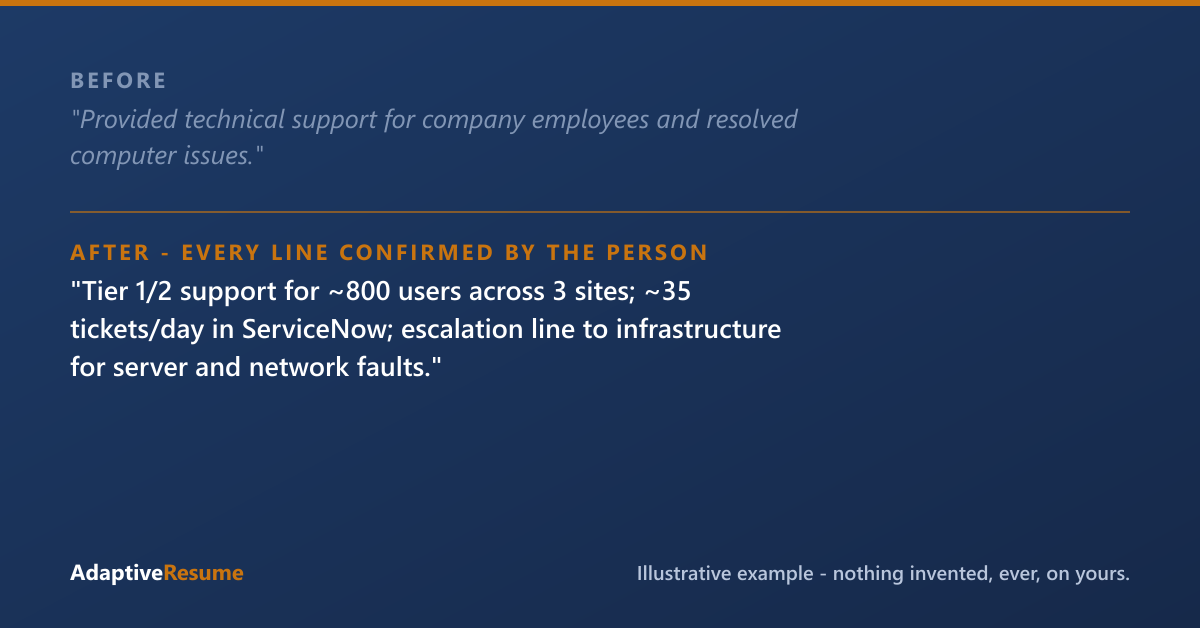
Illustrative example. On your resume, every line comes from your real history - proposed as a question, added only when you confirm it.
What this occupation is called elsewhere
Job titles for this work vary a lot — help desk analyst, desktop support technician, IT support specialist, technical support specialist all describe the same core occupation, which the Department of Labor tracks as Computer User Support Specialists (O*NET 15-1232.00). O*NET’s profile lists those titles among the ones actually reported by people in the role, and names help desk software, ServiceNow, and Active Directory in its technology skills — useful confirmation that this vocabulary is the occupation’s real language, not jargon we made up. Search postings under all of those titles; your resume’s skills section should read naturally against any of them.
Format notes
One page if you’ve held one substantive role; two pages is normal once you have more than one to describe (federal IT jobs through USAJOBS cap at two pages as of the September 2025 OPM change). Single column, standard headings, certifications in their own block, scope line atop each role. No skill-rating bars — “Active Directory” as selectable text is searchable; a four-star graphic is invisible to parsing software.
How we build a help desk resume with you
Our build starts from your actual history and works backwards from what your work really involved: which ticketing system, what volume, where your escalation line sat, which certs you hold. Each specific goes in as a question — “about how many tickets a day did you carry?” — and nothing lands on the page without your say-so. In a field where the interviewer can pull up your claims in their own ticketing system, that’s the only resume worth sending. The Help Desk Resume Skeleton below gives you the structure to start tonight.
Common questions
What certifications matter most on a help desk resume?
CompTIA A+ is the classic screening filter for entry and tier 1; Network+ and Security+ signal readiness for tier 2 and up. An ITIL Foundation cert reads well in shops that run formal service management. List exactly what you hold with dates — and nothing you're 'about to take.'
How do I show tier level if my title was just 'IT Support'?
Keep the real title — titles get checked — and put the scope in the first bullet: what you resolved yourself versus escalated, and to whom. 'Resolved tier 1/2 issues; escalated server and network faults to the infrastructure team' says your level without inflating your title.
Should I list every tool I've ever touched?
List what you could take a question on in an interview. A ticketing system, an endpoint tool, and a directory service you know well beat a twenty-item wall of logos. Depth reads as competence; padding reads as padding.
Help Desk Resume Skeleton
Pop your email in and the download unlocks right here — and being on the list before launch day locks in 25% off your first build. We'll also send the occasional useful note and tell you the moment AdaptiveResume goes live. No spam.
Download: Help Desk Resume SkeletonThanks — you're on the launch list, your 25% is locked in, and your download is ready below.
That email didn't look right — mind trying it again?
Ready to do this on your own resume?
We'll find what you've left off and you approve every line — nothing made up.
Build your resume — $49Try the demo first — a sample review, no sign-up · See how the service works
Paid a resume service and got a template back? Start at Fix my resume.