Guides · For job seekers
Loan Officer Resume: NMLS Status, Volume, and Product Mix
Lending managers read for production and standing: your NMLS status written exactly right, funded volume with a purchase-refinance split, and the products and systems you actually ran. Here's how to write yours honestly.
Published 09/08/2026
Lending managers read a loan officer resume for two things: standing and production. Standing means your SAFE Act status written exactly right — your NMLS number, whether you are state-licensed or federally registered, and in which states. Production means numbers a sales manager can compare against the desk next to you: funded volume, units, purchase versus refinance, and what fed your pipeline. Generic language (“originated residential mortgage loans while delivering exceptional customer service”) answers neither question. The specifics do.
The other thing that sinks loan officer resumes is a blurred job. Retail originator, broker, consumer-direct originator, bank consumer lender, commercial lender, and loan processor are different jobs with different licensing and metrics. A resume that says “loan officer” and stops competes badly against one that names the channel, the products, and the numbers.
The production line: your scope in one sentence
Under each role, give one line another originator would recognize instantly.
Before: “Loan officer responsible for originating mortgage loans and providing excellent customer service to borrowers.”
After: “Mortgage Loan Originator, NMLS #[1234567], state-licensed in [GA, FL]; funded $[42]M across [140] units in [2025], [70]% purchase; conventional, FHA, and VA; [Encompass] LOS.”
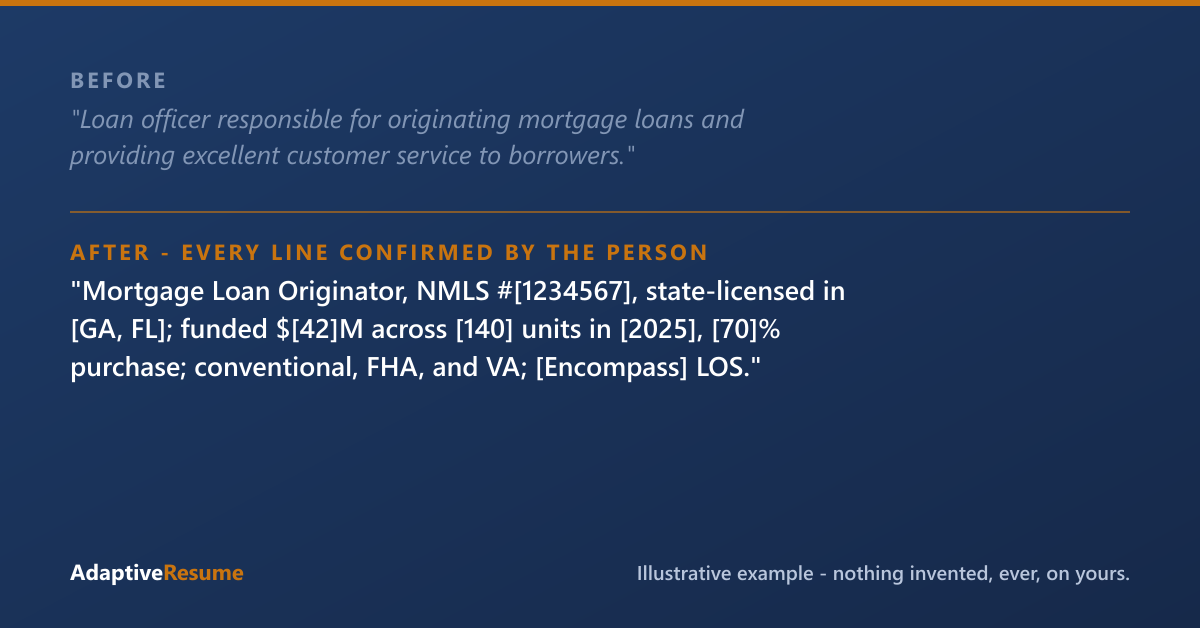
Illustrative example. On your resume, every line comes from your real history — proposed as a question, added only when you confirm it.
The second version is scannable in four seconds and answers what the first leaves a reader guessing at. Notice the rewrite invents nothing; it just says plainly what the vague version was hiding. Fill the brackets from your production reports, not memory — a manager can and will ask for the report.
Licensed or registered: get your SAFE Act status exactly right
The SAFE Act (Secure and Fair Enforcement for Mortgage Licensing Act) requires anyone who originates residential mortgage loans to be either state-licensed or federally registered as an MLO (mortgage loan originator). Both tracks run through the same system — NMLS, the Nationwide Multistate Licensing System, run by the CSBS (Conference of State Bank Supervisors) with the American Association of Residential Mortgage Regulators — but they are not interchangeable, and writing the wrong one is the fastest way to lose ground.
State-licensed MLOs work for nonbank lenders and brokers and hold a license in each state where they originate. Getting there means the 20-hour NMLS-approved pre-licensing course, a passing score on the SAFE MLO Test (the NMLS national test with uniform state content), and whatever each state adds. Keeping it means at least 8 hours of NMLS-approved continuing education each year — the federal minimum under the SAFE Act; some states require more.
Federally registered MLOs are employees of federally insured or chartered banks and credit unions (and certain subsidiaries regulated by a federal banking agency). They register through NMLS and get an NMLS unique identifier too, but they hold no state license, and the SAFE Act does not require the pre-licensing course or the test to register.
Write whichever you are, plainly: “NMLS #[N], state-licensed in [states]” or “NMLS #[N], federally registered MLO.” If you hold pieces of both tracks, say each part with a date. And if your lending isn’t residential mortgage at all — commercial, auto, personal — you may hold no MLO status, which is normal; don’t stretch to fill the line.
Credentials, exactly as held
Every item in this block gets checked against NMLS Consumer Access, a free public lookup. Our guide on how to list certifications on a resume covers placement; here is what typically belongs in a loan officer block:
- NMLS unique identifier — the number itself, once, near the top of the page.
- State licenses — each state, and the year issued if you want to show tenure. Only states where the license is current.
- Federal registration — for bank and credit union originators, “federally registered MLO through NMLS” and your employer.
- SAFE MLO Test (the NMLS national test with uniform state content) — worth its own line if you passed it outside of a license, or as a registered originator preparing to move to a licensed seat.
- Pre-licensing and continuing education — “20-hour SAFE pre-licensing education, [year]” and “annual SAFE continuing education current” are fine as single lines; don’t itemize course titles.
List exactly what you hold, with real status. Nothing you’re “about to take” unless it’s labeled that way — “SAFE MLO National Test scheduled [month/year]” is honest and reads fine. An overstated status is a compliance problem for the employer, not just for you.
The parts of the job that carry the most weight
Funded production. Annual dollar volume and unit count, by year. Units matter as much as dollars — a manager reading $[N]M wants to know whether that was [40] jumbo loans or [200] first-time-buyer loans.
Purchase versus refinance. State the split. A purchase book built on referrals and a refinance book built on lead flow are different skills, and a hiring manager is staffing for one of them.
Pipeline health. Pull-through rate (the share of applications that fund) and average days from application to close separate volume from clean volume. Give the ones you actually track; don’t back into a figure you never measured.
Referral sources. Real estate agents, builders, past clients, and company-provided leads. “[60]% of purchase volume from [25] active agent relationships” says more than “strong referral network.”
Product mix. Conventional, FHA (Federal Housing Administration), VA (Department of Veterans Affairs), USDA (U.S. Department of Agriculture), jumbo, and non-QM (non-qualified mortgage) or portfolio products where you ran them. Construction, renovation, or reverse mortgages get named too — they’re filtered for.
Systems. The LOS (loan origination system) by name: Encompass by ICE Mortgage Technology, or Calyx Point. The AUS (automated underwriting system) by name: Fannie Mae Desktop Underwriter (DU) and Freddie Mac Loan Product Advisor (LPA). Your CRM (customer relationship management system) by name. Screening software keys on product names, not on “proficient in loan software.”
Consumer and commercial lending. On the bank side — auto, personal, HELOC (home equity line of credit), small-business, or commercial real estate — the same rules apply with different numbers: portfolio size, loans booked per month, approval authority in dollars, delinquency in your book, and the credit analysis you did yourself. Our underwriter resume guide covers the credit-decision side the same way.
Processors moving up. Write the work you did — files per month, conditions cleared, AUS findings worked — then the originator steps you’ve completed, each with a date. That beats a borrowed title. Coming from the branch? Our bank teller resume guide covers that starting point.
Format notes
Length follows your history, not a page rule. Two pages is normal and expected once you have more than one substantive lending role to describe; one page is right for newly licensed originators or processors making the move. Order matters more than length: NMLS number and status near the top in its own labeled section (screening software keys on it), then experience with a production line atop each role. If you’re trimming to fit, cut older non-lending detail before you cut a single number.
One genuine exception worth knowing: federal applications through USAJOBS cap at two pages as of the September 2025 OPM change. That’s a hard requirement, not a style preference.
Otherwise: reverse chronological, single column, standard headings, real text rather than graphics or tables — applicant systems parse plain layouts most reliably. Skip the graphics.
A bullet bank you can adapt — keep only what’s true
- “Mortgage Loan Originator, NMLS #[N], [state-licensed in [states] / federally registered]; [retail/broker/consumer-direct] channel”
- “Funded $[N]M across [N] units in [year]; [N]% purchase, [N]% refinance”
- “Maintained [N]% pull-through and [N]-day average application-to-close on a pipeline of [N] active files”
- “Built and serviced [N] active real estate agent and builder relationships producing [N]% of purchase volume”
- “Originated conventional, FHA, VA, [USDA/jumbo/non-QM] loans; structured files to DU and LPA findings”
- “Ran full application-to-funding workflow in [Encompass/Calyx Point]; managed disclosures and rate locks within required timelines”
- “Booked [N] consumer loans per month with $[N] individual approval authority; portfolio delinquency of [N]%”
Each bullet is a frame, not a claim. If a line isn’t true of your book, it doesn’t go on your page — the production report will find it.
What screening software looks for on a loan officer resume
Lender filters read for the vocabulary of origination, and a sales manager reads for the same words minutes later. The terms that typically matter: mortgage loan originator, MLO, NMLS, SAFE Act, state-licensed, federally registered, funded volume, purchase, refinance, pull-through, pipeline, conventional, FHA, VA, USDA, jumbo, non-QM, Encompass, Calyx Point, Desktop Underwriter, DU, Loan Product Advisor, LPA, rate lock, disclosures, referral, and CRM.
One honesty note on job codes: O*NET profiles this work under Loan Officers (13-2072.00). That one code covers mortgage, consumer, and commercial lending together — which is exactly why your channel line and your numbers have to carry the message the code can’t. If your work has moved toward planning and advice, our financial advisor resume guide covers that page.
The highest-risk lines overstate standing or scope — a lapsed license written as current, “licensed” written by a registered originator, a team’s volume written as your own. Lending is a small, regulated world, and every one of those is a quick lookup.
The Role Skills Checklist below helps you inventory what your production and licensing history actually proves, which is often considerably more than the resume currently says. Our build does it with you: we work backwards from your real channel, volume, products, and NMLS status, propose the lines that history supports — each one offered as a question, not a decision made for you — and ask you to confirm every item before it appears. We never add a license, a number, or a product you didn’t tell us about.
Common questions
Should I put my NMLS number on my resume?
Yes, if you have one. Your NMLS (Nationwide Multistate Licensing System) unique identifier is public record — anyone can look it up on NMLS Consumer Access — so listing it costs you nothing and lets a hiring manager confirm your status in seconds. Write it once near the top: 'NMLS #[N]'. Then say which track you're on: 'state-licensed in [states]' or 'federally registered'.
I'm a federally registered MLO at a bank, not state-licensed. Is that weaker on a resume?
It's different, not weaker — but it has to be written accurately. Under the SAFE Act, employees of federally insured banks and credit unions register through NMLS rather than holding state licenses, and registration doesn't require the 20-hour pre-licensing course or the SAFE MLO National Test. If you're applying to a nonbank lender or broker, expect to be asked whether you hold, or can get, a state license; if you've completed the education or passed the test on your own, say so, and say it exactly: 'passed the SAFE MLO Test (the NMLS national test with uniform state content), [year]'.
I'm a loan processor trying to move into origination. How do I write that?
Write the processing work as what it is and let its scope carry you: files handled per month, the LOS (loan origination system) you ran, the AUS (automated underwriting system) findings you cleared, conditions you worked, and cycle times you helped hit. Then add any originator steps you've actually taken — the pre-licensing course completed, the test passed, a license issued — each with a date. Don't write 'loan officer' as a title you haven't held; the NMLS lookup will show the difference.
My last year was a down year for volume. Do I have to put the number?
You don't have to put any number you'd rather not, but never invent or inflate one. Options that stay honest: give a multi-year total ('$[N]M funded, [year]–[year]'), give units instead of dollars, or lead with a rate that held up (pull-through, cycle time, referral share). Lenders lived through the same market you did; a truthful number in context reads far better than a suspiciously round one.
Role Skills Checklist
Pop your email in and the download unlocks right here — and being on the list before launch day locks in 25% off your first build. We'll also send the occasional useful note and tell you the moment AdaptiveResume goes live. No spam.
Download: Role Skills ChecklistThanks — you're on the launch list, your 25% is locked in, and your download is ready below.
That email didn't look right — mind trying it again?
Ready to do this on your own resume?
We'll find what you've left off and you approve every line — nothing made up.
Build your resume — $49Try the demo first — a sample review, no sign-up · See how the service works
Paid a resume service and got a template back? Start at Fix my resume.