Guides · For job seekers
Hotel Manager Resume: ADR, RevPAR, and Property Scope
Hotel manager resumes are read for property scope and the numbers you moved — ADR, RevPAR, occupancy, and guest scores. How to write yours with real metrics and the limited-service vs. full-service distinction that changes what a reader expects.
Published 08/30/2026
Hotel management hiring turns on two questions a reader asks in the first ten seconds: how big was the property, and did the numbers get better while you ran it. A general manager of a 90-room limited-service hotel and a GM of a 400-room full-service convention property are doing genuinely different jobs, and a resume that reads as generically “hotel management” competes badly against both. The single most useful thing you can do is make your property scope — room count, service level, and what you owned — unmissable in the first three lines.
The second most useful thing is putting the real operating metrics on your work. Hospitality resumes are unusually vague about the numbers that define the job. Plenty say “responsible for daily operations” and never say the ADR, the RevPAR trend, the occupancy, or where guest scores landed. Those numbers are exactly what a hiring owner or management company is trying to read for.
Lead with property scope, then the numbers you moved
Under each employer, give the context in one line before the bullets — property type, room count, brand flag, departments you owned, and the P&L scope.
Before: “Responsible for daily operations, staff supervision, and guest satisfaction at a busy hotel.”
After: “General Manager, 140-room select-service Hilton-flag property; owned front office, housekeeping, and breakfast F&B, ~$7M annual revenue P&L; grew RevPAR [12%] and held occupancy at [78%] while lifting the brand guest-satisfaction score to the top [quartile] of the region.”
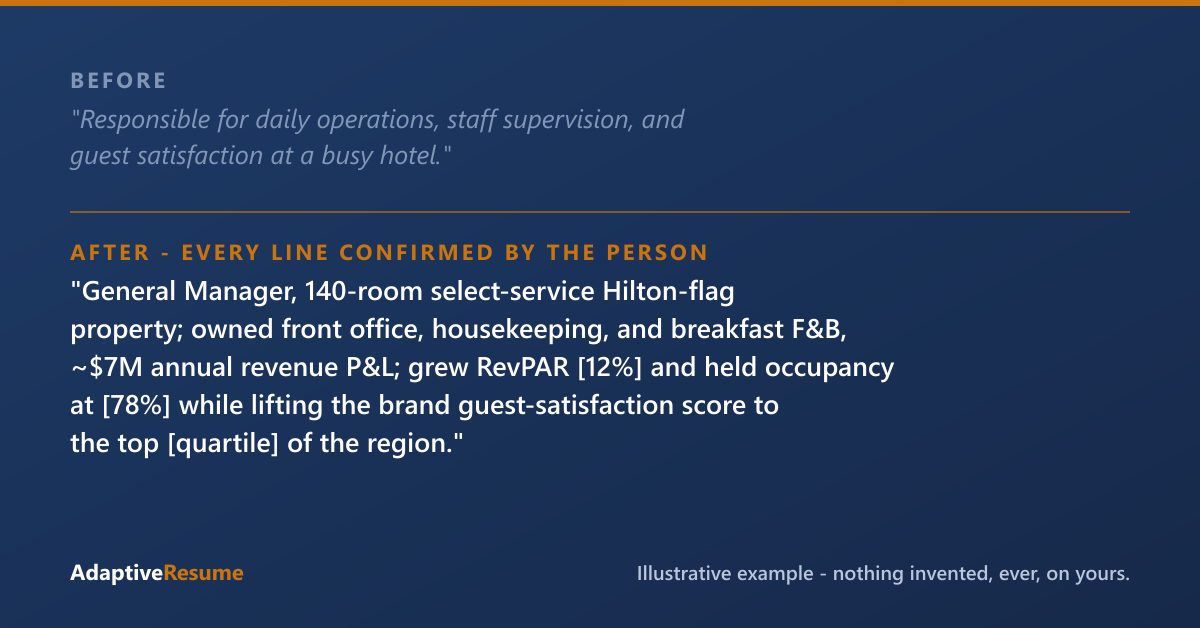
The second version is scannable in a few seconds and answers what the first leaves a reader guessing at: the size of the property, what “operations” actually covered, and whether the business improved on your watch. Room count and service level tell a reader instantly whether your experience transfers to the property they’re filling.
The metrics that carry the most weight
ADR, RevPAR, and occupancy are the revenue vocabulary of the job, and a hotel-management resume that avoids them reads as junior. ADR is average daily rate — the average room revenue per paid room. RevPAR is revenue per available room, which folds occupancy and rate into one number and is a figure owners watch closely. Occupancy is the percentage of available rooms sold. Show the direction you moved them and over what period. If you don’t have exact figures, use honest ranges and say so.
P&L ownership is the line that separates a general manager from a department head. Say what you actually owned: full-property P&L, or a specific budget — rooms, F&B, labor. Name the annual revenue scope in a range you can defend, and if you managed to a flow-through or GOP (gross operating profit) target, that’s worth a line.
Guest satisfaction is measured differently by every brand, so name the measure you actually worked to — a brand guest-satisfaction index (often abbreviated GSS), a specific review score, or a ranking within your brand or region. Show whether you held or improved it. This is a metric owners and franchisors care about deeply, because it drives repeat business and brand compliance.
Labor cost and scheduling are where much of a property’s controllable expense lives. If you held labor to a target percentage of revenue, managed to productivity standards, or cut overtime while protecting service, those are concrete lines. Naming the scheduling or labor-management system you used helps.
Systems, brand standards, and flag compliance
Property management systems are a hard filter. Name the PMS you’ve run — Oracle Opera or OPERA Cloud is widely used at flagged and full-service properties; there are others depending on the brand and property size. If you’ve run a brand’s central reservation and revenue tools, or a revenue-management system, name those too, because larger operators screen for them directly.
Brand standards and flag compliance are a real part of the job at any franchised or managed property. If you ran a Marriott, Hilton, or IHG flag, you worked to that brand’s operating standards and were measured by brand quality audits and inspections. Say which brand and, honestly, how your property performed against its standards — passing a brand quality assurance audit is a legitimate, checkable accomplishment. Do not claim a certification the property held as if it were your personal credential; describe the work you did to earn or maintain it.
Department and property-type notes
Front office is the guest-facing revenue and service engine — reservations, check-in/out, rate management at the desk, and the first line of guest recovery. Name the volume and the systems.
Housekeeping is typically the largest labor line in a rooms-focused hotel and the biggest driver of cleanliness scores. Room-attendant productivity standards, inventory, and inspection pass rates are all concrete.
Food and beverage ranges from a limited breakfast bar to full restaurants, banquets, and catering. If you oversaw a real F&B operation — or worked alongside a restaurant general manager (that job has its own guide) or an executive chef running full-service outlets and banquets — say so, and name the revenue and cover volume. F&B scope is one of the clearest signals of how full-service your experience really is.
Limited-service vs. full-service is the distinction that changes what a reader expects, so name it plainly. Limited-service and select-service properties run leaner — the GM owns more directly and F&B is minimal. Full-service properties carry restaurants, banquets, larger teams, and more department heads reporting up. Neither is more impressive; they’re different jobs. A reader hiring for one wants to see that you’ve done that one, or can explain how your experience transfers.
Format notes
Length follows your history, not a page rule. The “keep it to one page” advice gets repeated far past the point where it helps. If you’ve run three properties across two brands, or moved up from front office to assistant GM to GM, or opened a hotel — that’s the material that puts you ahead of the other candidates, and cramming it onto one page to satisfy a convention throws away your advantage.
The honest rule: two pages is normal and expected once you have more than one substantive role to describe. What matters is that every line earns its space. A tight two pages beats a padded one page. Cut duties every GM shares; keep scope, metrics, brands, systems, and anything that shows judgment.
One genuine exception worth knowing: federal applications through USAJOBS cap at two pages as of the September 2025 OPM change. That’s a hard requirement rather than a style preference.
Otherwise: reverse chronological, single column, a property-scope line under every employer, and a clearly labeled systems block. Skip the graphics.
A bullet bank you can adapt — keep only what’s true
- “Ran a [N]-room [limited-service/full-service] [brand] property; owned [departments] and a ~$[N]M P&L”
- “Grew RevPAR [N%] and ADR to $[N] while holding occupancy at [N%] over [period]”
- “Lifted brand guest-satisfaction score to the top [quartile] of the [region/brand]”
- “Held labor cost to [N%] of revenue; cut overtime [N%] while protecting service scores”
- “Passed [brand] quality assurance audit with a score of [N]; maintained flag compliance”
- “Managed [N] team members across front office, housekeeping, and F&B; reduced turnover [N%]”
- “Ran [Opera/OPERA Cloud] PMS and [revenue-management system]; [led the transition to a new PMS]”
- “Oversaw F&B operations of $[N]M across [restaurant/banquets/catering] with [N] covers per [period]“
What screening software looks for on a hotel manager resume
Filters commonly read for: hotel operations, general manager, property management, ADR, RevPAR, occupancy, revenue management, P&L, GOP, flow-through, front office, housekeeping, food and beverage, F&B, guest satisfaction, brand standards, flag compliance, quality assurance, labor cost, scheduling, PMS, Opera, OPERA Cloud, Marriott, Hilton, IHG, franchise, forecasting, and yield management. Related roles like restaurant general manager and executive chef share much of this F&B vocabulary. O*NET’s lodging managers profile has the full task and skill list.
The highest-risk lines are the ones that overstate scope — a room count or revenue figure larger than you actually ran, a brand certification the property held claimed as your own, or a metric you can’t defend when an interviewer asks how you got it. Hospitality is a small industry and references get checked informally as often as formally.
The Role Skills Checklist below helps you inventory what your properties actually prove, which is often considerably more than the resume currently says. Our build does it with you: we work backwards from your real properties, brands, and numbers, propose the metrics and systems that work like yours normally involve, and ask you to confirm every line before it appears. We never add a brand, a system, or a number you didn’t tell us about.
Common questions
Do I need a hospitality degree to be a hotel manager?
It depends on the property and the brand. Some flagged hotels and larger management companies prefer a hospitality or business degree; plenty of general managers came up through front office or F&B without one. List what you actually hold — a degree, a brand certification, a CHA or CHDM credential — with its real status, and let your property results carry the rest.
Should I put P&L numbers on my resume if I don't have the exact figures?
Use ranges you can stand behind rather than precise numbers you'd have to guess at. 'Owned a roughly $6M annual revenue P&L' is honest and useful; a false-precise figure you can't defend in an interview is a liability. If you managed a department budget rather than the whole property, say department — the scope difference matters to a reader.
Is managing a limited-service hotel less impressive than full-service?
No — it's a different job, not a smaller one. Limited-service and select-service properties often run leaner, so the GM wears more hats and owns more of the day-to-day directly. Name the property type plainly. A reader hiring for a limited-service flag would rather see relevant limited-service experience than full-service experience that doesn't transfer cleanly.
How do I show guest satisfaction if I don't have the scores in front of me?
Describe the measure and the direction you moved it, honestly. If you know your property ranked in the top tier of its brand's guest-satisfaction index or held a specific review score, name it. If you improved scores but don't recall exact figures, say you improved them and how — you can bring the specifics to the interview. Don't invent a number.
Role Skills Checklist
Pop your email in and the download unlocks right here — and being on the list before launch day locks in 25% off your first build. We'll also send the occasional useful note and tell you the moment AdaptiveResume goes live. No spam.
Download: Role Skills ChecklistThanks — you're on the launch list, your 25% is locked in, and your download is ready below.
That email didn't look right — mind trying it again?
Ready to do this on your own resume?
We'll find what you've left off and you approve every line — nothing made up.
Build your resume — $49Try the demo first — a sample review, no sign-up · See how the service works
Paid a resume service and got a template back? Start at Fix my resume.