Guides · For job seekers
Restaurant General Manager Resume: AUV, Prime Cost, and Team
Restaurant operators read a GM resume for unit scope and the numbers you moved: annual unit volume, food and labor cost, guest scores, health inspections, and the team you built. Here's how to write yours honestly, whether you run a full-service independent, a fast-casual unit, or a franchise QSR.
Published 09/09/2026
Restaurant operators read a general manager resume the way they read a P&L: unit size first, then whether the numbers got better while you ran it. Two people can both write “General Manager” and mean a $[1.2]M franchise QSR (quick-service restaurant) with a crew of 20 or a $[6]M full-service independent with a bar and a catering line. “Managed restaurant operations” hides which one you were. The unit line under each restaurant — concept, annual volume, team size, what you owned — is what tells them.
Then come the operating numbers. Food cost, labor percentage, prime cost, the guest score you were measured on, and how the last health inspection went are what a hiring operator, franchisee, or area director skims for, and a surprising number of GM resumes never state one of them. Hotel general managers have their own version of this page — our hotel manager resume guide covers rooms, ADR, and RevPAR; this page is the restaurant.
The unit line: your scope in one sentence
Under each restaurant, give one line another operator would recognize instantly, before the bullets.
Before: “Managed all aspects of restaurant operations including staff, inventory, and customer service.”
After: “General Manager, [full-service] [brand] unit, $[3.2]M AUV, [450] covers on a peak day; owned the unit P&L and held prime cost at [58]% ([30]% food, [28]% labor); [Toast] POS; team of [45] with [3] shift leads promoted from crew.”
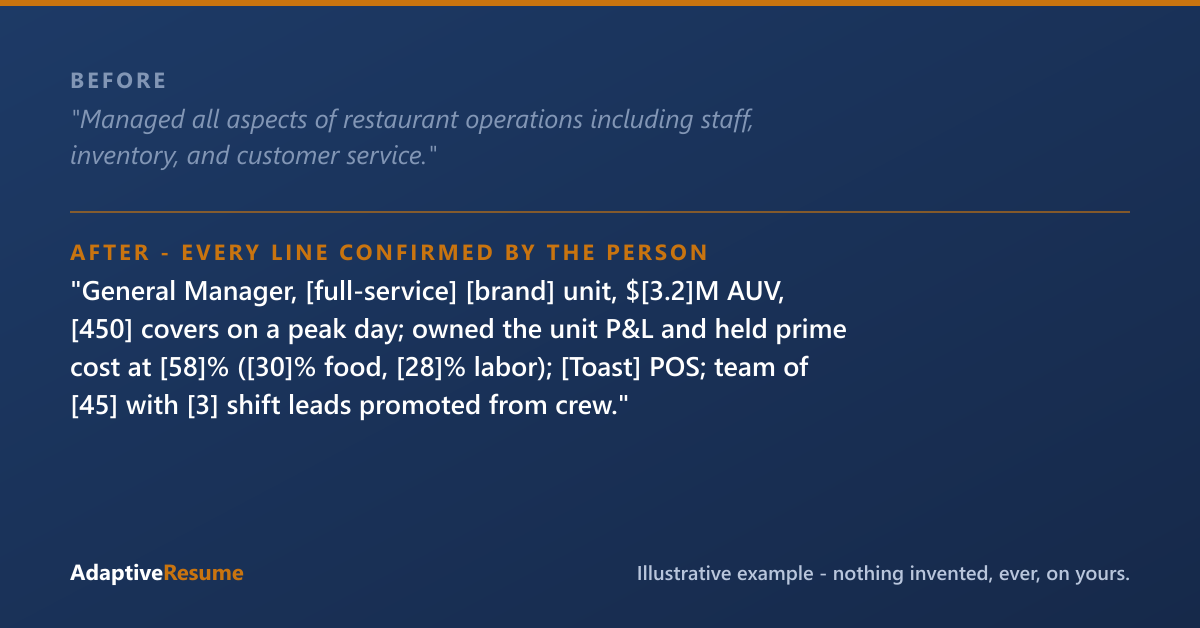
Illustrative example. On your resume, every line comes from your real history — proposed as a question, added only when you confirm it.
An operator reading the second version knows in one line what concept you ran, how much it did, whether prime cost was under control, which POS you can train on, and that you built people rather than just scheduled them. Nothing in it is new; it is the same job with the numbers left in. Fill the brackets from your P&L and POS reports, not from memory — an operator will ask to talk through the numbers.
Food safety and alcohol credentials, exactly as held
Restaurant management has few formal credentials, so the ones that exist get checked. Our guide on how to list certifications on a resume covers placement; here is what belongs in a GM’s block and how to write each one.
Food protection manager certification. The FDA Food Code, which nearly every state’s health code is based on in some version, says the person in charge of a food establishment must be a certified food protection manager who passed a test from an accredited program (low-risk operations can be exempted by the local authority, and states adopt the code on their own schedule). The best-known exam is the ServSafe Food Protection Manager Certification from the National Restaurant Association; its exam is accredited by the ANSI National Accreditation Board (ANAB) under the Conference for Food Protection standard, and the certification is valid for five years (some states and counties recognize it for less, so use the date on your local certificate if you hold one). Other ANAB-accredited food manager exams exist and count the same way under the code. Write what you hold with the year: “ServSafe Food Protection Manager Certification, [year]”. Some states and counties issue their own food manager certificate on top of the exam, so if yours does, add “[state/county] Certified Food Protection Manager, [year]”. Do not write “ServSafe certified” and stop — the Food Handler course is a different, shorter program, and a reader cannot tell which one you mean.
Alcohol service and manager training. Requirements come from the state (and sometimes the city or county), and they differ. Two training programs you will see everywhere are ServSafe Alcohol (National Restaurant Association) and TIPS, Training for Intervention ProcedureS (now offered by 360training). Some states run their own server or manager permit instead of, or on top of, those. Write the exact thing you hold: “ServSafe Alcohol, [year]” or “[state] alcohol server/manager permit, [year]”. If you were the named manager on the establishment’s liquor license, say so; that is a real piece of scope.
Allergen training. Some jurisdictions require food allergen training for managers or all food workers — Massachusetts and Rhode Island are two the National Restaurant Association names — and many operators require it regardless. “ServSafe Allergens, [year]” is one line if you have it.
Brand training. Franchise systems run their own manager training programs. Write them by the brand’s name with the year — “[Brand] general manager certification, [year]” — and do not present internal brand training as a public credential.
The numbers that carry the page
Annual unit volume. AUV is the size-of-job number. Give it as a figure or an honest range: ”$[N]M AUV”. Add covers per day, transactions per week, or average check where that is how your concept measures itself. Say whether the number included catering, delivery, or bar sales, and give the mix if it mattered (“[20]% of sales through third-party delivery”).
Prime cost. Food (or cost of goods) plus labor, as a percentage of sales, is the number a GM is judged on most. Give the pieces and the total: “food cost [N]%, labor [N]%, prime cost [N]%”, and the direction you moved them over what period. If you cut waste, tightened the order guide, renegotiated a vendor, or rebuilt the schedule against a sales forecast, that is the how — say it in one clause.
Guest feedback. Name the measure you actually worked to: the brand’s guest-satisfaction program, a survey score, or a public review rating you held or moved. Only name a number you can show. “Held a [4.6] Google rating across [1,200] reviews” is checkable; “excellent customer service” is not.
Health inspections and audits. Inspection results are public record in many places. “Passed [N] consecutive health inspections with no critical violations” or “scored [N] on the county inspection” is a strong line if it is true. Franchise operators add brand operations audits — name the audit by the brand’s term and give the score or the pass.
People. Team size, the leads and managers you developed, and turnover. Restaurant turnover is high and every operator knows it, so a real reduction is worth stating: “cut hourly turnover from [N]% to [N]% in [period]”. Hiring volume, onboarding, and the certifications you got your team through (food handler cards, alcohol training) are all concrete.
For more on turning duties into numbers, our quantify your resume bullets guide walks through it line by line.
Systems: POS, scheduling, and back office
Screening software keys on product names, and so does an operator who has to train you on theirs. Name each system you have run:
- POS (point of sale): Toast, NCR Aloha, Oracle MICROS Simphony, Square for Restaurants, or the brand’s own system if it has one.
- Scheduling and labor: 7shifts, HotSchedules (now part of Fourth), or a brand-provided tool.
- Back office, inventory, and accounting: Restaurant365, MarketMan, or the franchisor’s platform.
- Ordering and delivery: the online-ordering platform and the third-party delivery apps you managed, if that was part of your job.
If you led a system rollout — a POS change, a new scheduling platform, online ordering — that is worth its own bullet, because it means you can do it again at the next unit.
Restaurant manager resume: AGM, shift lead, and the climb to GM
Many GMs came up through the building: crew to shift lead to assistant general manager to GM. A restaurant manager resume should show that climb rather than hiding it under one entry with the last title. Our guide on how to list promotions on a resume shows the layout; the restaurant-specific part is what to put under each step.
For an assistant general manager or restaurant manager, write the scope you owned, not the GM’s. Typical AGM ownership: the weekly schedule and labor target, the inventory count and food order, opening and closing, cash handling and deposits, the front-of-house or back-of-house team, and standing in as person in charge for inspections. If you carried the whole unit while the GM seat was empty, say so with the dates.
For a shift lead or supervisor, name the shift, the sales it did, the team on it, and what you were accountable for: cash, line checks, temperature logs, closing paperwork.
For a GM moving to multi-unit, the resume flips: the unit is now the row, not the page. Give the number of units, total sales across them, the GMs you hired and developed, and how the units compared against the brand or the company on cost and guest scores. Area and district managers are read for that comparison first.
Format notes
Length follows your history, not a page rule. Two pages is normal and expected once you have more than one substantive management role to describe; one page is right for a shift lead or a first-time AGM. Order matters more than length: a unit-scope line under every restaurant, a labeled certifications block near the top, and a systems block a screener can find. If you are trimming to fit, cut duties every GM shares before you cut a single number.
One genuine exception worth knowing: federal applications through USAJOBS cap at two pages as of the September 2025 OPM change. That’s a hard requirement, not a style preference.
Otherwise: reverse chronological, single column, standard headings, real text rather than graphics or tables. Skip the graphics.
A bullet bank you can adapt — keep only what’s true
- “General Manager, [full-service/fast-casual/QSR] [brand/independent] unit; $[N]M AUV, [N] covers per day, team of [N]”
- “Owned the unit P&L; held prime cost at [N]% ([N]% food, [N]% labor) against a target of [N]%”
- “Reduced food cost from [N]% to [N]% by [rebuilding the order guide / tightening waste logs / renegotiating [vendor]]”
- “Cut hourly turnover from [N]% to [N]% over [period]; promoted [N] crew members to shift lead”
- “Passed [N] consecutive health inspections with no critical violations; person in charge on record”
- “Scored [N] on [brand] operations audit; held a [N] guest-satisfaction score against a brand average of [N]”
- “Grew catering and delivery to [N]% of sales through [platform]; managed [N] third-party delivery partners”
- “Ran [Toast/Aloha/Simphony] POS and [7shifts/HotSchedules]; led the rollout of [system] across the unit”
Each bullet is a frame, not a claim. If a line isn’t true of your unit, it doesn’t go on your page — the P&L will find it.
What screening software looks for on a restaurant general manager resume
Operator filters read for the vocabulary of running a unit, and an area director reads for the same words minutes later. The terms that typically matter: general manager, restaurant manager, P&L, AUV, sales, food cost, labor cost, prime cost, cost of goods, inventory, scheduling, guest satisfaction, health inspection, food safety, ServSafe, certified food protection manager, alcohol service, hiring, training, turnover, full-service, fast-casual, QSR, franchise, brand standards, catering, delivery, POS, Toast, Aloha, Simphony, and the scheduling and back-office systems by name.
One honesty note on job codes: O*NET profiles this work under Food Service Managers (11-9051.00). That one code covers everything from a cafeteria to a fine-dining GM, which is exactly why your unit line and your numbers have to carry the message the code can’t.
The highest-risk lines overstate scope or standing — a system-wide AUV written as your unit’s, a lapsed food manager certificate written as current, an AGM year written as a GM year. Area directors and franchisees in the same market hire from each other’s units, and a former GM’s numbers are easy to check.
The Role Skills Checklist below helps you inventory what your units actually prove, which is often considerably more than the resume currently says. Our build does it with you: we work backwards from your real concept, volume, costs, systems, and certifications, propose the lines that history supports — each one offered as a question, not a decision made for you — and ask you to confirm every item before it appears. We never add a certification, a number, or a system you didn’t tell us about.
Common questions
What is the difference between a restaurant manager resume and a restaurant general manager resume?
Scope. A restaurant manager or assistant general manager usually owns shifts, a department (front of house or back of house), scheduling, and part of the cost picture. A general manager owns the whole unit: the P&L, hiring, food and labor cost, inspections, and the results. Write the scope you actually held. If you were a manager who carried GM-level pieces — the schedule, the inventory count, the food order, the health inspection — name each one; that is exactly what a hiring operator reads for when deciding who is ready for a unit.
Do I need ServSafe Manager on my resume?
If you hold it, yes — write it as 'ServSafe Food Protection Manager Certification, [year]', and add your state or county food manager certificate if your jurisdiction issues one separately. Many state and local health codes, following the FDA Food Code, require a certified food protection manager on the establishment's staff, and ServSafe is one of the accredited exams that satisfies it. Write only what you currently hold, with the year; the certificate is checkable and it expires.
Should I put the restaurant's sales volume on my resume?
Yes, if you know it and are allowed to share it. Annual unit volume (AUV) is the first number an operator uses to size your experience, the way room count works for hotels. Use a figure you can defend — '$[N]M AUV' or 'roughly $[N]M in annual sales' — and never a franchisor's system-wide average as if it were your unit. If your employer treats unit sales as confidential, use covers per day or transactions per week instead.
I ran a franchise unit, not an independent. What is different on the resume?
Name the brand and say 'franchise unit' or 'company-owned unit' plainly. Then show the things a franchise GM is measured on that an independent GM is not: brand operations audits or inspections passed, brand training completed, and results against the brand's own guest-feedback program. An independent GM shows menu, vendor, and pricing decisions instead. They are different jobs, not bigger and smaller ones, and a franchisee and an independent owner are each looking for proof you have run their kind.
Role Skills Checklist
Pop your email in and the download unlocks right here — and being on the list before launch day locks in 25% off your first build. We'll also send the occasional useful note and tell you the moment AdaptiveResume goes live. No spam.
Download: Role Skills ChecklistThanks — you're on the launch list, your 25% is locked in, and your download is ready below.
That email didn't look right — mind trying it again?
Ready to do this on your own resume?
We'll find what you've left off and you approve every line — nothing made up.
Build your resume — $49Try the demo first — a sample review, no sign-up · See how the service works
Paid a resume service and got a template back? Start at Fix my resume.