Guides · For job seekers
HVAC Technician Resume: EPA 608, Refrigerants, and Real Proof
HVAC technician resumes get read for the credential the law requires, the systems you actually run, and where you stand on the refrigerant transition. How to put your real service work on paper — with honest numbers.
Published 09/04/2026
HVAC (heating, ventilation, and air conditioning) hiring starts with a question the law answers: can this person legally handle refrigerants? That makes an HVAC technician resume unusual — there’s one credential a screener looks for before anything else, and a resume that buries it or states it vaguely loses ground to weaker techs who wrote it clearly. After that, a shop is reading for your real scope: service or install, residential or light commercial, which equipment, how many calls.
There’s also a moment happening in this trade that your resume should catch. The industry is mid-way through a refrigerant transition, and a tech who can truthfully say “I’m trained on the new refrigerants” is answering a question shops are actively asking. Vague resumes miss all of this. Specific ones read like the tech a dispatcher wants on the board.
Lead with your scope and the systems you run
Under each employer, give the picture in one line before the bullets — service or install, the equipment, the volume, and the credential.
Before: “Responsible for servicing and repairing residential HVAC systems.”
After: “Residential service and repair, [6–8] calls a day across gas furnaces, heat pumps, and split systems; diagnosed refrigerant, airflow, and low-voltage control faults; [90]% first-visit completion; EPA 608 Universal.”
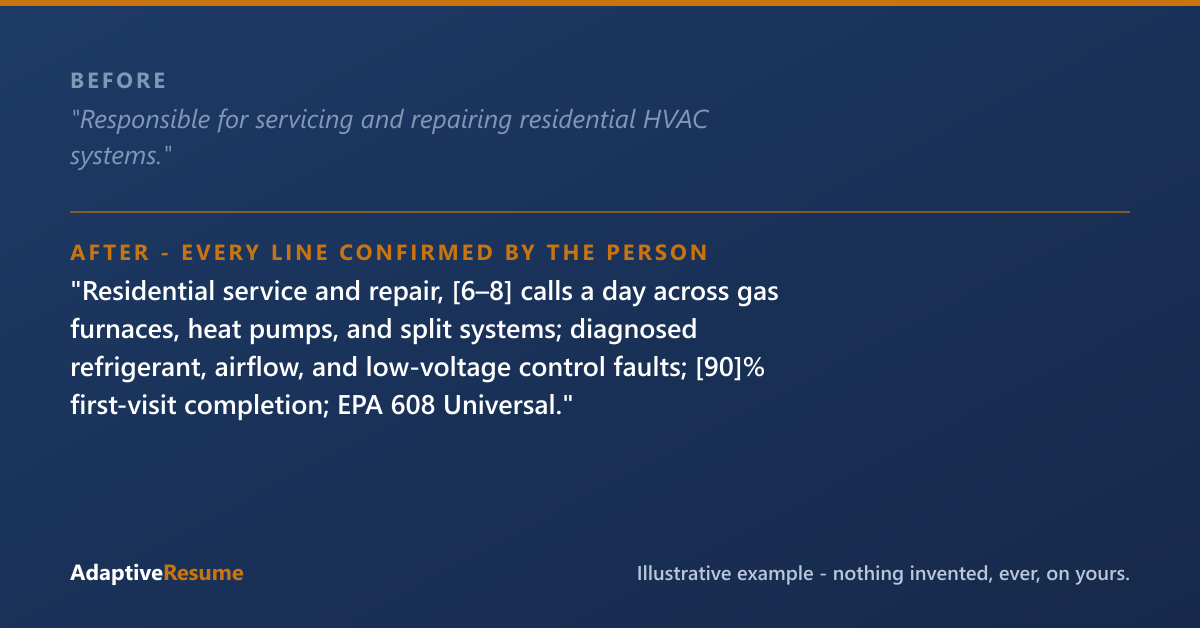
Illustrative example. On your resume, every line comes from your real history — proposed as a question, added only when you confirm it.
The second version answers what the first leaves a service manager guessing at: the lane (service, not install), the equipment mix, the daily volume, how often you fix it the first time, and the credential that makes it all legal. Every item is something you either did or didn’t, so it stays honest. To watch a review like this happen line by line, the free demo walks it on a sample profile from exactly this trade — an HVAC service tech.
EPA 608 — the credential the law requires
Section 608 of the Clean Air Act, administered by the EPA (Environmental Protection Agency), requires technician certification for anyone who maintains, services, repairs, or disposes of equipment that could release refrigerants. It’s the legal floor for the core of the job, and the first hard filter on an HVAC posting.
State it exactly, because the type tells a shop what you can touch:
- Type I — small appliances (five pounds of refrigerant or less)
- Type II — high-pressure appliances — the split systems and heat pumps that fill a service tech’s day
- Type III — low-pressure appliances, chiller territory
- Universal — all of the above
“EPA 608 Universal” is one of the strongest four-word lines an HVAC resume can carry. If you hold a type rather than Universal, name the type — it’s still the legal credential, and precision reads better than vagueness.
NATE, HVAC Excellence, and state licensing — exactly as held
NATE (North American Technician Excellence) is a voluntary certification shops widely recognize. List the real credential you earned: the traditional path is a core exam plus a specialty in an installation or service track — air conditioning, air distribution, heat pumps, gas heating, and others — and the newer Certified HVAC Professional (CHP-5) pathway certifies through five shorter exams. NATE also offers a Low-GWP Refrigerant certification exam — worth a line if you’ve taken it.
HVAC Excellence runs its own recognized ladder — Employment Ready certificates for students and entry-level techs, Professional Technician certifications for experienced ones. List the level and subject you earned, not just the brand name.
State licensing varies by state, and honesty here means saying so. Some states license HVAC contractors, some license journeyman and master mechanics, some leave it to cities and counties — no single license is universal across the country. Write the one you actually hold with its issuing state and real title: “[State] journeyman HVAC license, #[number].” If your state doesn’t license the work at your level, you lose nothing by not inventing one.
OSHA cards: an OSHA 10 or OSHA 30 card from the Occupational Safety and Health Administration’s Outreach Training Program is worth a line. Write it as a card — “OSHA 30 card” — never as a certification, because the Outreach Program isn’t one and a careful reader knows the difference.
The refrigerant transition — say where you stand
The transition belongs on your resume because shops are hiring around it. Under the AIM Act (the American Innovation and Manufacturing Act), HFC refrigerants are being phased down, and new residential and light-commercial equipment manufactured since the start of 2025 has moved from R-410A to lower-GWP (global warming potential) refrigerants — mainly R-454B and R-32. Both are classified A2L, meaning mildly flammable, and they carry different handling, leak-detection, recovery, and charging practices than R-410A.
If you’ve trained on A2L refrigerants or installed and serviced R-454B or R-32 equipment, write it — it’s current, specific, and scarce. And your R-410A and R-22 service history still matters, because the installed base runs for decades. “Service across R-22, R-410A, and A2L (R-454B) systems; A2L handling trained” tells a shop you span the whole installed base. Claim only the refrigerants you’ve actually put gauges on.
HVAC resume skills that carry real weight
The phrase “HVAC experience” carries almost no information. These are the skills shops actually read for — name the ones that are truly yours:
- Refrigeration circuit diagnosis — superheat and subcooling, metering devices, compressor and reversing-valve faults. The heart of service work; say it in those words.
- Electrical and low-voltage controls — 24-volt control circuits, thermostats, control boards, capacitors, contactors, multimeter diagnosis. A large share of “no cool” calls end here.
- Brazing — line sets and fittings, with a nitrogen purge if that’s your practice.
- Airflow and ductwork — static pressure readings, duct repair and sealing, and duct design to ACCA Manual D (ACCA is the Air Conditioning Contractors of America) if you’ve done design, not just installation.
- Load calculation — ACCA Manual J residential load calculations, if you perform them. A real dividing line between techs who size by rule of thumb and techs who calculate; claim it only if you run the numbers.
- Heat pumps and mini-splits — the growth end of the trade: cold-climate heat pumps, ducted and ductless mini-splits, multi-zone. If this is your strength, put it high.
- Combustion and gas heat — furnace diagnosis, combustion analysis if you carry and use an analyzer, gas piping, venting.
- Preventive maintenance — tune-ups and maintenance-agreement work: steady revenue for a shop, steady proof of thoroughness for you.
Honest service metrics — the numbers a shop can feel
Service managers live in dispatch software, so numbers from it translate instantly. If your shop ran ServiceTitan, Housecall Pro, FieldEdge, or similar, you may already know these: calls per day, first-visit completion rate (truck rolls saved — the number managers watch closest), callback rate (low is the badge; claim it only if you know it), maintenance agreements serviced, and systems installed per week for install work. “Ran [6–8] service calls a day with a [<5]% callback rate” is a line a service manager can feel in their own numbers. A metric you can’t back up in conversation is worse than no metric — bracket what varies and write only what’s true.
Format notes
Length follows your history, not a page rule. Many HVAC resumes are one strong page, and if you’ve held one or two roles, that’s the right call — but keep the specific proof. Your EPA 608 type, refrigerants handled, equipment mix, and real numbers are what a screener needs to find, so cut generic duty lines (“provided excellent customer service”) before you cut a real credential or metric. If you’ve run service and install across several shops, two pages is normal once you have more than one substantive role to describe — a tight two pages beats a padded one.
One genuine exception worth knowing: federal applications through USAJOBS cap at two pages as of the September 2025 OPM change. That’s a hard requirement, not a style preference.
Otherwise: reverse chronological, single column, a clearly labeled certifications block near the top — EPA 608 type first — and skip the graphics. A screener wants your credential and equipment list fast, not a layout to admire.
A bullet bank you can adapt — keep only what’s true
- “Ran [6–8] residential service calls daily across [furnaces / heat pumps / split systems]; [90]% first-visit completion”
- “Hold EPA 608 [Type II / Universal] certification; serviced [R-22 / R-410A / R-454B] systems”
- “Completed A2L refrigerant training; installed and charged [R-454B / R-32] equipment”
- “Diagnosed low-voltage control, capacitor, and control-board faults with multimeter; repaired on first visit”
- “Brazed line sets with nitrogen purge on [N] installs; passed [N] inspections without correction”
- “Installed [N] systems per week: [equipment types], [1.5–5]-ton range, startup and commissioning included”
- “Serviced [N] maintenance agreements per season; performed combustion analysis on gas heat tune-ups”
- “Performed ACCA Manual J load calculations and Manual D duct sizing on [replacement / new-construction] jobs”
What screening software looks for on an HVAC technician resume
Filters commonly read for: HVAC, EPA 608, Universal, refrigerant, refrigerant recovery, R-410A, R-454B, R-32, A2L, heat pump, mini-split, ductless, split system, furnace, air conditioning, brazing, low-voltage, thermostat, controls, superheat, subcooling, troubleshooting, preventive maintenance, Manual J, load calculation, ductwork, NATE, OSHA 10, and service calls. O*NET’s profile for heating, air conditioning, and refrigeration mechanics and installers has the full task and tool list.
The highest-risk lines are the ones that overstate scope — a 608 type you don’t hold, a refrigerant you’ve never recovered, or load calculations you’ve never actually run. Shops ride techs along on day one, so overstatement gets found fast. Accurate detail is both safer and stronger.
The Role Skills Checklist below helps you inventory what your service work actually proves, which is often far more than the resume currently says. Our build does it with you: we work backwards from the systems you ran, the calls you closed, and the credentials you hold, propose the refrigerants, standards, and control language work like yours normally involves, and ask you to confirm every line before it appears. We never add a certification, a refrigerant, or a number you didn’t tell us about.
Common questions
Do I need EPA 608 certification on an HVAC resume?
If you handle refrigerants, you need it to do the work at all — Section 608 of the Clean Air Act requires certification for anyone who maintains, services, repairs, or disposes of equipment that could release refrigerants. It's the first thing a screener looks for, so state it exactly: the type you hold (Type I, II, III, or Universal). If you're in school and haven't tested yet, say that plainly rather than leaving the line off.
Is NATE certification worth listing?
Yes, if you hold it — NATE (North American Technician Excellence) is voluntary, but shops recognize it and some postings filter for it. List the real thing you earned: the specialty and track for the traditional core-plus-specialty path, or the Certified HVAC Professional (CHP-5) pathway if that's how you certified. Don't round a practice course or in-house training up to 'NATE certified' — the credential is checkable.
Should I mention the new A2L refrigerants like R-32 and R-454B?
If you've been trained on them or worked on equipment that runs them, absolutely — the industry is mid-transition and techs current on A2L handling are exactly what many shops are looking for right now. Say what's true: training completed, systems installed or serviced, recovery and charging practices you've actually used. If you haven't touched A2L equipment yet, don't claim it; say what you do run.
I'm mostly an installer. Should my resume look different from a service tech's?
Same skeleton, different proof. Install proof is systems set per week, equipment types and tonnage range, brazing, line sets, ductwork, startup and commissioning, inspections passed. Service proof is calls per day, diagnosis, first-visit completion, and callbacks. Many techs do both — say which is your center of gravity, because shops hire for one or the other and want to know what they're getting.
Role Skills Checklist
Pop your email in and the download unlocks right here — and being on the list before launch day locks in 25% off your first build. We'll also send the occasional useful note and tell you the moment AdaptiveResume goes live. No spam.
Download: Role Skills ChecklistThanks — you're on the launch list, your 25% is locked in, and your download is ready below.
That email didn't look right — mind trying it again?
Ready to do this on your own resume?
We'll find what you've left off and you approve every line — nothing made up.
Build your resume — $49Try the demo first — a sample review, no sign-up · See how the service works
Paid a resume service and got a template back? Start at Fix my resume.