Guides · For job seekers
NICU Nurse Resume: Acuity Level, Certs, and Line Skills
NICU hiring reads for acuity level and hands-on proof: ventilated and CPAP neonates, umbilical lines, gavage feeds, and a certification block that survives credentialing. Here's how to write yours honestly.
Published 08/30/2026
Neonatal intensive care hires on trust in a way few other units do. The manager reading your resume wants to know one thing: can they assign you a 26-weeker on the ventilator with umbilical lines and not think about the baby again until rounds? Generic language (“provided compassionate care to critically ill infants in a fast-paced environment”) doesn’t answer that. The specifics do — your unit’s acuity level, your certifications exactly as held, and the therapies you have actually run.
The other thing that trips up NICU resumes is scope confusion. Newborn nursery, well-baby, mother-baby, and Level II special care are real and valuable jobs, but they are not the same as ventilated Level III/IV neonatal intensive care, and a resume that blurs them competes badly against nurses who name their level plainly. Say what your unit was, and what you did in it.
The unit line: your acuity picture in one sentence
Under each NICU role, give one line a fellow neonatal nurse would recognize instantly.
Before: “Registered nurse providing care to premature and critically ill newborns in the neonatal intensive care unit.”
After: “NICU RN, Level III, [40]-bed unit; ventilated and CPAP neonates, umbilical arterial and venous lines, gavage feeds, developmental and family-centered care; [Epic] charting.”
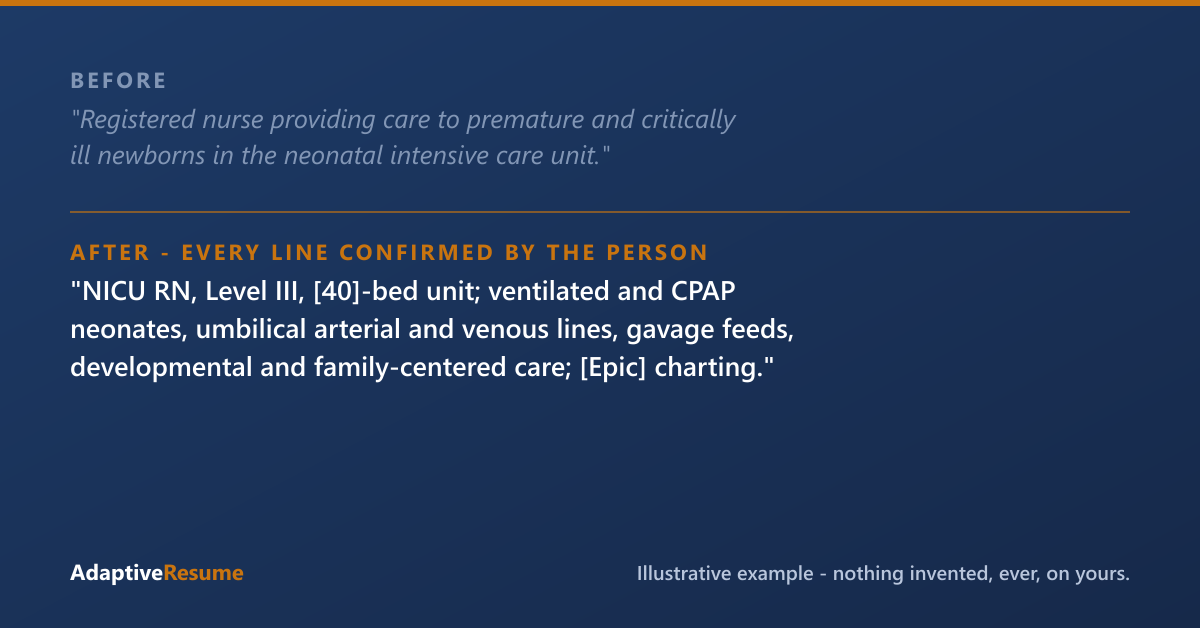
Illustrative example. On your resume, every line comes from your real history — proposed as a question, added only when you confirm it.
The second version is scannable in four seconds and answers what the first leaves a reader guessing at. Notice that the rewrite invents nothing; it just says plainly what the vague version was hiding. Fill the brackets with your real unit and systems.
Acuity level is the frame — name it
The American Academy of Pediatrics defines neonatal care in levels, and hiring managers read them as shorthand:
- Level II (special care nursery): stable or moderately ill infants, some born prematurely; short-term respiratory support and feeding support, but transferred out when acuity climbs.
- Level III (neonatal intensive care): full intensive care, including mechanically ventilated infants, umbilical and central lines, and sustained life support for the smallest and sickest.
- Level IV (regional NICU): everything a Level III does plus on-site pediatric surgery, ECMO (extracorporeal membrane oxygenation), and complex congenital care — the highest acuity there is.
Put your level in the unit line and let it do the work the occupation code can’t. If you’ve floated or transferred across levels, say which and for how long. A nurse who ran Level IV surgical neonates has evidence a Level II resume can’t imply, and a nurse with three solid years of Level III shouldn’t hide behind “NICU experience.”
Credentials, exactly as held
Every item in this block gets checked during credentialing, so it has to be exactly right.
- RN license with the state and, where relevant, your compact (multistate) status.
- NRP — the Neonatal Resuscitation Program, the AAP/AHA course for delivery-room and early stabilization. Effectively expected in the NICU; list it with current-through dates.
- S.T.A.B.L.E. — the post-resuscitation, pre-transport stabilization program (Sugar, Temperature, Airway, Blood pressure, Lab work, Emotional support). Common and worth a line, especially in transport and outreach roles.
- RNC-NIC — Neonatal Intensive Care Nursing certification, administered by the NCC (National Certification Corporation). This is the specialty board credential and leads the block if you hold it. Write the acronym correctly; it is not “CCRN-Neonatal” or “NICU-RN.”
- BLS, and PALS if your unit or transport role requires it.
List exactly what you hold, with real status. Nothing you’re “about to take” unless it’s labeled that way — “RNC-NIC, exam scheduled [month/year]” is honest and reads fine. An invented or misnamed credential is the fastest way to lose a NICU offer, because the whole specialty runs on verified competence.
The parts of the job that carry the most weight
Respiratory support. Say what you actually managed: ventilated neonates, CPAP, high-flow, and whether you assisted with intubation, surfactant administration, or extubation readiness. Name the vocabulary a NICU screener reads for rather than a vague “respiratory care.”
Lines and access. Umbilical arterial and venous (UAC/UVC) lines, PICC lines, and the monitoring and care they require. If you assisted with insertion versus managed after placement, describe the real role — the difference matters to the person hiring.
Feeding and nutrition. Gavage (NG/OG tube) feeds, feeding advancement, TPN (total parenteral nutrition) and lipids, and breastfeeding and lactation support. Feeding is a large share of daily NICU work and belongs on the page.
Developmental and family-centered care. Neuroprotective and developmental care, kangaroo (skin-to-skin) care, cue-based feeding, and the family teaching and discharge preparation that carry real weight in this specialty. Parents of NICU babies remember their nurses; managers know it.
Charting and monitoring. Epic or Cerner by name, plus the assessment and monitoring you did day to day. Screening software keys on the system name.
Format notes
Length follows your history, not a page rule. Two pages is normal and expected once you have more than one substantive nursing role to describe; one page is right for new graduates or nurses new to the specialty. Order matters more than length: license and certification block near the top in its own labeled section (screening software keys on it), then experience with an acuity/unit line atop each role. If you’re trimming to fit, cut older non-NICU detail before you cut a single neonatal specific.
One genuine exception worth knowing: federal applications through USAJOBS cap at two pages as of the September 2025 OPM change. That’s a hard requirement, not a style preference.
Otherwise: reverse chronological, single column, standard headings, real text rather than graphics or tables — hospital systems parse plain layouts most reliably. Skip the graphics.
A bullet bank you can adapt — keep only what’s true
- “NICU RN, Level [II/III/IV], [N]-bed unit; typical [1:1 / 1:2 / 1:3] assignments by acuity”
- “Managed ventilated and CPAP neonates, including [surfactant / high-flow / weaning] per unit protocol”
- “Maintained umbilical (UAC/UVC) and PICC lines; assisted with bedside insertions”
- “Administered and advanced gavage (NG/OG) feeds; managed TPN and lipids per orders”
- “Delivered developmental and family-centered care; coached kangaroo care and cue-based feeding”
- “Charted assessments, I&Os, and medications in [Epic/Cerner]; [barcode med administration]”
- “Attended high-risk deliveries and stabilized newborns per NRP; [transport / admission] role”
- “Precepted [N] nurses through NICU orientation; [charge nurse frequency]”
Each bullet is a frame, not a claim. If a line isn’t true of your practice, it doesn’t go on your page — an interviewer’s first follow-up question will find it.
What screening software looks for on a NICU nurse resume
Hospital filters read for the vocabulary of neonatal critical care, and a human reads for the same words minutes later. The terms that typically matter: NICU, neonatal intensive care, Level II / III / IV, ventilator, CPAP, high-flow, surfactant, umbilical line, UAC, UVC, PICC, gavage feeds, TPN, developmental care, family-centered care, kangaroo care, NRP, S.T.A.B.L.E., RNC-NIC, BLS, PALS, Epic, and Cerner.
One honesty note on job codes: O*NET profiles this work under Registered Nurses (29-1141.00). Neonatal intensive care is a specialty within the RN occupation, not a separately coded job — which is exactly why your acuity level and hands-on specifics have to carry the message the occupation code can’t. If you also work critical care elsewhere, our ICU nurse resume guide covers drips, vents, and CRRT the same honest way.
The highest-risk lines are the ones that overstate scope — a Level you didn’t work, a line you watched rather than managed, or a credential misnamed or not yet held. NICU is a small specialty, and employers check.
The Role Skills Checklist below helps you inventory what your bedside work actually proves, which is often considerably more than the resume currently says. Our build does it with you: we work backwards from your real units, acuity levels, and certifications, propose the lines and credentials that history supports — each one offered as a question, not a decision made for you — and ask you to confirm every item before it appears. We never add a credential, a level, or a therapy you didn’t tell us about.
Common questions
Do I need RNC-NIC to get a NICU job?
No. Many units require only BLS and NRP to start and train the rest at the bedside; RNC-NIC is the specialty's board certification through the NCC (National Certification Corporation) and a strong differentiator, not a gate. It also requires roughly two years of NICU experience to sit for, so newer nurses can't hold it yet. If you're scheduled to test, say so honestly: 'RNC-NIC — exam scheduled [month/year].'
How do I show NICU experience when my title just says 'RN'?
The unit line does it: acuity level, bed count, typical assignment, and the babies you actually cared for. 'RN' plus 'Level III NICU, ventilated and CPAP neonates, umbilical lines, gavage feeds' reads as neonatal critical care to anyone screening for it.
What's the difference between a Level II, III, and IV NICU on a resume?
Acuity, and it matters. The AAP defines Level II as special care, Level III as full neonatal intensive care including ventilated infants and lines, and Level IV as the highest — surgical neonates, ECMO, and complex congenital care. Name your real level. A manager reads it as shorthand for what you've handled.
Should I list every skill from my NICU orientation checklist?
No. List what you actually did at the bedside and could speak to in an interview. A shorter, true list beats a long one that falls apart on one follow-up question — and in a unit this small, every line gets tested quickly.
Role Skills Checklist
Pop your email in and the download unlocks right here — and being on the list before launch day locks in 25% off your first build. We'll also send the occasional useful note and tell you the moment AdaptiveResume goes live. No spam.
Download: Role Skills ChecklistThanks — you're on the launch list, your 25% is locked in, and your download is ready below.
That email didn't look right — mind trying it again?
Ready to do this on your own resume?
We'll find what you've left off and you approve every line — nothing made up.
Build your resume — $49Try the demo first — a sample review, no sign-up · See how the service works
Paid a resume service and got a template back? Start at Fix my resume.