Guides · For job seekers
ICU Nurse Resume: Drips, Vents, and Proof You Hold the Line
Critical care has its own proof points: ratios, titratable drips, ventilator management, CRRT, and a certification block that survives credentialing. Write them in.
Published 08/11/2026
Critical care units hire on trust. The manager reading your resume wants to know one thing: can they hand you a ventilated patient on three drips at 0700 and not think about you again until rounds? Generic language (“provided care to critically ill patients in a fast-paced environment”) doesn’t answer that. The specifics do: your ratios, your certifications exactly as held, and the therapies you have actually run. This guide walks through what belongs on the page, with honest examples you can adapt.
What hiring managers and screening software look for on an ICU nurse resume
Hospital screening software searches for the vocabulary of critical care, and a human reads for the same words a few minutes later. The terms that typically matter:
- Certifications: BLS and ACLS are assumed but still listed. CCRN leads the block if you hold it. Add PALS if your unit takes pediatric patients, and NIH Stroke Scale where your unit receives strokes.
- Therapies and equipment: ventilator management, titratable drips (vasopressors, sedation), CRRT (continuous renal replacement therapy), arterial and central line management, hemodynamic monitoring. If your unit runs ECMO or balloon pumps, name the role you actually played with them rather than the device alone.
- Assessment tools: RASS and CAM-ICU (the sedation and delirium scales), and the sedation and weaning protocols your unit works under.
- Charting and ratios: Epic or Cerner by name, and your typical assignment (1:1, 1:2).
One honesty note on job codes: O*NET profiles this work under Registered Nurses (29-1141.00). Critical care is a specialty within the RN occupation, not a separately coded job, which is exactly why your unit specifics have to carry the message the occupation code can’t.
Every item in the certification block gets checked during credentialing. List exactly what you hold, with current-through dates, and nothing you’re “about to take” unless it’s labeled that way.
The unit line: your acuity picture in one sentence
Under each ICU role, give one line a fellow critical care nurse would recognize instantly:
Before: “Registered nurse responsible for the care of critical patients in the intensive care unit.” After: “ICU RN, [MICU/SICU/CVICU], typically 1:2 assignments: ventilated patients, titratable drips, CRRT when assigned; [Epic] charting.”
Unit type, ratio, and the therapies you ran. Notice the rewrite invents nothing; it just says plainly what the vague version was hiding. Fill the brackets with your real unit and systems.
A bullet bank you can adapt — keep only what’s true
- “ICU RN, [unit type], [N]-bed unit; typical 1:2 assignments, 1:1 for [CRRT / unstable / fresh post-op] patients”
- “Managed ventilated patients through daily awakening and breathing trials per unit protocol”
- “Titrated vasopressors and sedation to ordered parameters; documented in [Epic/Cerner]”
- “Ran CRRT for assigned patients, including setup checks and troubleshooting per protocol”
- “Maintained arterial and central lines; assisted with bedside insertions”
- “Responded to codes on the unit; [rapid response / code team] member [frequency]”
- “Precepted [N] nurses through critical care orientation”
- “Charge nurse [frequency]: acuity-based assignments for a [N]-bed unit”
- “Presented patients in interdisciplinary rounds with intensivists, pharmacy, and respiratory therapy”
Each bullet is a frame, not a claim. If a line isn’t true of your practice, it doesn’t go on your page — an interviewer’s first follow-up question will find it.
How long should an ICU nurse resume be, one page or two?
Two pages for experienced critical care nurses, one for new graduates or nurses new to the specialty (federal applications through USAJOBS — VA hospitals, for example — cap at two pages as of the September 2025 OPM change). Order matters more than length: license and certification block near the top in its own labeled section (screening software keys on it), then experience with a unit line atop each role. Single column, standard headings, real text rather than graphics or tables — hospital systems parse plain layouts most reliably. If you’re trimming to fit, cut older non-ICU detail before you cut a single critical care specific.
Moving into the ICU from another unit
Coming from tele, stepdown, or the ER? Lead with the overlap that’s real: drips you already titrate, ACLS in actual use, codes you’ve worked, rhythms you already read. Then label the gap honestly — “seeking critical care residency” or “completing [hospital]‘s critical care course” — instead of blurring it. Units hire transition candidates constantly; what gets screened out is inflation. Stepdown experience presented accurately is strong evidence. Stepdown experience presented as ICU experience is a credibility problem you can’t recover from.
The before-and-after, at a glance
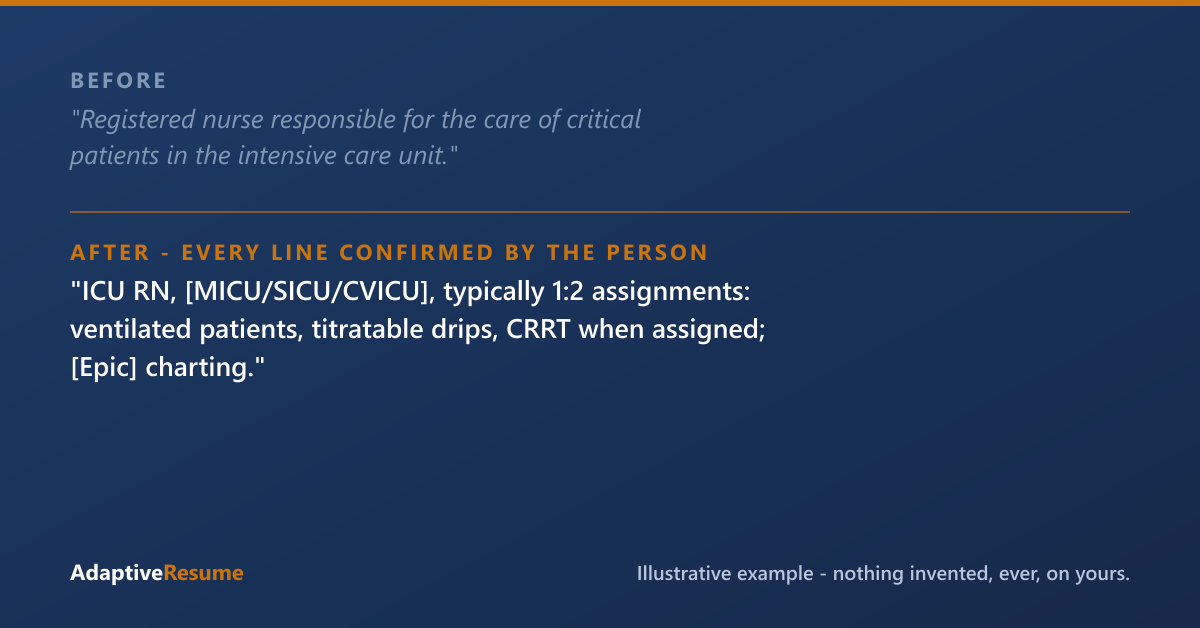
Illustrative example. On your resume, every line comes from your real history - proposed as a question, added only when you confirm it.
How AdaptiveResume helps
We work backwards from what your work actually involved. Tell us your units, your years, and your certifications, and we propose the lines that history supports — the ratios, the therapies, the trust roles like precepting and charge — each one offered as a question, not a decision made for you. Nothing lands without your say-so. In a specialty where every credential gets checked before you touch a patient, confirm-first is the only honest way to build the page. The ICU Nurse Resume Skeleton below gives you the one-page structure to start from today.
Common questions
Do I need CCRN to get an ICU job?
No. Many units require only BLS and ACLS to start and train the rest; CCRN is the specialty's board certification and a strong differentiator, not a gate. If you're sitting for it soon, say so honestly: 'CCRN — exam scheduled [month/year].'
How do I show ICU experience when my title just says 'RN'?
The unit line does it: unit type, bed count, typical ratio, and the therapies you ran. 'RN' plus '1:2 assignments, ventilated patients, titratable drips, CRRT' reads as critical care to anyone screening for it.
Should I list every skill from my ICU orientation checklist?
No. List what you actually used at the bedside and could speak to in an interview. A shorter, true list beats a long one that falls apart under one follow-up question.
ICU Nurse Resume Skeleton
Pop your email in and the download unlocks right here — and being on the list before launch day locks in 25% off your first build. We'll also send the occasional useful note and tell you the moment AdaptiveResume goes live. No spam.
Download: ICU Nurse Resume SkeletonThanks — you're on the launch list, your 25% is locked in, and your download is ready below.
That email didn't look right — mind trying it again?
Ready to do this on your own resume?
We'll find what you've left off and you approve every line — nothing made up.
Build your resume — $49Try the demo first — a sample review, no sign-up · See how the service works
Paid a resume service and got a template back? Start at Fix my resume.