Guides · For job seekers
LPN Resume: Scope of Practice, Patient Load, and Certifications
A director of nursing reads an LPN resume for the license written exactly right, a scope line that shows you know where practical nursing starts and stops in your state, and the hall you actually carried. Here's how to write yours honestly.
Published 09/18/2026 · Updated 09/29/2026
A director of nursing reads an LPN (licensed practical nurse) resume for three things. Is the license written exactly right — the state, the status, and whether you hold multistate privileges? Does the resume show you know where practical nursing starts and stops in your state? And what hall, clinic, or caseload did you actually carry, at what pace? A resume that says “provided nursing care to residents and administered medications” answers none of that. The specifics do.
The thing that sinks LPN resumes more than any other is the scope line. Practical nursing has a defined place in the nursing structure — under the direction of an RN (registered nurse), APRN (advanced practice registered nurse), or physician, with duties set by each state’s nurse practice act — and a resume that blurs that line, in either direction, reads as someone who doesn’t know their own job. This guide is about writing it exactly.
The hall line: your scope in one sentence
Under each role, give one line another LPN or a director of nursing would recognize instantly.
Before: “LPN responsible for providing nursing care to residents and administering medications.”
After: “LPN, [state] license (active), [Nurse Licensure Compact multistate]; [28]-resident hall on a [120]-bed skilled nursing facility, [night] shift; med pass, treatments and wound care, data collection and reporting to the RN; [state] IV therapy certified; charted in [PointClickCare].”
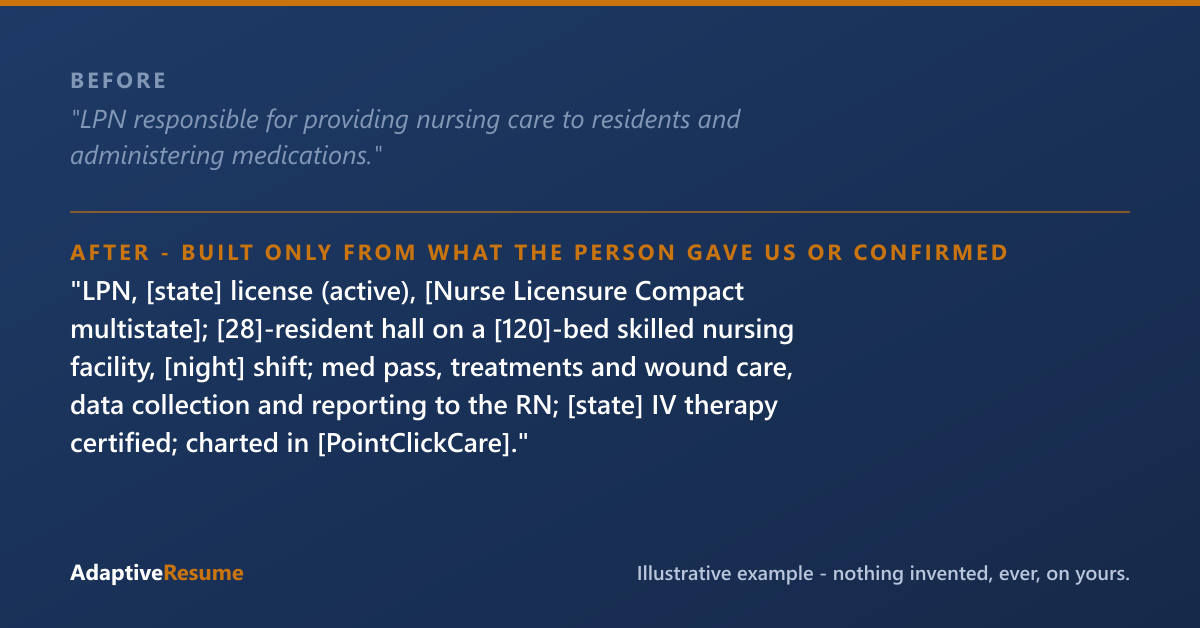
Illustrative example. Everything on your resume is yours: the experience you listed, plus the skills, tools, responsibilities, and credentials your work already involved, each added only after you confirm it’s true.
The second version answers what the first hides: the license and its status, the size of the hall and the facility, the shift, what you did, where your work sat relative to the RN, what you’re certified to do, and what system you charted in. It invents nothing. Fill the brackets from your real assignment and your real license.
Licensed — and sometimes licensed under another name
Every LPN and LVN passed the same exam, the NCLEX-PN (National Council Licensure Examination for Practical Nurses), and holds a license from a state board of nursing. The title differs by state: California and Texas issue the LVN (licensed vocational nurse); everywhere else it’s the LPN. It’s the same license doing the same job. Write the title your state issued, and put the other in parentheses once so screening software finds both.
Write the license as the board would show it: “[State] LPN license #[N], active, [year].” The Nurse Licensure Compact, run by the NCSBN (National Council of State Boards of Nursing), covers LPN/VNs as well as RNs; if your state is a member and your license is multistate, say so on the license line — it’s the first thing a travel or float employer checks. A license that has lapsed is a “was,” and the board’s public lookup says so to anyone who looks.
Scope of practice: the line that carries the whole page
An LPN works under the direction or supervision of an RN, an APRN, or a physician. What that means in practice is set by each state’s nurse practice act, and it varies — but the shape is consistent enough to write around.
In many states, the LPN collects assessment data — vital signs, observations, changes in condition — and reports it to the RN, who performs the nursing assessment, makes the nursing diagnosis, and owns the care plan. The LPN carries out the plan: administers medications, performs treatments, provides direct care, and documents. In some states the LPN may contribute to the care plan; in some, with the right certification, the LPN starts and maintains IVs (intravenous lines); in others those tasks are restricted.
The resume should use the vocabulary of your state’s act. “Collected and documented assessment data and reported changes in condition to the RN” is accurate almost everywhere. “Assessed patients” may be accurate in your state; check before you write it. “Supervised CNAs (certified nursing assistants) on the hall” is true in many facilities and states, and worth saying if it was your role. None of this is something to hide — it’s the job, written by someone who knows it. Our med-surg nurse resume guide and charge nurse resume guide cover the RN side of the same line; yours covers this side, and the two should never read as the same page.
Credentials, exactly as held
Our guide on how to list certifications on a resume covers placement; here is what belongs in an LPN’s block.
- State LPN or LVN license — state, number, status, and multistate status under the Nurse Licensure Compact if you hold it.
- NCLEX-PN — the month and year passed is enough; the license implies it, but new graduates should show it.
- IV therapy certification — where your state requires a board-approved course for LPN IV therapy, list it as the board names it, with the year. Where your state authorizes IV therapy on graduation, you may note “IV therapy within [state] LPN scope” rather than a certificate you don’t hold. Don’t list IV skills your state doesn’t permit.
- Wound care — the WCC (Wound Care Certified) credential from the NAWCO (National Alliance of Wound Care and Ostomy) is open to LPNs who meet its eligibility; if you hold it, write it as issued.
- Long-term care or gerontology certification — where you hold one, name it exactly as the issuing body names it, with the year. Don’t write a general “gerontology certified.”
- BLS — Basic Life Support. Write the issuer and the current-through date; if the facility asked for the American Heart Association course specifically, make it clear that’s the one you hold.
- Facility competencies — restraint alternatives, dementia care, infection control, medication aide supervision where applicable — each with a year.
List exactly what you hold, with real status. A certification you’re “working toward” is written as such or not at all.
The parts of the job that carry the most weight
Long-term care and skilled nursing. This is the largest employer of LPNs — about 37% of them, by the Bureau of Labor Statistics’ count — and the numbers are the story: hall size, facility bed count, shift, med pass counts, and treatments per shift. “[28]-resident hall, [two] med passes, [12] treatments per shift” tells a director of nursing exactly what you’ve handled.
Medication administration. Routes you administer, controlled substance counts and narcotic keys, insulin and sliding scales, crushed and tube medications, and the eMAR (electronic medication administration record) you used. If your error record is clean and tracked, that’s a real line.
Treatments and wound care. Dressing changes, staging and measuring under the RN or wound nurse, ostomy care, catheter care, tube feedings, oxygen and nebulizers, and glucose monitoring. Name what you did, with volume.
Data collection and reporting. Vitals, focused observations, changes in condition, SBAR (Situation, Background, Assessment, Recommendation) reports to the RN and to providers, and admission and readmission data collection. Written in your state’s vocabulary.
MDS participation. If you contributed to the MDS (Minimum Data Set), the federal assessment instrument used in nursing facilities, say what part — observations, interviews, documentation — and how many residents.
Supervision. Where your state and facility had you directing CNAs, say how many and on what shift. It’s leadership experience, and it’s what a charge LPN posting is looking for.
Other settings. Clinic LPNs: injections and immunizations, triage by protocol, phone follow-up, patients per day, and the EHR (electronic health record). Home health: visits per day, the territory, wound and medication management, and documentation for the agency. Corrections: sick call, med pass at scale, and the safety protocols. Rehab: post-acute loads and the therapy coordination. Travel LPN roles exist too — our travel nurse resume guide covers the assignment-by-assignment format that fits them.
Systems. PointClickCare or MatrixCare in long-term care; Epic or Oracle Health (formerly Cerner) in clinics and hospitals. Screening software keys on product names, not on “documented care accurately.”
LPN resume skills: the list, and how to make it true
Every skill on an LPN list has to pass two tests: you did it on a real shift, and it sits inside your state’s scope. With that settled, here is what postings name, in their own words: medication administration, eMAR, controlled substance counts, insulin administration, IV therapy (where permitted), wound care, dressing changes, ostomy and catheter care, tube feedings, oxygen and nebulizer therapy, glucose monitoring, data collection, vital signs, SBAR reporting, admission data collection, MDS participation, CNA supervision, dementia care, infection control, PPE (personal protective equipment), and your charting system by name.
What you did, not what your program covered; and nothing outside your state’s act — a director of nursing in your state knows it, and one item outside it discounts the rest of the list.
Format notes
Length follows your history, not a page rule. One page is right for a new LPN or for a few years in one facility. Two pages is normal and expected once you have more than one substantive role to describe — a skilled facility and a clinic, say, each with its own loads and systems. Order matters more than length: license, compact status, and certifications near the top in their own labeled section (screening software keys on them), then experience with a hall line atop each role. If you’re trimming to fit, cut older non-nursing detail before you cut a number.
One genuine exception worth knowing: federal applications through USAJOBS cap at two pages as of the September 2025 OPM (Office of Personnel Management) change. VA (Department of Veterans Affairs) LPN postings run through USAJOBS, so if that’s where you’re headed, that’s a hard requirement.
Otherwise: reverse chronological, single column, standard headings, real text rather than graphics or tables — applicant systems parse plain layouts most reliably. Skip the graphics. For more on how the nursing pages on this site fit together, see our nurses page.
A bullet bank you can adapt — keep only what’s true
- “LPN, [state] license (active), [multistate under the Nurse Licensure Compact]; [N]-resident hall on a [N]-bed skilled nursing facility, [shift]”
- “Administered [N] scheduled medications per shift across [N] residents in [eMAR]; maintained controlled substance counts with [zero] discrepancies in [N] months”
- “Performed [N] treatments per shift including dressing changes, ostomy care, and tube feedings under the RN’s direction”
- “Collected and documented assessment data and reported changes in condition to the RN using SBAR; supported [N] admissions per month”
- “Contributed observations and documentation to MDS assessments for [N] residents”
- “Directed [N] CNAs on [shift] where permitted under [state] scope; coordinated assignments and break coverage”
- “[State] IV therapy certification, [year]; started and maintained peripheral IVs within [state] LPN scope”
Each bullet is a frame, not a claim. If a line isn’t true of your shifts — or isn’t inside your state’s scope — it doesn’t go on the page. The board lookup and your former director of nursing are one call away.
What screening software looks for on an LPN resume
Facility filters read for the vocabulary of practical nursing, and the director of nursing who opens the file next reads for the same words. The terms that typically matter: licensed practical nurse, LPN, LVN, licensed vocational nurse, NCLEX-PN, Nurse Licensure Compact, multistate, medication administration, eMAR, med pass, IV therapy, wound care, WCC, treatments, ostomy, catheter, tube feeding, data collection, SBAR, MDS, skilled nursing, long-term care, CNA supervision, PointClickCare, MatrixCare, Epic, BLS.
One honesty note on job codes: O*NET profiles this work under Licensed Practical and Licensed Vocational Nurses (29-2061.00) — one code, both titles, which is exactly why writing your state’s title plus the other once covers you on every posting.
The highest-risk lines overstate scope or status — an RN task written as your own, an IV skill your state doesn’t permit, a lapsed license written as active, “RN” written before the license exists. Nursing is a licensed, looked-up world; every one of those is a board search away.
The Role Skills Checklist below helps you inventory what your license and your shifts actually prove, which is often considerably more than the resume currently says. Our build does it with you: we work backwards from your real settings, loads, certifications, and state scope, propose the lines that history supports — each one offered as a question, not a decision made for you — and ask you to confirm every item before it appears. We never add a credential, a number, or a skill you didn’t tell us about.
Common questions
I'm an LVN in Texas. Do I write LVN or LPN on my resume?
Write what your license says, then the other title once in parentheses: 'LVN (Licensed Vocational Nurse; LPN in other states)'. California and Texas call the license LVN; everywhere else it's LPN. It's the same NCLEX-PN and the same job, and screening software reads for both, so naming both costs nothing and keeps the license line exact.
Can I write 'assessed patients' on an LPN resume?
Write what your state's practice act lets you do, in its words. In many states the LPN collects assessment data — vitals, observations, changes in condition — and reports to the RN, who does the nursing assessment and owns the care plan. 'Collected and documented assessment data and reported changes in condition to the RN' is accurate almost everywhere and reads as someone who knows the line. 'Assessed' may be accurate in your state; check your practice act before you claim it.
Do I need IV certification, and how do I list it?
It depends entirely on your state. Some states authorize LPN IV therapy on graduation from an approved program, some require a board-approved course before you can start or maintain IVs, and some restrict what you may do even with the course. Write what you hold as your board issued it — '[State] LPN IV therapy certification, [year]' — and don't list IV skills your state doesn't permit. A director of nursing in your state knows the rule.
I'm halfway through an LPN-to-RN bridge program. Where does that go?
In education, written as in progress with the expected finish: '[School] LPN-to-RN bridge, ADN (associate degree in nursing) expected [month year]'. Keep your LPN license and your LPN work as the main story — that's what you're licensed to do today. Don't write 'RN' anywhere on the page until the license is issued; the board lookup is the first thing a hiring manager opens.
Role Skills Checklist
Pop your email in and the download unlocks right here. Joining our list also takes 25% off your first purchase within 30 days of joining, when you create your account with this same email. We'll also send the occasional useful note. No spam.
Download: Role Skills ChecklistThanks, you're on our list, and your download is ready just above. Your 25% off a first purchase is good for 30 days from the day this email joined our list.
That email didn't look right — mind trying it again?
Ready to do this on your own resume?
We'll find what you've left off, and nothing goes on your resume that you didn't give us or confirm.
Get your resume build — $29Every purchase is one payment, and nothing renews. A single resume build can be used any time within 12 months of buying it, and AR Pass builds you don't use end when its 90 days end.
Try the demo first — a sample review, no sign-up · See how the service works
Paid a resume service and got a template back? Start at Fix my resume.