Guides · For job seekers
Maintenance Supervisor Resume: Crew Size, PM Completion, and Downtime
Maintenance supervisor resumes are read for scope first — how many technicians, how many shifts, what kind of plant — and then for the numbers a maintenance program lives on: PM completion, downtime, and safety. How to write yours with real crew, real systems, and credentials exactly as held.
Published 09/02/2026
A maintenance supervisor resume gets read in a specific order: what kind of place, how big a crew, and what the numbers looked like. A plant manager scanning resumes wants to know within a few seconds whether you ran six technicians on one shift in a distribution center or twenty across three shifts in a food plant. Generic versions — “supervised maintenance staff,” “ensured equipment uptime” — answer none of that, and they lose to the resume that does.
The second thing that separates a strong maintenance supervisor resume from a weak one is the difference between listing duties and showing a program. Every supervisor “oversaw preventive maintenance.” Far fewer say what their PM completion rate was, which system they ran it in, and what happened to downtime while they had the crew. Those are the lines a hiring manager is actually trying to find.
Lead with the crew, the shifts, and the numbers
Under each employer, give the scope in one line before the bullets — the setting, the crew, the shifts, and the numbers your program was measured on.
Before: “Supervised maintenance technicians and ensured equipment was running.”
After: “Led [N] technicians across [N] shifts in a [food-processing plant / hospital / distribution center]; PM completion held at [N]% in [Maximo / Fiix / UpKeep]; unplanned downtime on [line / system] cut [N]% over [period].”
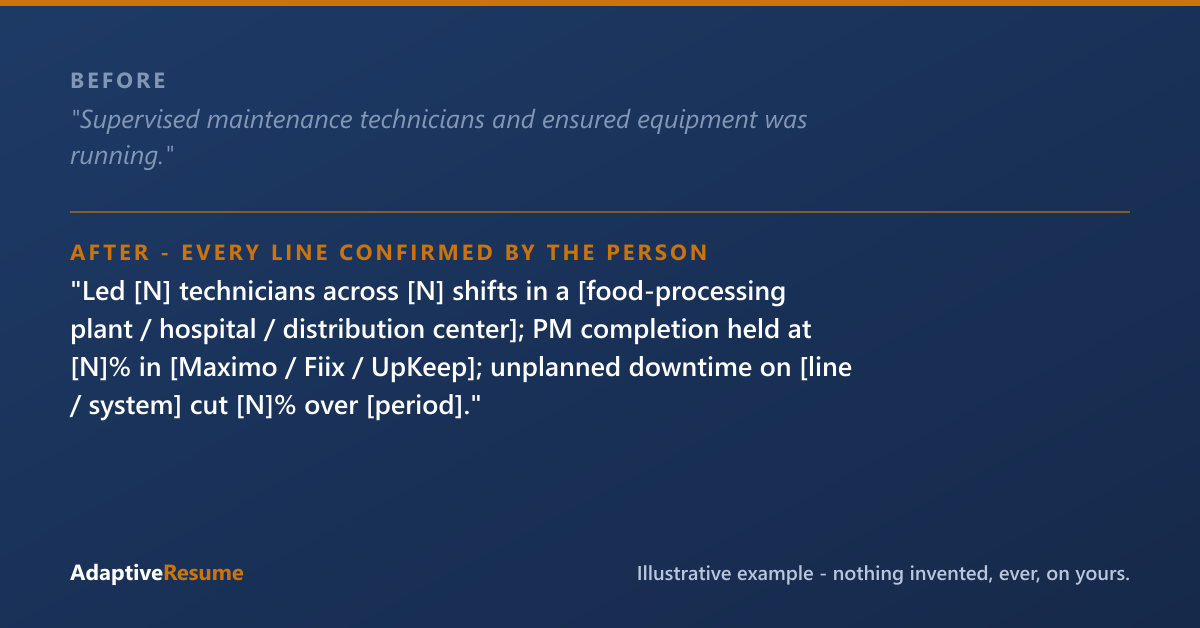
The second version tells the reader the setting, the size of the job, the software, and one result — all in a line a hiring manager can check. Fill in only what’s true. A small true downtime number still reads better than a vague claim, because it shows you tracked it.
The parts of the job that carry the most weight
The preventive maintenance program is the center of most maintenance supervisor resumes. Say how it ran: the number of assets on PM, the PM completion rate, the ratio of preventive to corrective work, and whether you built or rebuilt the schedule. If you moved a crew from mostly breakdown response to mostly planned work, that is one of the strongest things you can say — write the before and after in real numbers.
Work orders and the CMMS deserve their own lines. Name the system you ran the program in — IBM Maximo, SAP Plant Maintenance (SAP PM), Fiix, UpKeep, eMaint, MaintainX, or Limble — and what you did in it: scheduling, backlog management, parts kitting, reporting. Hiring managers read the CMMS name as a proxy for how fast you’ll be useful, and larger employers filter on it.
Downtime and reliability is where numbers do the work. Unplanned downtime hours, downtime as a percentage of scheduled run time, mean time between failures (MTBF), and mean time to repair (MTTR) are the standard measures. Use the ones your plant actually tracked. If you never had an MTBF figure, say “reduced unplanned downtime on [line]” with the number you do have.
The safety program is the responsibility employers fear getting wrong. Lockout/tagout under OSHA 29 CFR 1910.147 is the big one — write whether you wrote or audited equipment-specific procedures, trained the crew, and ran the annual inspections the standard requires. Electrical safety work under NFPA 70E (arc-flash boundaries, PPE, energized-work permits) belongs here too. Recordable incidents, near-miss reporting, and days without a lost-time injury are legitimate lines if they’re true.
Contractors, parts, and budget show the business side of the job. The size of the parts and MRO inventory you managed, the annual maintenance budget, the contractors you scheduled and held to scope — HVAC, electrical, fire-protection testing, elevator — and any spend you cut without cutting reliability.
The people are the reason the word “supervisor” is in the title. Hiring, scheduling, training, performance reviews, cross-training between mechanical and electrical, and shift coverage. Say how many people, and what you did for their skills.
Credentials and licenses, exactly as held
List what you actually hold, with the real name and its true status.
OSHA 10-hour and 30-hour Outreach cards are worth a line, and worth naming accurately: they are course-completion cards, not certifications or licenses, and OSHA says so directly. The 30-hour general industry card is the one written for supervisors.
EPA Section 608 technician certification is a real federal credential for anyone who services equipment containing refrigerants. State the type — Type I, II, III, or Universal — and nothing more.
Boiler and stationary engineer licenses are state- or city-specific. Some states license them, some don’t, and some cities (Chicago and New York City, for example) require their own. Name your license exactly as the issuing authority names it, with the jurisdiction and class. Don’t generalize it into a credential that doesn’t exist.
CMRP (Certified Maintenance & Reliability Professional) from the Society for Maintenance & Reliability Professionals is the recognized professional credential at this level. If you hold it, list it with the year; it is valid for three years and renewed with course hours, so keep the status honest.
Trade licenses — electrician, plumbing, HVAC — are state-issued and vary by state. List them with the state and license type.
Setting notes
Manufacturing and food processing: production lines, changeovers, PLC-driven equipment, sanitation cycles, and the downtime-versus-throughput math. Name a food-safety audit scheme only if you were actually part of it.
Hospitals and healthcare: the utility systems — emergency power, medical gas, HVAC and pressure relationships, water — under the Joint Commission’s Environment of Care standards. Generator testing, documentation, and survey readiness are the lines a hospital facilities director reads first. This is the “facilities maintenance” version of the job, and the documentation load is the story.
Commercial property and campus facilities: square footage, building count, tenant or occupant response, vendor management, and the building systems you owned. Work-order response times and vendor spend matter more here than production numbers.
Distribution and warehousing: conveyor and sortation systems, dock equipment, and peak-season readiness.
Maintenance manager resume: the same page, one level up
If you’re writing a maintenance manager resume, everything above still applies, and the scope line changes. A manager’s resume is read for the department: total headcount including supervisors, the annual budget, capital projects delivered, the reliability program, and results across the whole site rather than one shift. If you did that work under a supervisor title, describe it in the bullets and keep the true title.
Format notes
Length follows your history, not a page rule. Maintenance careers usually start on the tools, and the technician years are not filler — they’re the reason a crew will follow you. If you’ve held two supervisory roles and spent years as a millwright or electrician before that, cramming it into one page throws away your advantage.
The honest rule: two pages is normal and expected once you have more than one substantive role to describe. Every line has to earn its place. Cut duties every supervisor shares; keep crew size, systems, numbers, safety, and anything that shows judgment.
One genuine exception worth knowing: federal applications through USAJOBS cap at two pages as of the September 2025 OPM change. That’s a hard requirement rather than a style preference.
Otherwise: reverse chronological, single column, a scope line under every employer, and a clearly labeled block for licenses, certifications, and systems. Conservative formatting is right in this field. Skip the graphics.
A bullet bank you can adapt — keep only what’s true
- “Led [N] maintenance technicians across [N] shifts at a [N]-square-foot [plant / facility]”
- “Raised PM completion from [N]% to [N]% in [Maximo / SAP PM / Fiix / UpKeep / eMaint] over [period]”
- “Cut unplanned downtime on [line / system] by [N]% ([N] hours per month) by [root-cause action]”
- “Wrote and audited [N] equipment-specific lockout/tagout procedures under 29 CFR 1910.147; ran annual procedure inspections”
- “Managed [$N] annual maintenance budget and [$N] MRO parts inventory; reduced spend [N]% without an increase in downtime”
- “Scheduled and held [N] contractors to scope — [HVAC / electrical / fire-protection testing] — across [N] buildings”
- “Cleared work-order backlog from [N] to [N] open orders; average response time [N] hours”
- “Maintained [generator / medical gas / HVAC] testing and documentation for [Joint Commission / state] survey with [N] findings”
What screening software looks for on a maintenance supervisor resume
Filters commonly read for: preventive maintenance, predictive maintenance, corrective maintenance, CMMS, work orders, PM completion, downtime, MTBF, MTTR, root cause analysis, lockout/tagout, LOTO, OSHA, NFPA 70E, EPA 608, PLC, HVAC, electrical, hydraulics, pneumatics, conveyors, boilers, chillers, building automation, contractor management, MRO inventory, budget, scheduling, shift supervision, training, and safety audits. O*NET’s profile for first-line supervisors of mechanics, installers, and repairers has the full task list.
The highest-risk lines are the ones that overstate scope — a crew you led on paper but not in practice, a CMMS you logged into but never ran, or a downtime number you didn’t measure. Plant managers ask about these in the first interview, and the maintenance world is small enough that they ask around too.
The Role Skills Checklist below helps you inventory what your program actually proves, which for most supervisors is considerably more than the resume currently says. Our build does it with you: we work backwards from your real crew, systems, and safety work, propose the standards and software that work like yours normally involves, and ask you to confirm every item before it appears. We never add a credential, a license, or a system you didn’t tell us about.
Common questions
I was a lead technician, not an official supervisor. Can I call myself a maintenance supervisor?
Keep your real title and describe the real scope. If you scheduled the crew, assigned work orders, and signed off on completed jobs, say exactly that under your true title — a reader sees supervisory work either way. Changing the title is the kind of thing a reference check catches, and the honest version is stronger than it feels.
Do I need a CMRP or a degree to be hired as a maintenance supervisor?
Most postings ask for years of hands-on maintenance experience plus some lead or supervisory time, not a degree. The CMRP from SMRP is real and respected, and if you hold it, list it. If you don't, your PM program, your crew, and your safety record carry the resume. Never list a credential you haven't earned.
Which numbers matter most on a maintenance supervisor resume?
Crew size and shifts, PM completion percentage, unplanned downtime (as a percentage or hours), work-order backlog, and the size of the parts or contractor budget you managed. If you only have a few of these, write those. A single true downtime number beats a paragraph of duties.
What is the difference between a maintenance supervisor resume and a maintenance manager resume?
Mostly scope. A supervisor runs a crew and a shift; a manager runs the department — budget, capital projects, multiple supervisors, and the reliability program. If you did manager-level work under a supervisor title, describe that work in your bullets and keep the true title. The bullets, not the title, show the level.
Role Skills Checklist
Pop your email in and the download unlocks right here — and being on the list before launch day locks in 25% off your first build. We'll also send the occasional useful note and tell you the moment AdaptiveResume goes live. No spam.
Download: Role Skills ChecklistThanks — you're on the launch list, your 25% is locked in, and your download is ready below.
That email didn't look right — mind trying it again?
Ready to do this on your own resume?
We'll find what you've left off and you approve every line — nothing made up.
Build your resume — $49Try the demo first — a sample review, no sign-up · See how the service works
Paid a resume service and got a template back? Start at Fix my resume.