Guides · For job seekers
Maintenance Technician Resume: Equipment, Safety Standards, and Downtime Numbers
Industrial maintenance technician resumes are read for the equipment you keep running, the safety standards you work under, and the downtime numbers you own. Here's how to write yours with the real machines, the exact standards, and the CMMS and PLC work that hiring managers screen for.
Published 10/05/2026 · Updated 10/30/2026
A maintenance technician resume is read by a maintenance manager who wants three things right away: which equipment you keep running, which safety standards you work under, and whether you have moved a number they care about, such as downtime or preventive maintenance completion. Most technician resumes say “responsible for maintenance and repair of plant equipment” and answer none of the three.
The work behind that sentence is specific and valuable. It covers the conveyors, fillers, presses, compressors, chillers, and packaging lines you keep running, the lockout/tagout and arc-flash procedures you work under, the CMMS you close work orders in, and the PLC fault you traced at two in the morning so the line ran by six. That is the resume, and it is already true.
Lead with the equipment and the standards
Before: “Maintenance technician responsible for troubleshooting and repairing production equipment.”
After: “Multi-craft maintenance technician on a 24/7 food-packaging line: 40 machines including fillers, case packers, conveyors, and two ammonia-refrigerated chillers; lockout/tagout under OSHA 29 CFR 1910.147 on every job; preventive maintenance completion raised from 78% to 96% in one year, tracked in Fiix.”
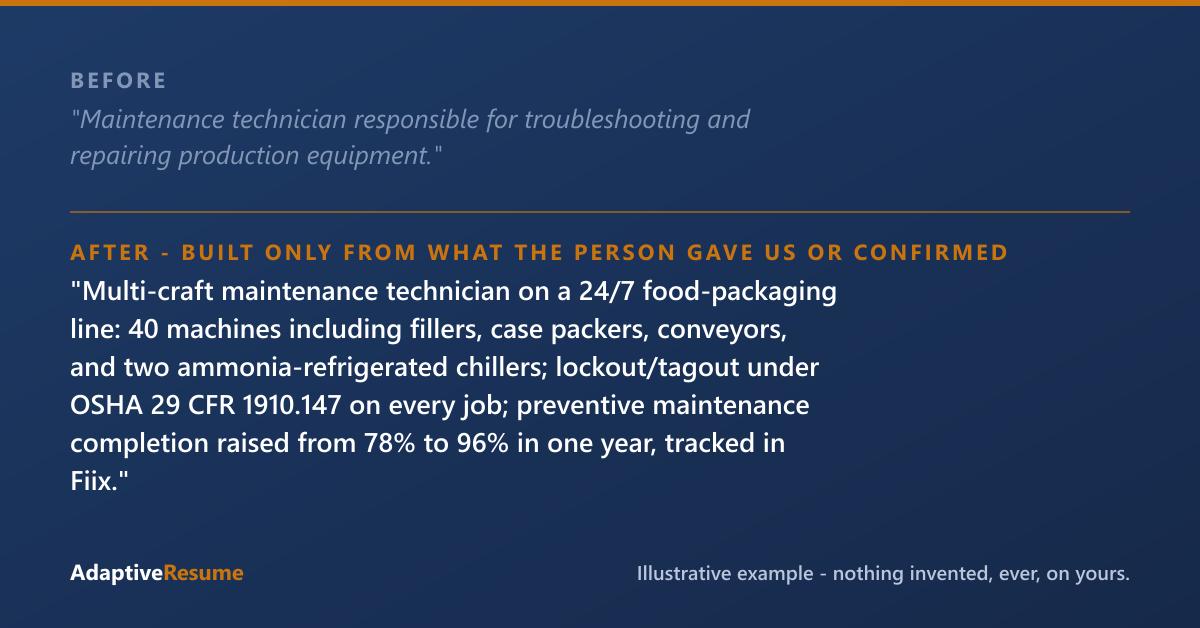
Illustrative example. Everything on your resume is yours: the experience you listed, plus the equipment, standards, and safety training your work already involved, each added only after you confirm it’s true.
The second version tells the manager the setting, the equipment, the standard, the system, and a number you moved. Every piece of a line like this comes from your own work history, and a plant manager can check each one.
The parts of the job that carry the most weight
Equipment, by name and count. Name the equipment you maintain, such as conveyors, packaging lines, fillers and cappers, presses, CNC and production machinery, compressors, boilers, chillers, pumps, motors, gearboxes, and the building systems if you cover facilities. Name the count and the environment: “40 machines on a 24/7 line” says more than “a variety of equipment.”
Safety standards you work under. Name lockout/tagout (OSHA 29 CFR 1910.147), electrical safety and arc-flash practices under NFPA 70E, machine guarding, and confined space entry if you have done it, and add your OSHA 10-hour or 30-hour General Industry card. Write the standards you actually follow; a safety manager reads this section closely.
Electrical, controls, and PLC work. Describe your work on three-phase motors and controls, variable frequency drives (VFDs), sensors and photo-eyes, and PLC troubleshooting at its real level: reading ladder logic, forcing outputs under the plant’s procedure, replacing I/O modules, and using the platform’s software (Allen-Bradley Studio 5000 or RSLogix, Siemens TIA Portal). If you only trace faults and replace components, say that; it is valuable, and overstating it is caught in the first technical interview.
Mechanical, hydraulic, and pneumatic work. Name the mechanical work you do, such as bearings, belts, chains, gearboxes, alignment, hydraulic and pneumatic systems, welding and fabrication, and the precision tools you use.
The CMMS and the numbers. Name the computerized maintenance management system (Fiix, MaintainX, UpKeep, SAP Plant Maintenance, Maximo, eMaint) and the numbers you were measured on: preventive maintenance completion rate, unplanned downtime, mean time to repair, work orders closed per week. If you built or improved a preventive maintenance schedule, that is a project worth its own line.
Refrigeration and HVAC, if you cover it. EPA Section 608 certification (Type I, II, III, or Universal) is required for work that could release refrigerant from stationary refrigeration and air conditioning that uses regulated refrigerants, including attaching gauges or adding refrigerant, and employers verify it. Ammonia and CO2 systems fall outside Section 608, and ammonia refrigeration in food plants has its own training programs; name the one you completed.
Predictive work and the reliability numbers
Predictive and condition-based maintenance is a different skill from preventive maintenance, and plants that run it say so in the posting. If you have done it, name the method and the tool: vibration analysis with a route-based data collector, infrared thermography on electrical panels and bearings, oil sampling and analysis, or ultrasonic leak and bearing detection. Write what you found with it, such as “caught [N] bearing failures before they stopped the line,” and list any formal level you hold, such as a vibration analyst category under ISO 18436-2, with the certifying body.
Mean time between failures and mean time to repair are the two reliability numbers a maintenance manager reports upward. MTBF is operating time divided by the number of failures; MTTR is total repair time divided by the number of repairs. If your plant gave you these figures, use them rather than your own math. If you cut the repair time on a machine by standardizing the fix, stocking the right spares, or writing a troubleshooting guide, that is a project worth its own line, and the before-and-after numbers are the proof.
Credentials, exactly as held
List your OSHA 10-hour or 30-hour General Industry card with the year. If you drive a forklift, write that you were trained and evaluated under OSHA 29 CFR 1910.178, with the year of your last evaluation. Give EPA Section 608 with the type. If you hold the Certified Maintenance and Reliability Technician (CMRT) from the Society for Maintenance and Reliability Professionals, list it with the year. Name manufacturer training on specific equipment or controls. If you hold a state electrical or boiler license, list it with the state and expiration.
Training you completed without a credential is listed as training, with the provider. A technician who writes “arc flash training, [provider], [year]” is stronger than one who writes “NFPA 70E certified” without a certificate to show.
Plants, distribution centers, and facilities
The setting changes the emphasis. A manufacturing plant resume leads with production equipment, changeovers, and line uptime. A distribution center resume leads with conveyors, sortation, dock equipment, and throughput. A food or beverage plant adds sanitation, washdown-rated equipment, and food-safety practices under the plant’s program. A facilities resume leads with building systems, HVAC, and tenant response times. Write your setting and its numbers, and if you have worked in more than one, say so, because a manager hiring for a mixed site will look for it. If you lead a crew, our maintenance supervisor resume guide covers the crew and budget side.
Format notes
Length follows your history, not a page rule. A technician with three plants, two industries, and a controls specialty has more that matters than one page holds. Two pages is normal and expected once you have more than one substantive job to describe. Keep the equipment, the standards, the systems, and the numbers; cut the duties every technician shares.
Use reverse chronological order and a single column, add a clearly labeled block for certifications and systems, and leave out graphics and photos. Plant applications often pass through screening software before a manager sees them, and a two-column template can scramble the read. One exception worth knowing: federal applications through USAJOBS cap at two pages as of the September 2025 OPM change.
A bullet bank you can adapt — keep only what’s true
- “Maintained [N] machines on a [24/7 / two-shift] [industry] line: [equipment types]”
- “Performed lockout/tagout under OSHA 29 CFR 1910.147 on every repair that required it; [N] years with no recordable injury”
- “Troubleshot [Allen-Bradley/Siemens] PLC faults: read ladder logic, forced outputs under plant procedure, replaced I/O modules”
- “Raised preventive maintenance completion from [N]% to [N]% in [CMMS]; cut unplanned downtime by [N] hours a month”
- “Repaired and aligned [motors/gearboxes/pumps]; rebuilt [N] [component] per year”
- “EPA Section 608 [type] certified; serviced [N] [chillers/rooftop units/walk-in coolers] on [refrigerant]”
- “Maintained [N] [ammonia/CO2] refrigeration systems; [refrigeration training program and provider], [year]”
- “Completed [N] work orders a week in [CMMS] with parts and labor documented”
- “Trained [N] operators on autonomous maintenance checks and [N] new technicians on plant safety”
What screening software looks for on a maintenance technician resume
Filters commonly read for: industrial maintenance, multi-craft, preventive maintenance, predictive maintenance, lockout/tagout, LOTO, arc flash, NFPA 70E, OSHA 10, OSHA 30, PLC, Allen-Bradley, Siemens, VFD, three-phase, hydraulics, pneumatics, conveyors, CMMS, Fiix, MaintainX, SAP PM, Maximo, EPA 608, welding, troubleshooting, root cause, downtime, and MTTR. O*NET’s profile for industrial machinery mechanics has the full task list, and general maintenance and repair workers have their own profile.
The highest-risk lines are the ones a plant verifies in the technical interview or the first week: PLC programming you have not done, a certification you have not earned, or a number your last plant will not confirm. Write the work at its real level.
The Role Skills Checklist below helps you inventory what your plant history actually proves, which is usually more than the resume currently says. Our build does it with you: we work backwards from your real equipment, standards, and systems, and we ask you about the certifications, tools, and safety training that work like yours normally involves. Nothing goes on your resume that you didn’t give us or confirm, so a certification, a system, or a number you never told us about stays off the page.
Common questions
What is the difference between a maintenance technician resume and a maintenance supervisor resume?
Scope. A technician resume is built on the equipment you maintain, the standards you work under, and the repairs and preventive maintenance you perform. A supervisor resume is built on the crew, the schedule, the budget, and the plant-level numbers. If you lead a shift or a crew, say so with the head count, and read our maintenance supervisor guide as well; if you do the work, this guide is yours.
Do I need a certification to be a maintenance technician?
Most plant technician jobs require no license, and the credentials that help are specific: OSHA 10-hour or 30-hour General Industry cards, forklift training and evaluation from your employer under OSHA 29 CFR 1910.178, EPA Section 608 if you touch refrigeration, and trade-specific credentials such as the Certified Maintenance and Reliability Technician (CMRT) from the Society for Maintenance and Reliability Professionals. List what you hold with the date, and list training you completed as training.
How do I show PLC skill without overstating it?
Say what you actually do with it. Reading ladder logic to find a fault, forcing an output under the plant's procedure to test a device, and replacing and configuring an I/O module are technician-level PLC work. Writing new programs is a different claim. Name the platform (Allen-Bradley, Siemens, or another) and describe the work at its real level.
Which numbers matter most on a maintenance resume?
The ones a maintenance manager reports on: preventive maintenance completion rate, unplanned downtime reduced, mean time to repair, and the equipment count you cover. If your plant tracked them in a computerized maintenance management system, use the figures you saw there and can stand behind. If it did not, use the counts you know: machines maintained, work orders closed, and the outcome of a project you led.
Role Skills Checklist
Pop your email in and the download unlocks right here. Joining our list also takes 25% off your first purchase within 30 days of joining, when you create your account with this same email. We'll also send the occasional useful note. No spam.
Download: Role Skills ChecklistThanks, you're on our list, and your download is ready just above. Your 25% off a first purchase is good for 30 days from the day this email joined our list.
That email didn't look right — mind trying it again?
Ready to do this on your own resume?
We'll find what you've left off, and nothing goes on your resume that you didn't give us or confirm.
Get your resume build — $29Every purchase is one payment, and nothing renews. A single resume build can be used any time within 12 months of buying it, and AR Pass builds you don't use end when its 90 days end.
Try the demo first — a sample review, no sign-up · See how the service works
Paid a resume service and got a template back? Start at Fix my resume.