Guides · For job seekers
Labor and Delivery Nurse Resume: Certs, Triage, and Unit Scope
Labor and delivery hiring reads for readiness: fetal monitoring credentials, triage and cesarean experience, and a unit line that shows your real scope. Here's how to write yours honestly.
Published 09/04/2026
Labor and delivery hiring runs on readiness. The manager reading your resume wants to know one thing: can they give you a laboring patient on an oxytocin drip, trust you to watch the strip, and trust you to call for help at the right moment? Generic language (“provided compassionate care to mothers and babies in a fast-paced environment”) doesn’t answer that. The specifics do — your unit’s size and delivery volume, your fetal monitoring credentials exactly as held, and the situations you have actually worked.
The other thing that trips up labor and delivery resumes is scope vagueness. L&D (labor and delivery), LDRP (labor, delivery, recovery, postpartum), OB (obstetric) triage, antepartum, and mother-baby are related but different jobs, and a resume that just says “OB nurse” competes badly against one that names the unit and the work. Say what your unit was, and what you did in it.
The unit line: your scope in one sentence
Under each role, give one line a fellow perinatal nurse would recognize instantly.
Before: “Registered nurse providing care to mothers and newborns in the labor and delivery unit.”
After: “L&D RN, [16]-bed unit supporting [180] births per month; labor through delivery and recovery, OB triage rotation, circulating for cesarean sections; [Epic] charting.”
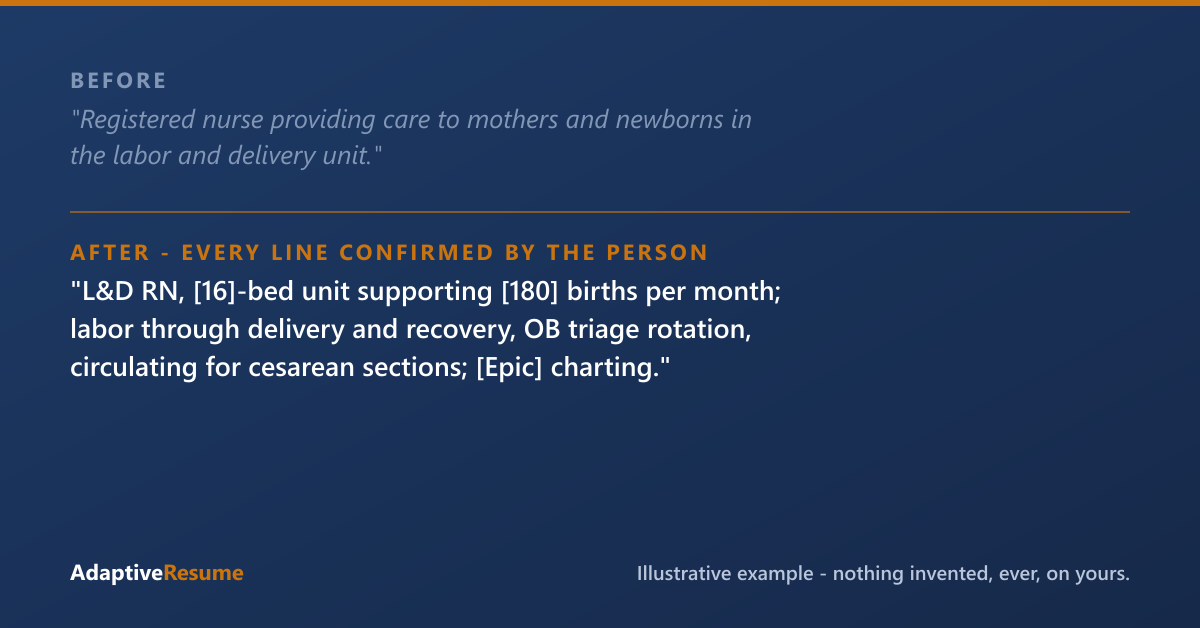
Illustrative example. On your resume, every line comes from your real history — proposed as a question, added only when you confirm it.
The second version is scannable in four seconds and answers what the first leaves a reader guessing at. Notice the rewrite invents nothing; it just says plainly what the vague version was hiding. Fill the brackets with your real unit and numbers.
Credentials, exactly as held
Every item in this block gets checked during credentialing, so it has to be exactly right. Our guide on how to list certifications on a resume covers placement and format; here is what typically belongs in a labor and delivery block:
- RN license with the state and, where relevant, your compact (multistate) status under the Nurse Licensure Compact, which the NCSBN (National Council of State Boards of Nursing) administers.
- BLS and ACLS — typically through the American Heart Association. ACLS is often required because laboring patients are adults who can deteriorate fast.
- NRP — the Neonatal Resuscitation Program, the American Academy of Pediatrics course for delivery-room resuscitation. Many L&D units expect it; list it with current-through dates.
- AWHONN fetal monitoring education — the Association of Women’s Health, Obstetric and Neonatal Nurses offers the Intermediate Fetal Heart Monitoring Course and the Advanced Fetal Heart Monitoring Course. Many units require one or both; name the course and year completed.
- C-EFM — the Electronic Fetal Monitoring certification from the NCC (National Certification Corporation). An exam-based credential, distinct from the AWHONN courses.
- RNC-OB — Inpatient Obstetric Nursing certification, also through the NCC. This is the specialty’s board credential and leads the block if you hold it.
- S.T.A.B.L.E. — the post-resuscitation, pre-transport newborn stabilization program (Sugar, Temperature, Airway, Blood pressure, Lab work, Emotional support). Worth a line where your unit stabilizes sick newborns before transfer.
List exactly what you hold, with real status. Nothing you’re “about to take” unless it’s labeled that way — “C-EFM, exam scheduled [month/year]” is honest and reads fine. A misnamed credential is the fastest way to lose ground in a specialty where every certification gets checked before you touch a patient.
The parts of the job that carry the most weight
Fetal monitoring. This is the center of the specialty. Say what you actually did: continuous electronic fetal monitoring, strip interpretation, intrauterine resuscitation measures, and escalation to the provider. Name your monitoring education and credentials in the block above and let the experience lines show them in use.
Labor management and titration. Oxytocin (Pitocin) titration per protocol, magnesium sulfate administration and monitoring for preeclampsia patients, epidural support, and cervical exams. “Per protocol” is honest and correct phrasing — these are provider-ordered, nurse-titrated therapies, and writing them that way shows you know the line.
Obstetric emergencies. Postpartum hemorrhage response — including quantified blood loss and your unit’s hemorrhage protocol — plus shoulder dystocia response, urgent cesarean activation, and cord prolapse drills. Write what you have actually worked, not what the unit is equipped for.
Cesarean sections. Circulating for cesarean sections is operating-room work and deserves its own line: counts, positioning, prepping, and newborn hand-off. If you also scrub, say so — the combination is valuable and often filtered for.
Triage and antepartum. OB triage is its own skill — rapid assessment of laboring, bleeding, hypertensive, and decreased-fetal-movement presentations, and the judgment to escalate. If you rotate through triage or an antepartum assignment, give it a line with volume.
Couplet care and recovery. Recovery of mother and newborn after delivery, couplet care on LDRP units, breastfeeding support, and discharge teaching. This is real, nameable work — name it rather than folding it into “postpartum duties.”
Charting. Epic or Oracle Health (formerly Cerner) by name, plus any obstetric-specific documentation your unit runs. Screening software keys on the system name.
Format notes
Length follows your history, not a page rule. Two pages is normal and expected once you have more than one substantive nursing role to describe; one page is right for new graduates or nurses new to the specialty. Order matters more than length: license and certification block near the top in its own labeled section (screening software keys on it), then experience with a unit line atop each role. If you’re trimming to fit, cut older non-perinatal detail before you cut a single labor and delivery specific.
One genuine exception worth knowing: federal applications through USAJOBS cap at two pages as of the September 2025 OPM change. That’s a hard requirement, not a style preference.
Otherwise: reverse chronological, single column, standard headings, real text rather than graphics or tables — hospital systems parse plain layouts most reliably. Skip the graphics.
A bullet bank you can adapt — keep only what’s true
- “L&D RN, [N]-bed unit supporting [N] births per month; [labor/LDRP/triage] assignments”
- “Managed continuous electronic fetal monitoring; escalated category changes per unit protocol”
- “Titrated oxytocin (Pitocin) and administered magnesium sulfate per protocol with ordered monitoring”
- “Circulated for [N] cesarean sections per [month/quarter]; [scrubbed when assigned]”
- “Responded to postpartum hemorrhage events; quantified blood loss and activated the hemorrhage protocol”
- “Staffed OB triage: assessed [N] patients per shift for labor, bleeding, and hypertensive presentations”
- “Recovered mothers and newborns post-delivery; provided couplet care and breastfeeding support”
- “Precepted [N] nurses through L&D orientation; charge nurse [frequency] on a [N]-bed unit”
Each bullet is a frame, not a claim. If a line isn’t true of your practice, it doesn’t go on your page — an interviewer’s first follow-up question will find it.
What screening software looks for on a labor and delivery nurse resume
Hospital filters read for the vocabulary of perinatal care, and a human reads for the same words minutes later. The terms that typically matter: labor and delivery, L&D, LDRP, OB triage, antepartum, fetal monitoring, electronic fetal monitoring, EFM, oxytocin, Pitocin, magnesium sulfate, cesarean, circulating, postpartum hemorrhage, couplet care, RNC-OB, C-EFM, NRP, AWHONN, BLS, ACLS, Epic, and Cerner.
One honesty note on job codes: O*NET profiles this work under Registered Nurses (29-1141.00). Labor and delivery is a specialty within the RN occupation, not a separately coded job — which is exactly why your unit line and hands-on specifics have to carry the message the occupation code can’t. If you work other units too, our nursing resume guides cover ICU, NICU, ER, and more the same honest way.
The highest-risk lines are the ones that overstate scope — postpartum work written as labor management, an emergency you drilled but never worked, or a credential misnamed or not yet held. Perinatal nursing is a small world, and employers check.
The Role Skills Checklist below helps you inventory what your bedside work actually proves, which is often considerably more than the resume currently says. Our build does it with you: we work backwards from your real units, delivery volumes, and certifications, propose the lines and credentials that history supports — each one offered as a question, not a decision made for you — and ask you to confirm every item before it appears. We never add a credential, a unit, or a therapy you didn’t tell us about.
Common questions
Do I need RNC-OB to get a labor and delivery job?
No. Many units require only BLS, and often ACLS and NRP, to start and train the rest at the bedside; RNC-OB is the specialty's board certification through the NCC (National Certification Corporation) and a strong differentiator, not a gate. The RNC-OB exam also requires roughly two years of specialty experience to sit for, so newer nurses can't hold it yet. If you're scheduled to test, say so honestly: 'RNC-OB — exam scheduled [month/year].'
How do I show labor and delivery experience when my title just says 'RN'?
The unit line does it: unit type, bed count, delivery volume, and the work you actually did. 'RN' plus 'L&D, OB triage, continuous fetal monitoring, circulating for cesarean sections' reads as labor and delivery to anyone screening for it.
What's the difference between C-EFM and the AWHONN fetal monitoring courses?
C-EFM is a certification — an exam-based credential in electronic fetal monitoring from the NCC that you hold and renew. AWHONN's Intermediate and Advanced Fetal Heart Monitoring Courses are education — instructor-led courses many units require or sponsor. Both belong on the page, listed as what they are: the certification in your certification block, the courses under education or professional development.
I work an LDRP unit and do a bit of everything. How do I write that?
Say so plainly — it's a strength, not a blur. LDRP (labor, delivery, recovery, postpartum) nurses follow the same family through the whole stay, and couplet care of mother and newborn together is real, nameable work. One line covers it: 'LDRP unit; labor through recovery, then couplet care of mothers and newborns.' Just don't present postpartum-only experience as labor experience — the interview will find the difference.
Role Skills Checklist
Pop your email in and the download unlocks right here — and being on the list before launch day locks in 25% off your first build. We'll also send the occasional useful note and tell you the moment AdaptiveResume goes live. No spam.
Download: Role Skills ChecklistThanks — you're on the launch list, your 25% is locked in, and your download is ready below.
That email didn't look right — mind trying it again?
Ready to do this on your own resume?
We'll find what you've left off and you approve every line — nothing made up.
Build your resume — $49Try the demo first — a sample review, no sign-up · See how the service works
Paid a resume service and got a template back? Start at Fix my resume.