Guides · For job seekers
Manufacturing Resume: Standards, Machines, and Shift Numbers
Manufacturing resumes are read for the standards you work under, the machines you run, and the numbers your shift hits — and most people never write any of that down. How to put the plant floor on paper, honestly.
Published 09/02/2026
Manufacturing is the field where the resume leaves the most real work on the table. Every day on the floor you follow lockout/tagout before you clear a jam. You keep your station to 5S. You log SPC readings, hold scrap under a number, and know what a changeover costs the shift. None of that is a card in your wallet — so it never occurs to most people to write it down. The resume says “operated machinery and met production goals,” and it looks like every other resume in the pile.
The single most useful thing you can do is write down the standards you already work under, the machines you run, and the numbers your shift hits. Those three things are what a plant manager is trying to read. A resume that names them reads like someone who has stood on the floor; one that doesn’t reads like a template.
Lead with the line, the machine, and the numbers
Under each plant, give the context in one line before the bullets — what you ran, at what rate, against what standard.
Before: “Operated machinery on a production line and met daily quotas.”
After: “Line operator, injection molding, [N] presses on rotating shifts; ran [N] units/shift against a [N]-unit standard, held scrap under [N]%, and cut changeovers from [N] to [N] minutes on a 5S/SMED project; lockout/tagout trained, forklift trained and evaluated under 29 CFR 1910.178.”
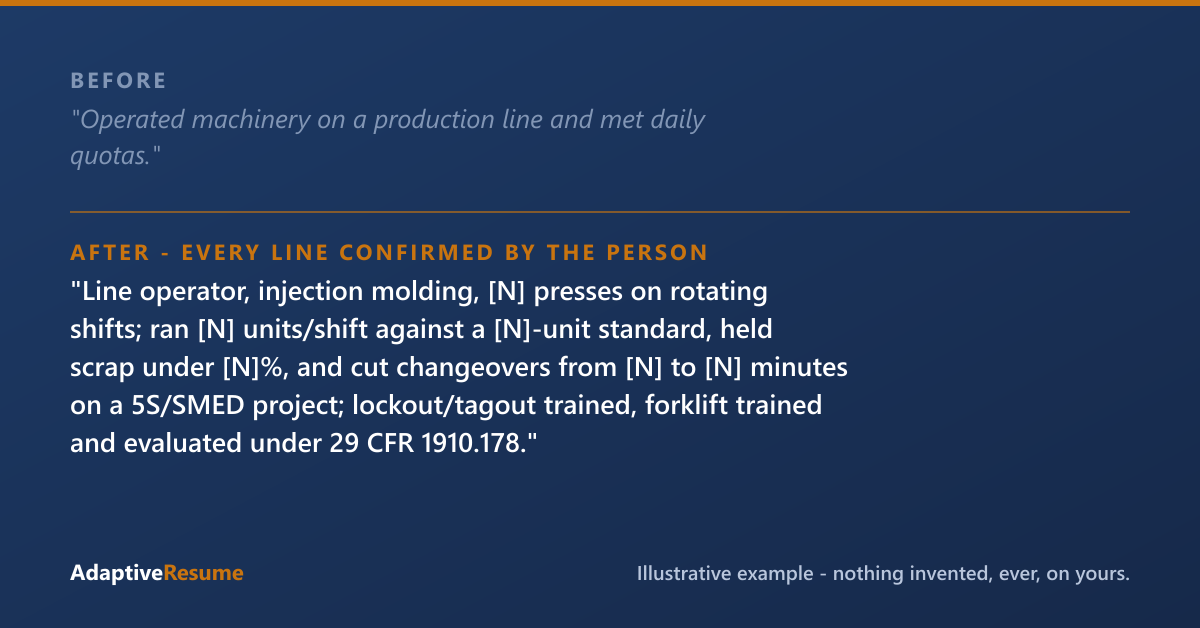
The second version is readable in a few seconds. It names the process, the scale, the rate and the standard, the scrap number, a real improvement with a before and after, and two safety items a posting can filter on. Every one of those is something you did or didn’t do — so it stays honest, and every bracket is a number only you can fill in.
The standards you already work under — write them down
This is the block most manufacturing resumes are missing. You don’t need a certificate for most of it. You need to name it.
Safety. If you hold an OSHA 10-Hour or 30-Hour General Industry card from the Outreach Training Program, list it with the year. OSHA itself says the card is not a certification — write “card,” not “certified.” Lockout/tagout under 29 CFR 1910.147 is worth its own line if you were trained on it and performed it: say what you locked out. Forklift — if your employer trained and evaluated you under 29 CFR 1910.178, you’re a certified operator at that plant, and OSHA requires a re-evaluation at least every three years; name the truck type.
Quality systems. If your plant was registered to ISO 9001:2015, you worked inside it — audits, nonconformance reports, corrective actions, calibrated gauges. Say so. Automotive plants add IATF 16949; aerospace plants add AS9100. Food and pharma run GMP — for pharma that’s FDA current good manufacturing practice under 21 CFR Part 211; for human food it’s 21 CFR Part 117, often alongside HACCP plans. Batch records, line clearances, and sanitation roles under any of these are quality-system experience and belong on the page.
Process control and lean. SPC (statistical process control) means you took measurements and plotted them against control limits — name the characteristic and the gauge. 5S, Kaizen events, lean projects, and SMED changeover work are real experience if you took part; say your role and what changed. For Six Sigma, list only a belt you actually hold, by its real name: ASQ Certified Six Sigma Yellow Belt (CSSYB), Green Belt (CSSGB), or Black Belt (CSSBB). A company-issued belt is fine to list — say so. Other real credentials if held: the SME Lean Certification (Bronze, Silver, Gold) and the MSSC Certified Production Technician (CPT 4.0).
Numbers a plant manager actually reads
Production resumes are unusually vague about output, and output is exactly what the reader wants. Pull the numbers you know:
- Units per shift against the standard or takt time you ran to.
- Scrap and rework rate — the percent you held, or the drop you helped produce.
- First-pass yield — good parts out the first time, no rework.
- OEE (overall equipment effectiveness: availability × performance × quality) if your plant shared it with the floor.
- Changeover time before and after, if you worked a SMED project.
- Safety record — shifts without a recordable on your line, if you know it.
Two true numbers beat seven adjectives. If a number is an estimate, write it as one — “about [N] units/shift” — and never one you’d have to guess at when asked.
Machines and systems — name them
Screeners filter on the specific machine and software because it maps straight to how fast you’ll be productive.
Machines by sector: CNC mills and lathes (name the control if you know it); injection molding presses (tonnage, and whether you set up or ran); assembly lines and cells (manual, semi-automated, robotic); packaging lines (fillers, cappers, labelers, case packers, palletizers); stamping, extrusion, welding cells, blending and batching in process plants. Say whether you set up, ran, or both.
Systems: the ERP or MES you logged work in is a hard filter in many postings. Name it — SAP, Oracle NetSuite, Epicor Kinetic, Plex (now part of Rockwell Automation) — and say what you did in it: clocked jobs, logged counts, recorded scrap, pulled work orders.
Production worker and factory worker resumes
If your title is production worker, production associate, factory worker, or general laborer, show a reader you’re an operator with range — with the same three things: standards, machines, numbers. “Rotated across [N] stations on the [assembly/packaging] line, held [N] units/shift, lockout/tagout and forklift trained, zero recordables in [N] years” is a strong line. Cross-training is your evidence of range — list the stations you were signed off on. Attendance and shift flexibility are real qualifications in plants; if you worked nights, weekends, or steady overtime, say so plainly.
Production supervisor resumes
Supervisor resumes get read for span, results, and safety. Span is headcount and shifts: “[N] operators across [N] lines, [N] shifts.” Results are the plant’s numbers — OEE, scrap, first-pass yield, on-time delivery, overtime hours — with what moved on your watch. Safety is your recordable rate and what you did about it: toolbox talks, near-miss reporting, audits, incident investigations. Add the people work: hiring, training matrices, cross-training plans, and the daily production meeting you ran. If you scheduled in an ERP or MES, name it. An OSHA 30-Hour card is the one supervisor postings most often ask for; list it only if you hold it.
Format notes
Length follows your history. For an operator with one plant and a short history, one strong page is right — because the history is short, not because detail should be cut. Keep the standards, machines, and numbers; cut the duty lines everyone shares (“followed safety procedures,” “worked in a fast-paced environment”) before you cut a real scrap rate.
If you’ve run several plants, held a lead or supervisor role, or moved from the floor into quality or maintenance, The honest rule: two pages is normal and expected once you have more than one substantive role to describe. A tight two pages beats a padded one. One exception: federal applications through USAJOBS cap at two pages as of the September 2025 OPM change — that’s a hard requirement, not a style preference.
Otherwise: reverse chronological, single column, a clearly labeled block for safety cards and quality systems, and skip the graphics.
A bullet bank you can adapt — keep only what’s true
- “Ran [injection molding/assembly/packaging] line, [N] units/shift against a [N]-unit standard”
- “Held scrap under [N]% and first-pass yield above [N]% on [product/part]”
- “Cut changeover from [N] to [N] minutes on a [5S/SMED/Kaizen] project; role: [team member/lead]”
- “Performed lockout/tagout under 29 CFR 1910.147 on [presses/conveyors/mixers] before clearing jams and servicing”
- “Forklift operator, [sit-down/stand-up reach], employer-evaluated under 29 CFR 1910.178, [year]”
- “Logged SPC readings on [characteristic] with [gauge]; flagged out-of-control points to the lead”
- “Worked under [ISO 9001:2015/IATF 16949/GMP 21 CFR 211]; completed [batch records/line clearances/NCRs]”
- “Supervised [N] operators across [N] lines and [N] shifts; OEE from [N]% to [N]%, [N] recordables”
What screening software looks for on a manufacturing resume
Filters commonly read for: production, line operator, machine operator, assembly, packaging, injection molding, CNC, units per shift, takt time, scrap, rework, first-pass yield, OEE, downtime, changeover, SMED, 5S, Kaizen, lean manufacturing, Six Sigma, SPC, ISO 9001, IATF 16949, AS9100, GMP, cGMP, HACCP, lockout/tagout, LOTO, OSHA 10, OSHA 30, forklift, PPE, work orders, SAP, Oracle, Epicor, Plex, MES, ERP, cross-trained, shift, and overtime. O*NET’s profile for first-line supervisors of production and operating workers has the full task and skill list, and most of it applies to leads and operators too.
The highest-risk lines are the ones that overstate scope — a belt you don’t hold, “certified” on something that was a class, or a number you’d have to walk back. Plants call the last plant. Accurate detail is both safer and stronger.
The Role Skills Checklist below helps you inventory what your floor work actually proves, which for most manufacturing workers is far more than the resume currently says. Our build does it with you: we work backwards from the lines you ran, the standards you worked under, and the numbers your shift hit, propose the safety, quality, and lean language work like yours normally involves, and ask you to confirm every line before it appears. We never add a card, a standard, or a number you didn’t tell us about.
Common questions
I never got a certificate for lockout/tagout or 5S. Can I still put them on my resume?
Yes, as long as you say what's true. Lockout/tagout, 5S, and SPC are things you were trained on and did, not credentials you hold. Write them as work — 'lockout/tagout trained and performed on [N] presses' — not as a certification. The only items that go in a credentials block are the ones with a real card or certificate behind them, like an OSHA 10-hour card, a forklift evaluation, or an ASQ belt.
Is an OSHA 10 card a certification?
No, and it's worth getting the wording right. OSHA's own guidance says an Outreach Training card is not a certification or license — it's proof you completed the 10-hour or 30-hour class. List it as 'OSHA 10-Hour General Industry card' with the year. It still matters to screeners, because plenty of postings ask for it by name.
My plant didn't share numbers with the floor. How do I show results?
Use the numbers you did see. Most operators know their units per shift, the standard they ran against, how often the line went down, and what a changeover took before and after a project. Estimates you can stand behind when asked are fine if you write them as estimates — 'about [N] units per shift' — and never a number you'd have to guess at.
Should I say 'production worker' or the title my plant used?
Keep the real title your employer used, and put the plain job under it. 'Production Associate II (line operator, packaging)' gives a screener the title they'd find on a reference check and the words a posting uses. Retitling yourself is the thing that falls apart first when someone calls the plant.
Role Skills Checklist
Pop your email in and the download unlocks right here — and being on the list before launch day locks in 25% off your first build. We'll also send the occasional useful note and tell you the moment AdaptiveResume goes live. No spam.
Download: Role Skills ChecklistThanks — you're on the launch list, your 25% is locked in, and your download is ready below.
That email didn't look right — mind trying it again?
Ready to do this on your own resume?
We'll find what you've left off and you approve every line — nothing made up.
Build your resume — $49Try the demo first — a sample review, no sign-up · See how the service works
Paid a resume service and got a template back? Start at Fix my resume.