Guides · For job seekers
How to List Promotions on a Resume (With Examples)
Promotions are the strongest proof on your resume — if the reader can see them. Here's how to show one job, two titles, without confusing anyone.
Published 07/30/2026 · Updated 08/06/2026

A promotion is the best evidence a resume can carry: another employer already bet on you and won. But many resumes bury it — two titles mashed into one entry, or split into what looks like two separate jobs. Either way, the reader misses the story. Here’s how to make the climb impossible to miss.
How to list promotions on a resume: the two-second rule
Whoever reads your resume is skimming. If your promotion takes detective work to spot, it doesn’t exist. Every format below serves that one goal: company once, titles stacked newest-first, dates on each title.
One promotion at the same company: stack the titles
Put the company on one line with your total years there, then each title with its own dates underneath.
Before (the promotion is invisible):
Shift Supervisor, Danner Logistics — 2021–2026
After (the climb is the headline):
Danner Logistics — 2021–2026 Shift Supervisor (2024–2026) Warehouse Associate (2021–2024)
Same job history, but now the reader sees three things at once: loyalty, growth, and a company that promoted you.
Multiple promotions: same ladder, more rungs
The stacked format scales. List every title, newest first, each with dates. Give your bullets to the most recent role, with one or two under earlier titles if they show something the current role doesn’t. You don’t need to repeat duties that carried upward — the reader assumes them.
Bullets that prove it was a promotion
“Promoted” is a claim; the bullet underneath is the evidence. Say what grew:
Promoted to Shift Supervisor after two years — now responsible for a crew of 9 and the site’s most error-prone dock.
Scope is the language of promotions: more people, more money, more risk handed to you. If you can put an honest number on what expanded, do it.
Title changed but the work didn’t
Reorgs rename people without promoting them. Don’t dress a re-title up as a climb — an interviewer will find the seam in one question. List the newer title and note the earlier one in plain text (“previously titled Line Lead”) if the older name helps a keyword match.
Promoted in duties but not in title
Common and frustrating: you absorbed the bigger job, the title never followed. Your resume can say exactly what’s true — “took over scheduling and vendor orders for the department (responsibilities of the lead role)” — without inventing a title you never held. The scope is real; claim the scope, not the rank.
Will an ATS (applicant tracking system) read stacked titles correctly?
Mostly yes — if you keep the ladder machine-simple:
- Each title on its own line, with its own dates. That’s the pattern parsers are built to recognize. Don’t put the ladder in a table, columns, or a text box — those are where parsing breaks.
- When the application form asks you to enter jobs one at a time, give each title its own entry there. The form is its own parser; your document’s clever formatting doesn’t carry into it. Two titles = two entries in the form, even though your resume document stays stacked.
- If a posting runs through an older system and you’re nervous, the safe fallback is repeating the company name above each title. It costs a little elegance and never costs parsing.
For what these systems actually do with your resume, see what the ATS reads.
The two mistakes that erase promotions
- Splitting one company into two entries. It reads as two short stints — job-hopping — instead of one climb. Worst possible trade.
- Only listing the final title. Clean, but it deletes the single strongest fact: they promoted you. Show the rung you started on.
The before-and-after, at a glance
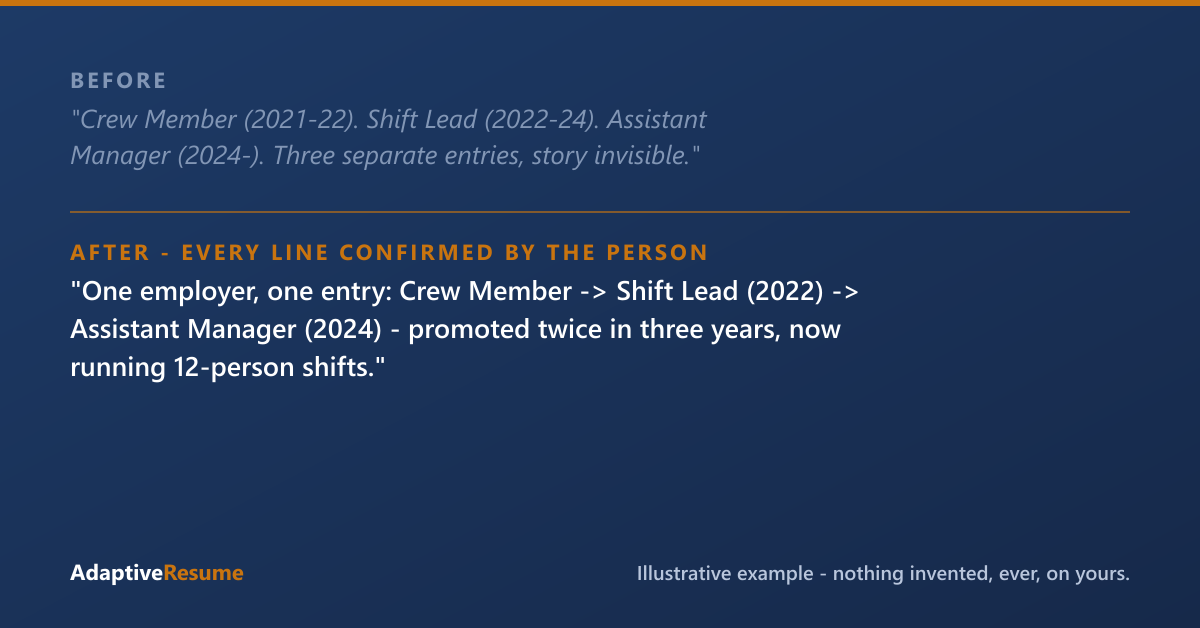
Illustrative example. On your resume, every line comes from your real history - proposed as a question, added only when you confirm it.
The Promotion-History Worksheet below walks you through it title by title: dates, what grew, and the honest number behind each step. Our build does the same thing with you — it spots multiple titles at one employer in your history and formats the climb so no reader can miss it, using only what you confirm is true.
Common questions
Do lateral moves count as promotions?
They're growth, not promotions - and worth showing when scope grew. 'Moved to the higher-volume store to stabilize a struggling team' tells a story; calling it a promotion when title and pay didn't move doesn't survive a reference check.
What if my title never changed but my duties grew?
State the scope change with its date, honestly: 'absorbed scheduling and ordering after the assistant manager role went unfilled (2023)'. Growth without the title is still evidence - and common.
How do promotions work across different companies?
Company-to-company advancement shows as increasing scope across entries - each new role's first bullet states what got bigger (team, budget, territory). The ladder reads through the numbers.
Promotion-History Worksheet
Pop your email in and the download unlocks right here — and being on the list before launch day locks in 25% off your first build. We'll also send the occasional useful note and tell you the moment AdaptiveResume goes live. No spam.
Download: Promotion-History WorksheetThanks — you're on the launch list, your 25% is locked in, and your download is ready below.
That email didn't look right — mind trying it again?
Ready to do this on your own resume?
We'll find what you've left off and you approve every line — nothing made up.
Build your resume — $49Try the demo first — a sample review, no sign-up · See how the service works
Paid a resume service and got a template back? Start at Fix my resume.