Guides · For job seekers
Diesel Mechanic Resume: ASE T-Series, DOT Inspections, Fleet Proof
Diesel mechanic resumes get read for what you're qualified to sign and what you kept running — the ASE tests you hold, the DOT inspections you perform, and the real size of the fleet behind you. How to put all of it on paper honestly.
Published 09/04/2026
Diesel repair is a documented, regulated trade, and the resume rarely shows it. A diesel mechanic — or diesel technician; postings use both words for the same work — can carry federally defined inspection qualifications, certifications that took years of tests to build, and responsibility for keeping a multi-million-dollar fleet on the road. Then the resume says “maintained and repaired trucks,” and none of it comes through.
A shop or fleet manager is trying to read two things fast: what you’re qualified to sign — ASE tests, Department of Transportation (DOT) inspection qualification, brake inspector status — and the real scope of what you kept running: how many units, what kind, on what preventive maintenance load. Put both on the page in plain numbers and real names, and your resume starts telling the truth about your value.
Lead with the fleet, the qualifications, and the trucks
Under each employer, give the context in one line before the bullets — the fleet or shop, the equipment, and what you were trusted to do.
Before: “Responsible for maintenance and repair of diesel trucks and equipment.”
After: “Maintained a [120]-unit fleet of Class 8 tractors and trailers; completed [30+] preventive maintenance services per month, diagnosed engine and aftertreatment faults with Cummins INSITE and JPRO, and performed DOT annual inspections as a qualified inspector under 49 CFR 396.19.”
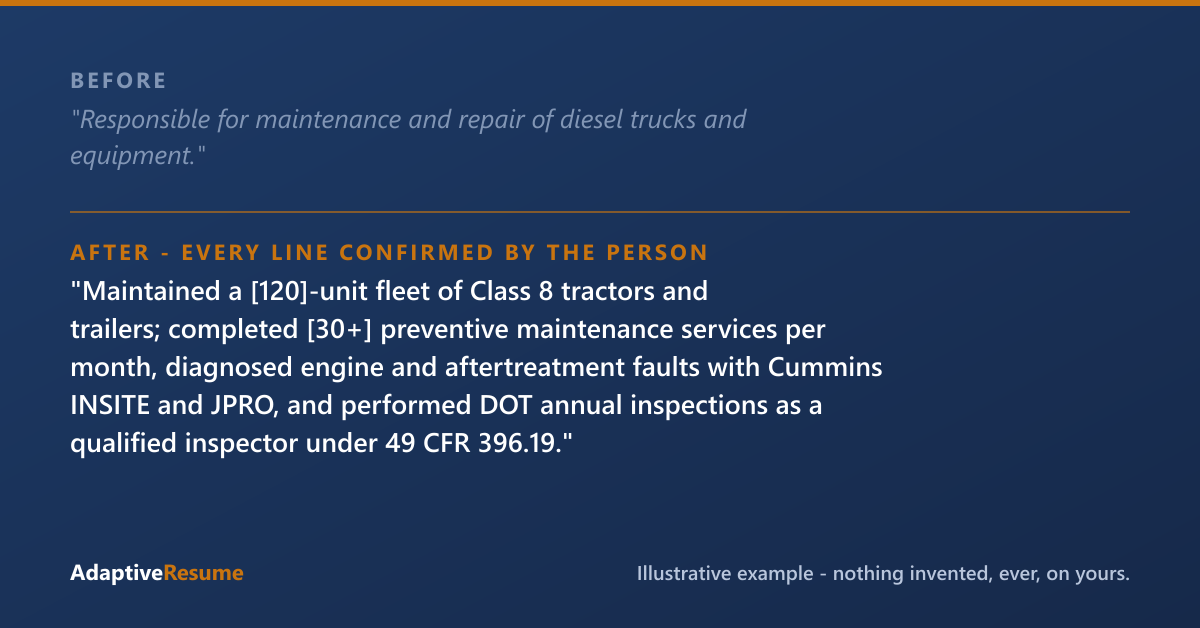
Illustrative example. On your resume, every line comes from your real history — proposed as a question, added only when you confirm it.
The second version answers in a few seconds what the first leaves a reader guessing: the size and type of the fleet, your share of the preventive maintenance load, the diagnostic software you actually run, and whether you carried inspection authority. Every one of those is something you either did or didn’t do — so the line stays honest while working far harder.
ASE T-series — list exactly what you hold
The National Institute for Automotive Service Excellence (ASE) runs a Medium-Heavy Truck test series, T1 through T8: T1 Gasoline Engines, T2 Diesel Engines, T3 Drive Train, T4 Brakes, T5 Suspension and Steering, T6 Electrical/Electronic Systems, T7 Heating, Ventilation and Air Conditioning, and T8 Preventive Maintenance Inspection.
Master status has a specific definition: technicians certified in T2 through T8 are recognized as ASE Master Medium-Heavy Truck Technicians. T1 is not required for Master status. So write it exactly as held — “ASE Master Medium-Heavy Truck Technician (T2–T8)” if you have all seven, or “ASE certified: T2 Diesel Engines, T4 Brakes, T8 Preventive Maintenance Inspection” if that’s your set. Certifications also expire — retesting comes every five years — so make sure what you list is current, and add the year if a recertification is recent.
Don’t round up. A screener can check ASE status, and “Master” claimed without the tests behind it costs more credibility than three honestly listed certifications ever could.
DOT inspections, air brakes, and the CDL
Fleet work runs under the Federal Motor Carrier Safety Administration (FMCSA), and two qualification rules are worth naming because they describe authority you may already carry.
Annual inspections. The mechanics who perform DOT annual inspections must be qualified under 49 CFR 396.19 — through a federal or state-sponsored training program or state certificate, or through at least a year of combined training and experience — and the carrier keeps evidence of that qualification on file. If you performed annuals, write the rule and the volume: “performed DOT annual inspections under 49 CFR 396.19; [N] per year.” If you did the wrench work while someone else held the qualification, describe your work accurately without claiming theirs.
Brakes. Brake inspection and repair has its own rule, 49 CFR 396.25, covering who may inspect, service, and repair brakes on commercial vehicles. Air brake work — foundation brakes, slack adjusters, chambers, valves, and the antilock braking system (ABS) — deserves specific lines, because brake competence is the thing a fleet can least afford to guess about.
The CDL. A Class A or Class B commercial driver’s license is a real plus for a diesel mechanic: it means you can road-test what you fix and move units without a driver. If you hold one, give it a line with the class stated exactly.
Engines, aftertreatment, and the software you diagnose with
Modern diesel diagnosis runs through a laptop, and shops read software names as a direct measure of how fast you’ll be productive. Name only what you’ve actually run: Cummins INSITE for Cummins engines, Detroit Diesel Diagnostic Link (DDDL) for Detroit engines, and JPRO (Noregon’s mixed-fleet tool) for working across brands. If you’ve done engine control module (ECM) parameter work or forced regenerations from the software, say so.
Aftertreatment is its own competence now, and worth naming by system: the diesel particulate filter (DPF), selective catalytic reduction (SCR) running on diesel exhaust fluid (DEF), and exhaust gas recirculation (EGR). Fault trees on these systems eat diagnostic hours across the industry, and a mechanic who can work them from the fault code to the fix — not just swap sensors — should say exactly that.
Preventive maintenance, hydraulics, and welding
Preventive maintenance (PM) is the backbone of fleet work, and it carries real numbers: services completed per week or month, the intervals you worked to (mileage- or hour-based), on-time completion, and comeback rate — how often a unit returned for the same problem. Those numbers are the fleet manager’s own scoreboard, so speaking in them reads as fluency. Only use numbers you can stand behind; a range beats an invented precision.
Hydraulics — liftgates, wet kits, power take-off (PTO) systems, cylinders and pumps on refuse and construction equipment — widens the equipment you can be assigned. Welding is a genuinely valuable adjacent skill in a truck shop: brackets, hangers, steps, and trailer repairs. Name the process you run if you have one. And if you operate a forklift in the shop or yard, the honest line is that you were trained and evaluated under 29 CFR 1910.178 — there is no national forklift license.
Fleet, dealership, or owner-operator — say which world
The settings read differently, and naming yours helps a reader place you. Fleet shops are about uptime: PM schedules, DOT compliance, quick turnarounds on a known set of units. Dealerships run deeper on one engine family — factory training, warranty procedures, flat-rate discipline — so name the original equipment manufacturer (OEM) training you’ve completed. Independent shops and owner-operator work prove range and customer judgment: many makes, no factory support, and the call on what’s worth fixing. None of these outranks the others; the resume just needs to say which one shaped you.
Format notes
Length follows your history, not a page rule. If you’ve held one substantive shop role, one strong page is right — but keep the detail that matters. Certifications, inspection qualifications, software, and fleet scope stay even when the page is tight; the generic duty lines (“followed all safety procedures”) go first.
The honest rule: two pages is normal and expected once you have more than one substantive role to describe. A tight two pages beats a padded one. One genuine exception: federal applications through USAJOBS cap at two pages as of the September 2025 OPM change — a hard requirement, not a style preference, and it matters for depot, postal, and military-transition roles.
Otherwise: reverse chronological, single column, a clearly labeled certifications block up top, and a software-and-equipment block that reads at a glance. Skip the graphics.
A bullet bank you can adapt — keep only what’s true
- “Maintained a [N]-unit fleet of [Class 8 tractors / trailers / refuse trucks / construction equipment]”
- “Completed [N] preventive maintenance services per [week/month] on [mileage/hour]-based intervals; [N%] on-time”
- “Performed [N] DOT annual inspections per year as a qualified inspector under 49 CFR 396.19”
- “Diagnosed engine and aftertreatment faults with [Cummins INSITE / Detroit Diesel Diagnostic Link / JPRO]; comeback rate under [N%]”
- “Completed [DPF / EGR / SCR] repairs and forced regenerations; [N] aftertreatment jobs per [month]”
- “Inspected, serviced, and repaired air brake systems ([foundation brakes / slack adjusters / ABS]) under 49 CFR 396.25”
- “Held ASE [Master Medium-Heavy Truck (T2–T8) / T-series tests by name]; CDL Class [A/B] for road tests”
- “Welded [process] repairs on [brackets / hangers / trailer components]; forklift-trained and evaluated under 29 CFR 1910.178”
What screening software looks for on a diesel mechanic resume
Filters commonly read for: diesel engines, preventive maintenance, DOT inspections, annual inspection, FMCSA, air brakes, ABS, aftertreatment, DPF, DEF, SCR, EGR, ECM, Cummins, Detroit Diesel, INSITE, DDDL, JPRO, electrical diagnostics, hydraulics, liftgates, PTO, welding, CDL, Class 8, fleet maintenance, ASE certified, T-series, and Master Medium-Heavy Truck. O*NET’s Bus and Truck Mechanics and Diesel Engine Specialists profile has the full task and technology list.
The highest-risk lines are the ones that overstate qualification — an ASE test you haven’t passed, inspector status you never held, or software you’ve only watched someone else run. This is a field where employers check credentials and where a working interview happens at a truck, so accurate detail is both safer and stronger.
The Role Skills Checklist below helps you inventory what your shop history actually proves — which, for many diesel mechanics, is more than the resume currently says. Our build does it with you: we work backwards from the fleets you kept running, the tests you passed, and the systems you fixed, propose the standards and software that work like yours normally involves, and ask you to confirm every line before it appears. We never add a certification, a qualification, or a piece of software you didn’t tell us about.
Common questions
Do I need ASE certification to get a diesel mechanic job?
No — there's no license requirement to work as a diesel mechanic, and plenty of shops hire on demonstrated skill. That said, ASE T-series credentials from the National Institute for Automotive Service Excellence are recognized across the industry, and a screener can match them to a posting instantly. List exactly the tests you've passed and skip the ones you haven't. Claiming Master status without holding T2 through T8 is the kind of thing an employer checks.
Can I put 'DOT qualified inspector' on my resume?
If you performed annual inspections as a qualified inspector under 49 CFR 396.19, yes — say so, and say roughly how many. The qualification comes through a training program or state certificate, or through at least a year of combined training and experience, and your employer keeps the evidence on file. Describe the real basis: 'performed DOT annual inspections under 49 CFR 396.19; qualified by [training program / N years experience].' Don't claim it if you assisted but never carried the qualification yourself.
Is a CDL worth having as a diesel mechanic?
It's a genuine plus, and worth its own line if you hold one. A Class A or Class B commercial driver's license means you can road-test the trucks you fix and move units around the yard and between facilities without waiting on a driver. Some employers list it as a requirement, others as a preference. State the class and any endorsements exactly as held — you're not claiming to be a driver, just a mechanic who can complete the whole job.
Diesel mechanic or diesel technician — which should my resume say?
They're the same job, and postings use both words. Use the title your employer actually gave you, and don't worry about the label beyond that — screening software and human readers both find you through the specifics: the engines, the software, the certifications, and the fleet. If the posting says technician and your title was mechanic, the skills section carries the match; there's no need to rewrite your history.
Role Skills Checklist
Pop your email in and the download unlocks right here — and being on the list before launch day locks in 25% off your first build. We'll also send the occasional useful note and tell you the moment AdaptiveResume goes live. No spam.
Download: Role Skills ChecklistThanks — you're on the launch list, your 25% is locked in, and your download is ready below.
That email didn't look right — mind trying it again?
Ready to do this on your own resume?
We'll find what you've left off and you approve every line — nothing made up.
Build your resume — $49Try the demo first — a sample review, no sign-up · See how the service works
Paid a resume service and got a template back? Start at Fix my resume.