Guides · For job seekers
Medical Technologist Resume: Certification, Bench, CLIA
Medical technologist resumes are read certification-first, then by bench and department. How to write yours with real ASCP or AMT credentials, the departments you've run, and the LIS you've used — plus the MLS vs MT vs MLT distinction that trips people up.
Published 08/30/2026
Lab hiring is read certification-first. Before a lead tech reads a single bullet, they look for the credential — MLS(ASCP), MT(ASCP), MLS(AMT) — and the departments you’ve actually run. A resume that says “performed laboratory testing” without naming the bench, the instruments, or the certification competes badly against one that says exactly which departments you own and what you’re certified to do.
The second thing that carries weight is scope: which benches, which analyzers, which laboratory information system, and how much volume. Lab work is concrete, and the resumes that read strongest are the concrete ones. Vague verbs cost you against candidates who simply listed what they ran.
Lead with your certification and the benches you run
Under each employer, give the context in one line before the bullets — your role level, the departments you covered, the shift, and the volume.
Before: “Performed laboratory testing and reported results accurately.”
After: “Generalist bench, 400-bed hospital lab, night shift; chemistry, hematology, coag, urinalysis, and blood bank; ~250 specimens/shift on Roche cobas and Sysmex XN, all documented in Sunquest LIS.”
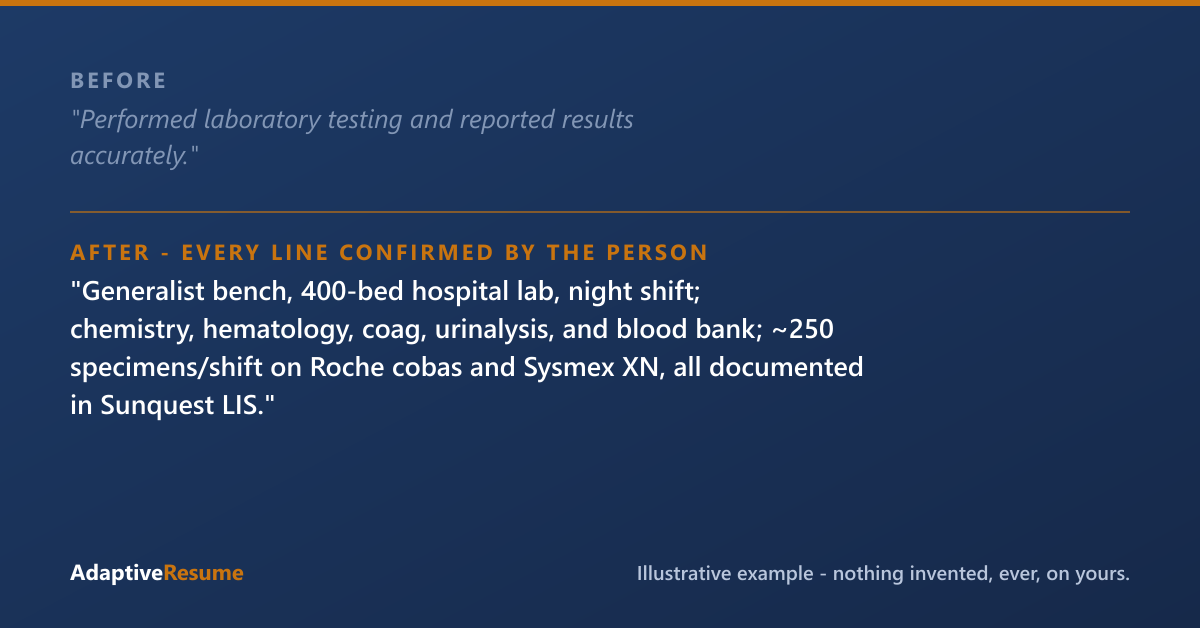
The second version is scannable in a few seconds and answers what the first leaves a reader guessing at: level, departments, instruments, volume, and the LIS. It also matches how labs describe their own openings — postings list the exact benches and analyzers they need covered, so naming yours lines you up against the requirement directly.
Certification and licensure, exactly as held
This is the part a lab checks first and the part you must get exactly right.
Certifying bodies. The ASCP Board of Certification is the largest and best known. Its current credential is MLS(ASCP) — Medical Laboratory Scientist — which replaced the older MT(ASCP) (Medical Technologist). Some longtime techs still hold and use MT(ASCP), and that’s legitimate; write whichever you were issued. The other national body is AMT (American Medical Technologists), whose current credential is MLS(AMT) — AMT announced in 2022 that its older MT(AMT) designation would become Medical Laboratory Scientist, phased in through 2023, so longtime techs may still hold and use MT(AMT). Write whichever you were issued. List the body, the credential, and the year if you have it. Categorical certifications — for example in chemistry, hematology, microbiology, or blood banking — are worth a line if you hold one, because they signal depth in a specific bench.
The MLS vs MT vs MLT line. Keep it honest. MLS and MT are the technologist-level credential (current name and older name for effectively the same track). MLT — Medical Laboratory Technician — is a different, technician-level credential, usually tied to an associate degree. If you hold an MLT, write MLT; don’t round it up to technologist. A reference check catches the difference immediately, and labs are a small enough world that they check.
State licensure. Several states license laboratory personnel — California, New York, and Florida are the ones that come up most often in postings, though other states have requirements too. If a state licenses you, list the license and its status; if a posting is in a licensure state and you’re not yet licensed there, be clear about that rather than silent.
CLIA context. The Clinical Laboratory Improvement Amendments set federal personnel standards keyed to test complexity (waived, moderate, high). You don’t need to recite the regulation, but it’s fine to note that you’re qualified to perform high-complexity testing, because that’s the standard many technologist roles are hiring against.
The departments — name them and show scope
Chemistry: analyzers you run (Roche cobas, Beckman, Abbott Architect/Alinity, Siemens), test menu, and any special assays. Volume and turnaround matter.
Hematology: CBCs and differentials, manual diffs, body fluids; instruments like Sysmex or Beckman Coulter. Coagulation often lives here too — PT/INR, PTT, and specialty coag.
Blood bank / immunohematology: type and screen, antibody identification, crossmatch, component preparation and issue, and transfusion reaction workups. This is the highest-stakes bench, so demonstrated antibody-ID work and a clean record read as real competence. Name your system — many labs run this in the LIS or a dedicated module.
Microbiology: culture setup and reading, Gram stains, susceptibility testing, and identification platforms (VITEK, MALDI-TOF, BD Phoenix). Molecular methods increasingly overlap here.
Molecular: PCR and other amplification methods, extraction platforms, and the assays you validated or ran. If you did assay validation or method verification, say so — it’s senior-level work.
Urinalysis and generalist coverage: if you cross benches on a shift, that range is an asset in smaller and night-shift labs. Write it as coverage, not as a gap.
The systems labs read for
Name your laboratory information system clearly — Sunquest, Epic Beaker, or Cerner (Oracle Health) are the ones postings ask for by name, and lab hiring treats LIS familiarity as a proxy for how fast you’ll be productive. Add middleware and analyzer interfaces if you’ve worked with them, plus any quality tools: QC review, Westgard rules, Levey-Jennings, proficiency testing (CAP surveys), and competency assessments. If you’ve supported a CAP or Joint Commission inspection, that’s a line worth having — it signals you understand the compliance side of the bench.
Format notes
Length follows your history, not a page rule. If you’ve held two or three bench roles, cross multiple departments, or moved from technician to technologist, that’s the material that puts you ahead — don’t crush it onto one page to satisfy a convention. The honest rule: two pages is normal and expected once you have more than one substantive role to describe. A tight two pages beats a padded one page. Cut duties every tech shares; keep departments, instruments, volume, certifications, and anything that shows judgment.
One genuine exception: federal applications through USAJOBS cap at two pages as of the September 2025 OPM change. That’s a hard requirement, not a style preference — relevant if you’re applying to a VA lab or another federal facility.
Otherwise: reverse chronological, single column, a department-and-instrument line under each employer, and a clearly labeled certification and LIS block near the top. Skip the graphics — lab hiring reads plain, scannable structure as professionalism.
A bullet bank you can adapt — keep only what’s true
- “Ran generalist bench across [chemistry/hematology/coag/UA/blood bank] on [shift]; ~[N] specimens/shift”
- “Performed high-complexity testing on [Roche cobas / Sysmex XN / Architect]; maintained QC per Westgard rules”
- “Resolved [N] antibody identifications and issued crossmatched components; [no transfusion errors on record]”
- “Set up and read cultures and susceptibilities; identified organisms on [VITEK / MALDI-TOF]”
- “Validated [assay] on [molecular platform]; wrote method verification documentation”
- “Reviewed daily QC and Levey-Jennings; passed [N] CAP proficiency surveys with [no unacceptable results]”
- “Documented results in [Sunquest / Epic Beaker / Cerner]; supported analyzer-to-LIS interfaces”
- “Supported [CAP / Joint Commission] inspection; maintained competency assessments for [N] test systems”
What screening software looks for on a medical technologist resume
Filters commonly read for: MLS(ASCP), MT(ASCP), MLS(AMT), MT(AMT), medical laboratory scientist, clinical laboratory scientist, high-complexity testing, CLIA, chemistry, hematology, coagulation, urinalysis, blood bank, immunohematology, antibody identification, crossmatch, microbiology, culture and sensitivity, Gram stain, molecular, PCR, quality control, Westgard rules, proficiency testing, CAP, Sunquest, Epic Beaker, Cerner, VITEK, MALDI-TOF, Sysmex, and Roche cobas. O*NET’s profile for Medical and Clinical Laboratory Technologists has the full task and skill list.
The highest-risk lines are the ones that overstate the credential — writing technologist when you hold an MLT, implying certification you don’t yet hold, or claiming a bench you only observed. Labs verify certifications directly with ASCP or AMT, and they check licensure with the state. State what’s true and let the bench work do the arguing.
The Role Skills Checklist below helps you inventory what your bench experience actually proves, which is often more than the resume currently says. Our build does it with you: we work backwards from your real departments, instruments, and systems, propose the credentials and skills that work like yours normally involves, and ask you to confirm every line before it appears. We never add a certification, a license, or an instrument you didn’t tell us about.
Common questions
Should my resume say Medical Technologist or Medical Laboratory Scientist?
Use the title on your certification and the title your employer actually gave you, and don't be afraid to show both. The ASCP Board of Certification renamed the credential to Medical Laboratory Scientist — MLS(ASCP) — and MT(ASCP) is the older designation that some longtime techs still carry. If your badge said Medical Technologist and your certification reads MLS(ASCP), write your title as it was and list the credential exactly as issued. Search filters read both terms, so having both on the page helps you rather than hurts.
Do I have to be certified to work as a medical technologist?
It depends on the employer and the state. Many hospital and reference labs require ASCP or AMT certification; some states — California, New York, and Florida among them — also require a state license to perform testing, and CLIA sets federal personnel standards for the complexity of tests you run. List what you actually hold with its real status: certification body, credential, and license number if a state requires one. If a credential is pending or an exam is scheduled, say so plainly rather than implying you already hold it.
What's the difference between an MLS and an MLT, and does it matter on a resume?
It matters, and blurring it is the fastest way to lose a reader's trust. A Medical Laboratory Scientist (MLS, formerly MT) typically holds a bachelor's degree and works at the technologist level; a Medical Laboratory Technician (MLT) typically holds an associate degree and works at the technician level. They are different credentials with different scopes. Write the one you hold, exactly as issued, and describe the work you actually did under it.
How do I show bench experience if I've mostly been a generalist?
Name the departments you rotate through and the volume you handle. Generalist experience is genuinely valuable in smaller hospitals and on off-shifts, so don't hide it — write the benches you cover (chemistry, hematology, coag, urinalysis, blood bank, micro), the instruments you run, and roughly how many specimens or shifts you carry. A clear generalist line reads as range, not as a lack of depth.
Role Skills Checklist
Pop your email in and the download unlocks right here — and being on the list before launch day locks in 25% off your first build. We'll also send the occasional useful note and tell you the moment AdaptiveResume goes live. No spam.
Download: Role Skills ChecklistThanks — you're on the launch list, your 25% is locked in, and your download is ready below.
That email didn't look right — mind trying it again?
Ready to do this on your own resume?
We'll find what you've left off and you approve every line — nothing made up.
Build your resume — $49Try the demo first — a sample review, no sign-up · See how the service works
Paid a resume service and got a template back? Start at Fix my resume.