Guides · For job seekers
Delivery Driver Resume: Stops, Vehicles, and a Clean Driving Record
Delivery driver resumes are read for the vehicle you can drive, the stops you can handle, and a record an insurer will accept. Here's how to write yours with real route numbers, the right license and medical card details, and gig or contract work listed honestly.
Published 10/11/2026 · Updated 10/30/2026
A delivery driver resume is read by a dispatcher, a station manager, or a fleet hiring coordinator who has a route to fill. They want to know which vehicles you can drive, how many stops you can handle in a day, and whether your driving record will pass their insurer. A resume that says “reliable driver with excellent customer service skills” answers none of those questions, and it reads like many other applications for the job.
Much parcel and gig delivery work is tracked stop by stop, and you likely know your own numbers well. Put the vehicle, the volume, and the record on the page.
Lead with the vehicle, the volume, and the record
Before: “Delivery driver responsible for delivering packages to customers safely and on time.”
After: “Delivery driver, [company], last-mile parcel routes: [140]-[180] stops a day in a [Ford Transit] cargo van, [98]% on-time and [99.5]% delivered without a damage claim; scanner and photo proof of delivery on every stop; [3] years without an at-fault accident.”
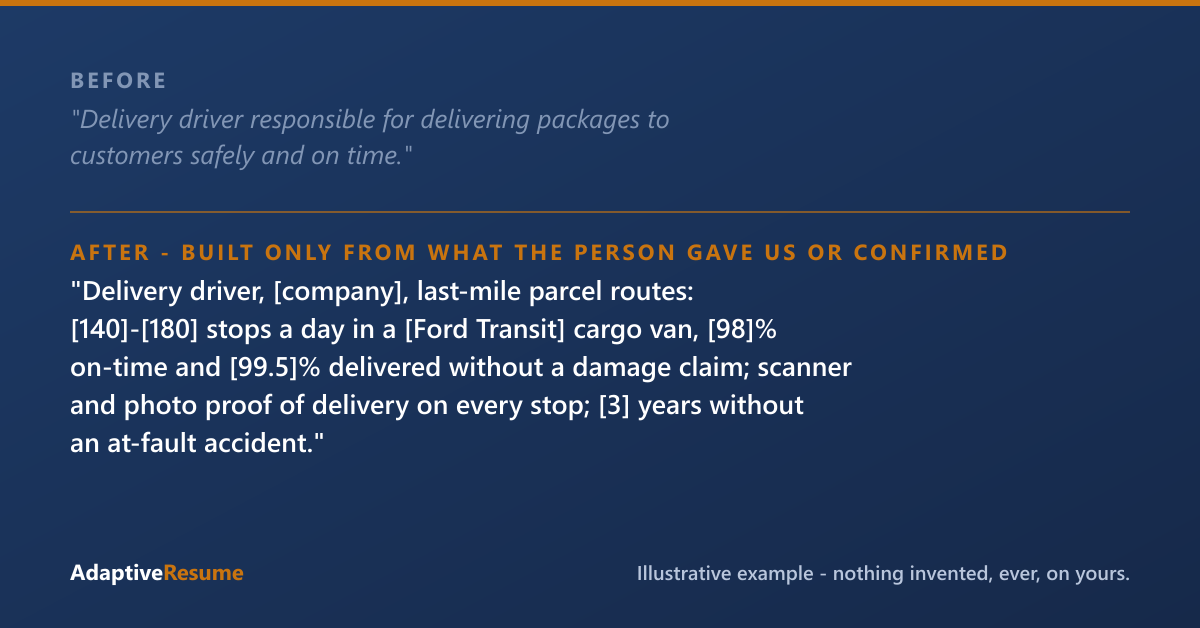
Illustrative example. Everything on your resume is yours: the experience you listed, plus the vehicles, routes, and safety training your work already involved, each added only after you confirm it’s true.
The second version tells the reader the work, the vehicle, the volume, the quality, and the safety record. Use the numbers you know from your own routes and can explain, and never copy anything out of a company’s systems.
The numbers a delivery manager reads
Stops and packages. Give your stops a day and packages a day, and say what kind of route it was: dense residential, rural, business, or apartment complexes. “170 stops a day on a dense residential route” and “60 stops a day on a rural route” are both strong lines; they just describe different work.
On-time and completion rate. Write the share of stops delivered in the promised window and the share completed without a return to the station. Many delivery companies score drivers on these, so you may have seen your own.
Delivery quality. Show damage claims, missing-package reports, and customer feedback scores if your company tracked them. A low claim rate shows that you handle freight carefully.
Route size and miles. Give daily miles, the area you covered, and whether you ran the same route or rotated, because a dispatcher plans around both.
The vehicles and the license line
Name the vehicles you have driven: cargo vans, high-roof sprinter-style vans, step vans, box trucks, or your own car for gig or courier work. If you drove a box truck, give its length or weight rating if you know it, since that tells the reader what you can handle.
Many delivery vehicles do not require a commercial driver’s license. A CDL is required for a single vehicle rated at 26,001 pounds or more, for a combination of 26,001 pounds or more when the trailer is rated over 10,000 pounds, for a vehicle that hauls placarded hazardous materials, or for one designed to carry 16 or more people, including the driver. Below that line, write the regular license class you hold and the state.
The medical card is the detail many drivers get wrong. Under FMCSA’s rules, a driver of a vehicle rated over 10,000 pounds in interstate commerce needs a valid medical examiner’s certificate, whether or not they hold a CDL. If you drove a larger box truck across state lines, you probably held one; list it with its expiration date.
Gig, contract, and partner work, listed honestly
Gig apps. List DoorDash, Uber Eats, Instacart, Amazon Flex, or similar work as independent contract work with your dates and your numbers: deliveries completed, ratings, and completion rate. Several years of steady gig delivery shows that you can manage your own time and keep a high rating without a supervisor.
Delivery service partners and contractors. Many parcel routes are run by smaller companies that contract with a large carrier or retailer. Your employer is the company that hired and paid you, so list it by name and the client beside it.
Your own vehicle. If you used your own car or van, say so. It tells a courier company you already understand the cost of the miles you drive.
Specialized delivery work
Furniture and appliance delivery. Two-person carries, stairs, in-home placement, hookup or installation, and haul-away are skills of their own. Write the products you handled and the services you performed.
Medical and lab courier work. Specimen pickups, temperature control, chain-of-custody forms, and time-critical runs matter here. List any specimen-handling or bloodborne pathogens training the company gave you, with the year.
Food, grocery, and route delivery. Temperature-controlled loads, restaurant or store accounts, and stocking or merchandising at the stop are worth naming. If you collected payments, say how you handled cash or card readers.
Safety and the driving record
Employers check your motor vehicle record, and their insurer often sets the bar for who can drive. Write what helps you: years without an at-fault accident, years without a moving violation, and any driving-safety program you completed. If your company scored driving with in-cab cameras or a driving-score app, a consistently high score is worth a line.
Drug and alcohol testing under the federal DOT rules applies to CDL drivers. Many delivery companies test non-CDL drivers under their own policy, and you do not need to list that on a resume.
Moving up from delivery driving
The lines that point upward matter: training new drivers, covering a dispatcher’s desk, running the station’s loading line, or earning a CDL. If you are working toward a Class A or Class B license, you will need Entry-Level Driver Training from a provider on FMCSA’s Training Provider Registry before your first Class A or Class B skills test, and our CDL truck driver resume guide covers how to write the license once you have it. If warehouse work is part of your history, our warehouse worker resume guide covers the loading-dock side.
Format notes
Length follows your history. A driver with one or two jobs usually fits on one page. Two pages is normal and expected once you have more than one substantive job to describe, such as several delivery companies plus gig work. Keep the vehicles, the numbers, and the record; cut the duties every driver shares.
Use reverse chronological order and a single column, and leave out graphics and photos. Large delivery companies often take applications through hiring software, and a two-column template can scramble the read. Gaps get one plain dated line, and seasonal peak work can be listed with its dates.
A bullet bank you can adapt — keep only what’s true
- “Delivered [N]-[N] stops a day on a [dense residential/rural/business] route in a [cargo van/step van/box truck]”
- “Kept a [N]% on-time rate and a [N]% damage-free rate over [N] months”
- “Completed [N] deliveries as an independent contractor on [app], [N]-star rating, [N]% completion rate”
- “Drove a [N]-foot box truck across [states]; DOT medical examiner’s certificate current through [month/year]”
- “Performed two-person furniture and appliance delivery with in-home placement and [installation/haul-away]”
- “Ran time-critical lab specimen pickups for [N] clinics; completed chain-of-custody forms on every run”
- “[N] years without an at-fault accident or moving violation”
- “Trained [N] new drivers on the route, the scanner, and proof-of-delivery steps”
What screening software looks for on a delivery driver resume
Filters commonly read for: delivery driver, courier, last-mile, package delivery, route, stops, on-time delivery, proof of delivery, handheld scanner, route app, cargo van, step van, box truck, valid driver’s license, clean driving record, MVR, DOT medical card, customer service, lifting, safe driving, two-person delivery, white glove, and the company or app names in the posting. O*NET’s profile for light truck drivers has the full task list.
Before your first route, a delivery company will usually verify your past jobs and may call your last station, so the lines most likely to cost you are a stop count your old station would not recognize, a vehicle you never drove, and gig work written as if you were an employee. Write each line so your last station would recognize it.
The Role Skills Checklist below helps you inventory what your driving history actually proves, which is usually more than the resume currently says. Our build does it with you: we work backwards from your real routes, vehicles, and years, and we ask you about the equipment, systems, and safety training that work like yours normally involves. Nothing goes on your resume that you didn’t give us or confirm, so a vehicle, a stop count, or a card you never told us about stays off the page.
Common questions
Do I need a CDL to be a delivery driver?
Many delivery jobs do not require a CDL. Cargo vans and many box trucks are rated under 26,001 pounds, which is below the line where a commercial driver's license is required, unless the vehicle hauls placarded hazardous materials or is designed to carry 16 or more people, including the driver. Write the license class you actually hold and the vehicles you have driven. If you hold a CDL, our CDL truck driver guide covers how to write it.
How do I list gig delivery work like DoorDash or Instacart?
List it as independent contract work, with the app's name, your dates, and real numbers: deliveries completed, your completion or on-time rate, and your customer rating if it is strong. Keep it honest about the arrangement. Writing 'Independent contractor, DoorDash' tells an employer exactly what the work was, and many will value the record of steady, self-managed driving.
I drove for an Amazon delivery service partner. Who do I list as the employer?
List the delivery service partner company that hired and paid you, and name Amazon as the client, for example '[Company name], Amazon delivery service partner.' That matches what an employment check will show. The same goes for drivers who worked for a contractor delivering for another carrier.
Should I put my driving record on my resume?
Put the facts that help you, such as years without an at-fault accident or a moving violation. Employers usually check your motor vehicle record, and their insurer often sets the bar, so the resume should match it. Never describe a record as clean if it is not; leave the line off and be ready to explain it plainly.
Role Skills Checklist
Pop your email in and the download unlocks right here. Joining our list also takes 25% off your first purchase within 30 days of joining, when you create your account with this same email. We'll also send the occasional useful note. No spam.
Download: Role Skills ChecklistThanks, you're on our list, and your download is ready just above. Your 25% off a first purchase is good for 30 days from the day this email joined our list.
That email didn't look right — mind trying it again?
Ready to do this on your own resume?
We'll find what you've left off, and nothing goes on your resume that you didn't give us or confirm.
Get your resume build — $29Every purchase is one payment, and nothing renews. A single resume build can be used any time within 12 months of buying it, and AR Pass builds you don't use end when its 90 days end.
Try the demo first — a sample review, no sign-up · See how the service works
Paid a resume service and got a template back? Start at Fix my resume.