Guides · For job seekers
Cyber Security Resume: Alerts, Tools, and Proof You Can Triage
Cyber security resumes get filtered on exact product names and cert status before anyone reads a bullet. How to write yours with honest triage numbers, the real cert block, and the help-desk-to-SOC story told straight.
Published 09/04/2026
Cyber security hiring runs on exact names. Screening software and the analysts reading behind it match on specific products, frameworks, and certifications — Splunk, Microsoft Sentinel, CrowdStrike Falcon, MITRE ATT&CK, Security+ — and a resume that says “monitored security systems” without naming one gets passed over for one that names three. The field’s vocabulary is unusually standardized, which means translation is unusually valuable: the work you did has an industry name, and your resume competes better when it uses it.
The second thing that separates cyber security resumes is honest numbers. Security work is heavily measured — alert queues, ticket counts, remediation deadlines — so vague bullets read as either inexperience or evasion. You don’t need dramatic numbers. You need real ones.
Lead with your scope, not your title
Under each role, give one line of context before the bullets: the team, the environment, and the volume you handled.
Before: “Monitored security alerts and escalated incidents to senior analysts.”
After: “Tier 1 analyst on a 24/7 SOC (security operations center) team of [N]; triaged ~[N] alerts per shift in Microsoft Sentinel, documented findings against MITRE ATT&CK techniques, and escalated confirmed incidents to tier 2 with host, user, and timeline attached.”
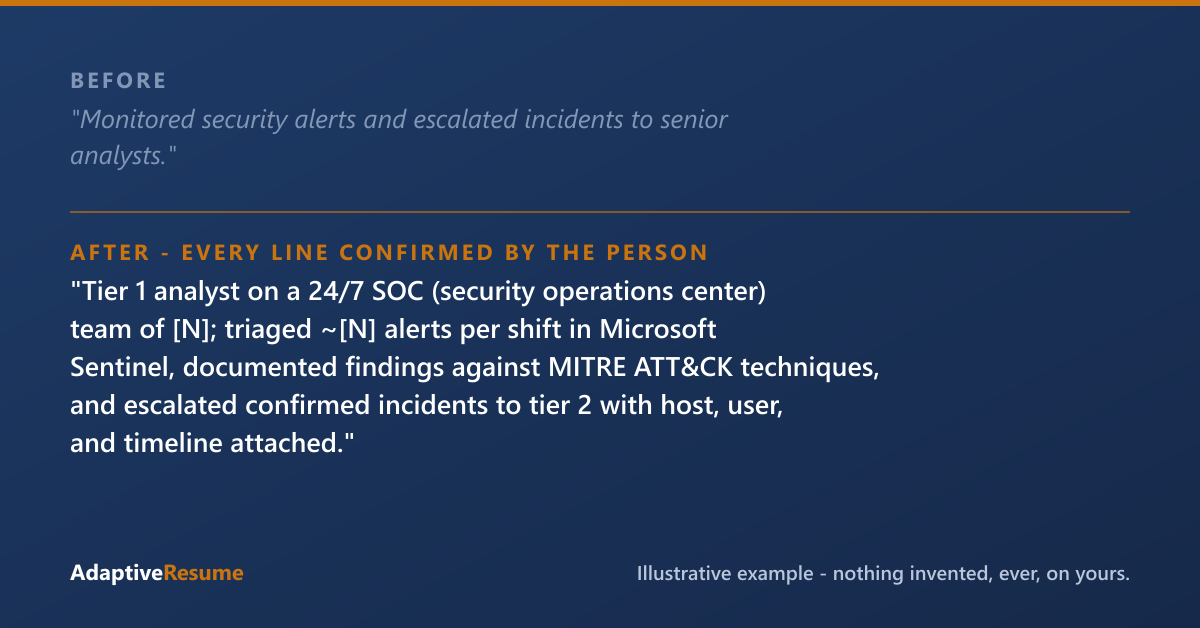
Illustrative example. On your resume, every line comes from your real history — proposed as a question, added only when you confirm it.
The second version answers the questions a hiring manager is actually asking: what queue, what tool, what volume, and whether your escalations arrive usable. Every bracket is a prompt for your real figure — never permission to invent one.
Certifications, exactly as held
Certifications carry unusual screening weight in security, so give them their own labeled block: full name, issuer, date.
- CompTIA Security+ — the standard entry filter, and the common baseline for Department of Defense (DoD) work under the DoD 8140 cyber workforce program (the successor to the older 8570 directive — you’ll still see contracts written against both).
- CompTIA CySA+ — CompTIA’s Cybersecurity Analyst cert; the step-up signal for detection and response roles.
- ISC2 CISSP — Certified Information Systems Security Professional. Requires five years of cumulative work experience in at least two of its eight domains; if you passed the exam without the experience, your real status is Associate of ISC2 — write that.
- ISC2 SSCP — Systems Security Certified Practitioner; the hands-on operations credential.
- ISACA CISM and CISA — Certified Information Security Manager and Certified Information Systems Auditor; the management and audit lanes, and the natural block for GRC (governance, risk, and compliance) work.
- GIAC GSEC and GCIH — GIAC Security Essentials and GIAC Certified Incident Handler, from the certification body associated with the SANS Institute; hands-on credentials that practitioners rate highly.
- EC-Council CEH — Certified Ethical Hacker; recognized by many screening filters for offensive-leaning roles.
In progress is worth a line if it’s true and specific: “Security+ — exam scheduled [month/year].” A bare cert name you haven’t earned is a fabrication that a credential check catches.
The tools and frameworks screening filters match on
Name what you actually worked in, exactly as the industry writes it. SIEM (security information and event management) platforms: Splunk, Microsoft Sentinel. EDR (endpoint detection and response): CrowdStrike Falcon, Microsoft Defender for Endpoint. Vulnerability scanning: Tenable Nessus, Qualys. Frameworks: the NIST Cybersecurity Framework, NIST SP 800-53 controls, MITRE ATT&CK for mapping attacker techniques, CIS benchmarks for hardening.
Two honesty rules. Name the platform you ran, not the category — “SIEM experience” invites the question “which one?” and the answer is stronger on the page. And don’t list a framework you’ve only heard named in a meeting; a first-round interviewer will ask which controls or techniques you actually worked against, and the gap shows quickly.
Cyber security analyst resume: numbers you can honestly claim
Security operations hand you figures you can defend in an interview because you saw them every shift: alerts triaged per shift, true-positive escalations, phishing reports analyzed, incidents you worked through the response lifecycle — preparation, detection and analysis, containment, eradication and recovery, and the post-incident review. If your team tracked MTTR (mean time to respond), your part in moving it is a legitimate line.
Vulnerability management has its own honest numbers: findings remediated or coordinated per cycle, scan coverage you expanded, critical-severity items closed inside the deadline your policy set. GRC work counts controls assessed, audits supported, and policies written against a named framework. If you never saw a dashboard, estimate from what you know — alerts per shift times shifts per week — and mark it approximate with a ”~”. Never quote a precise percentage you never saw.
SOC analyst resume: tiers, shifts, and escalation lines
SOC stands for security operations center, and SOC hiring wants your tier and your judgment made visible. Tier 1 is triage: state your alert volume, your escalation criteria, and what a good handoff from you contained. Tier 2 is investigation: incidents owned end to end, forensic and log analysis, containment actions you executed. If you wrote or tuned detection rules, that line carries weight at every tier — false-positive reduction is work every SOC values, and “tuned [N] noisy rules, cutting false positives on my queue by roughly [N]%” is the kind of specific, checkable claim this field rewards.
Shift reality is evidence too. Nights, weekends, and holiday rotations are part of SOC life; stating the rotation you carried tells a manager you know what the job is.
Breaking in from help desk or sysadmin work
The common path into security runs through IT support and systems administration, and that’s a resume advantage if you write it as one — you already know what normal looks like on a network, and knowing normal is a large part of detection. Translate the security work your IT jobs already contained: account lockouts and access reviews are identity and access management; patch cycles are vulnerability management; malware cleanups are incident response. Our help desk resume guide covers how to put honest ticket-queue numbers on the page, and the systems administrator guide covers writing the environment line that shows the scale you operated at — both of which carry straight into a security resume.
If you hold a security clearance from military or government work, list it with its real, current status — it’s a hard filter for a large slice of security jobs. Our government-to-private guide covers how to write cleared work honestly without breaching what you can’t discuss.
None of this is a shortcut, and nobody can promise you the jump. What the pathway framing does is make sure the security evidence you already have stops hiding inside IT-support language.
Format notes
Length follows your history, not a page rule. Two pages is normal once you have more than one substantive role to describe — and an IT-to-security progression is exactly the history that earns the second page. One genuine exception: federal applications through USAJOBS cap at two pages as of the September 2025 OPM change. That’s a hard requirement rather than a style preference.
Otherwise: reverse chronological, single column, certifications in their own labeled block, a scope line under each employer, and tools written as plain text — a parser reads “Splunk” as searchable text and reads a skill-rating bar as nothing.
A bullet bank you can adapt — keep only what’s true
- “Triaged ~[N] alerts per shift in [Splunk/Microsoft Sentinel]; escalated confirmed incidents with host, user, and timeline documented”
- “Investigated [N] incidents per [month/quarter] end to end: analysis, containment, and post-incident notes mapped to MITRE ATT&CK”
- “Tuned [N] detection rules, reducing false positives on my queue by ~[N]%”
- “Ran [weekly/monthly] vulnerability scans in [Tenable Nessus/Qualys] across [N] assets; coordinated remediation of [N] critical findings per cycle”
- “Analyzed ~[N] reported phishing messages per [week/month]; blocked senders and reset [N] compromised accounts”
- “Assessed [N] controls against [NIST SP 800-53 / CIS benchmarks]; documented gaps and tracked remediation to closure”
- “Onboarded [N] new log sources into [SIEM platform], expanding coverage to [systems]”
- “Held [clearance], active through [date]” — only if it’s real and current
What screening software looks for on a cyber security resume
Filters commonly read for: SIEM, SOC, incident response, threat detection, alert triage, EDR, vulnerability management, penetration testing, phishing analysis, log analysis, Splunk, Microsoft Sentinel, CrowdStrike, Nessus, Qualys, NIST, MITRE ATT&CK, firewall, IDS/IPS, identity and access management, risk assessment, and the cert names themselves. The Department of Labor tracks this occupation as Information Security Analysts (O*NET 15-1212.00), and its profile names Splunk and MITRE ATT&CK in its technology skills — confirmation that this vocabulary is the occupation’s real language.
The highest-risk lines are certs and clearances, because both get checked against the issuing body. Exact names, exact status, nothing assumed.
The Role Skills Checklist below helps you inventory what your shifts and projects actually prove, which is usually more than the resume currently says. Our build does it with you: we work backwards from your real queues, tools, and history, propose the platforms and frameworks that work like yours normally involves, and ask you to confirm every item before it appears. We never add a certification, a clearance, or a tool you didn’t tell us about.
Common questions
Do I need a certification to work in cyber security?
Many employers screen on one, and Department of Defense (DoD) work requires qualification under the DoD 8140 program, and an approved certification such as CompTIA Security+ is the common way to meet it. But plenty of working analysts got in on help desk or sysadmin experience plus one cert. List exactly what you hold with its issuer and date, and never list an exam you haven't passed.
Can I put CISSP on my resume if I passed the exam but don't have the experience yet?
Not as CISSP. ISC2 requires five years of cumulative paid work experience in at least two of its eight domains before granting the full credential. If you passed the exam without the experience, ISC2 designates you an Associate of ISC2 — write exactly that. It's a real, respectable status, and writing 'CISSP' instead is the kind of claim a credential check catches.
How do I write a cyber security resume when my titles were all IT support?
Write the security work inside the IT job. Password resets and account lockouts are identity and access work; patching is vulnerability management; malware cleanup is incident response. Describe it in security vocabulary under your real title — that's translation, not inflation, and it's how a lot of analysts made the move.
Should I list security tools I've only used in a home lab?
Yes — labeled as a home lab. Standing up a SIEM at home and writing detection rules against sample logs is real evidence of initiative and comfort with the tooling. 'Home lab: Splunk instance ingesting firewall and Windows event logs' is honest and worth a line. Listing the same tool as if you ran it in production is not.
Role Skills Checklist
Pop your email in and the download unlocks right here — and being on the list before launch day locks in 25% off your first build. We'll also send the occasional useful note and tell you the moment AdaptiveResume goes live. No spam.
Download: Role Skills ChecklistThanks — you're on the launch list, your 25% is locked in, and your download is ready below.
That email didn't look right — mind trying it again?
Ready to do this on your own resume?
We'll find what you've left off and you approve every line — nothing made up.
Build your resume — $49Try the demo first — a sample review, no sign-up · See how the service works
Paid a resume service and got a template back? Start at Fix my resume.