Guides · For job seekers
Pilot Resume: Certificates, Ratings, and Hours First
Aviation resumes are read in a fixed order: certificates, ratings, hours, currency. Put them where the reader looks first — and log them exactly.
Published 07/30/2026 · Updated 08/06/2026
A pilot resume is the most structured document in hiring: every reader — airline recruiter, charter chief pilot, insurance underwriter — scans for the same four things in the same order. Certificates. Ratings. Hours. Currency. A beautiful resume that buries those is worse than a plain one that leads with them.
The block that goes at the top of a pilot resume
Right under your name and contact line, before any work history:
- Certificates — exactly as the FAA words them: Commercial Pilot, Airline Transport Pilot, Certified Flight Instructor (CFI/CFII/MEI). Certificate number optional; some operators want it, so have it ready.
- Ratings — instrument, multi-engine, and any type ratings by their real designators.
- Medical — class and date. A current first-class medical is a screening item; say so plainly.
- Currency — flight review date, IPC if relevant, night/IFR currency as applicable.
This block is pure fact — which makes it the easiest section to get exactly right and the most damaging place to round up. Aviation is the one industry where your resume gets checked against logbooks and FAA records as a matter of routine. Every number must match what your logbook can show.
The hours table
Standard practice, and readers expect the format: a small table of total time, PIC, SIC, cross-country, night, instrument (actual and simulated), and multi-engine, plus time in type for anything relevant to the job. Round DOWN to the logbook, never up. If you’re between logbook audits, an honest “1,240+ (as of 07/2026)” beats a suspiciously round 1,300.
Before: “Experienced commercial pilot with extensive flight time in various aircraft.” After: a five-line hours table the reader absorbs in three seconds. In aviation, the table is the persuasion.
Work history: operations, not adjectives
For each flying job: operator, aircraft flown, operation type (Part 91/135/121, if applicable), and what the flying actually was — freight at night, medevac on call, instruction toward checkrides. Non-flying jobs stay on the page if they’re recent or explain a gap; one line each is enough.
CFI, low-time, and career-change pilots
If you’re building hours, your instructing is your experience: students soloed, checkride pass rate if you track it honestly, aircraft used. Career changers with a fresh commercial certificate: lead with the certificate block like everyone else, then let your prior career carry the professional-reliability weight — years of showing up, safety records, operational work. The certificate says you can fly; the history says you’re employable.
A&P mechanics: same logic, different block
Airframe & Powerplant certificate up top, IA if held, then aircraft types and inspection work. The certificate-first structure is identical — aviation hiring reads credentials before prose in every seat of the hangar.
Format notes
One page is the strong convention for pilot resumes; once you’ve held several flying jobs, a tight two pages is normal (and federal applications through USAJOBS — FAA and military-civilian roles — cap at two pages as of the September 2025 OPM change). Single column, no graphics — several operators run resumes through parsing software before a human sees them, and the hours table should be a simple table or aligned text, nothing decorative.
A bullet bank you can adapt - keep only what’s true
- “[N] TT / [N] PIC / [N] multi / [N] instrument - as of [month year], logbook-verified”
- “Certificates and ratings exactly as held: [Commercial ASEL/AMEL, Instrument, CFI/CFII/MEI, ATP]”
- “[Part 91/135/121] operations: [cargo/charter/instruction], including [night/mountain/international] routes”
- “Instructed [N] students; [N] passed checkrides on first attempt”
- “Clean record: no accidents, incidents, violations, or enforcement actions [if true - say nothing otherwise]“
What screening software looks for on a pilot resume
Filters read for: total time, PIC, multi-engine, instrument, type ratings by name, ATP/CTP, Part 121/135/91, CFI/CFII/MEI, turbine time, crew resource management. O*NET’s airline pilot profile has the task vocabulary; your hours block does the screening work. Every number must match your logbook - this is the one industry where they check.
The before-and-after, at a glance
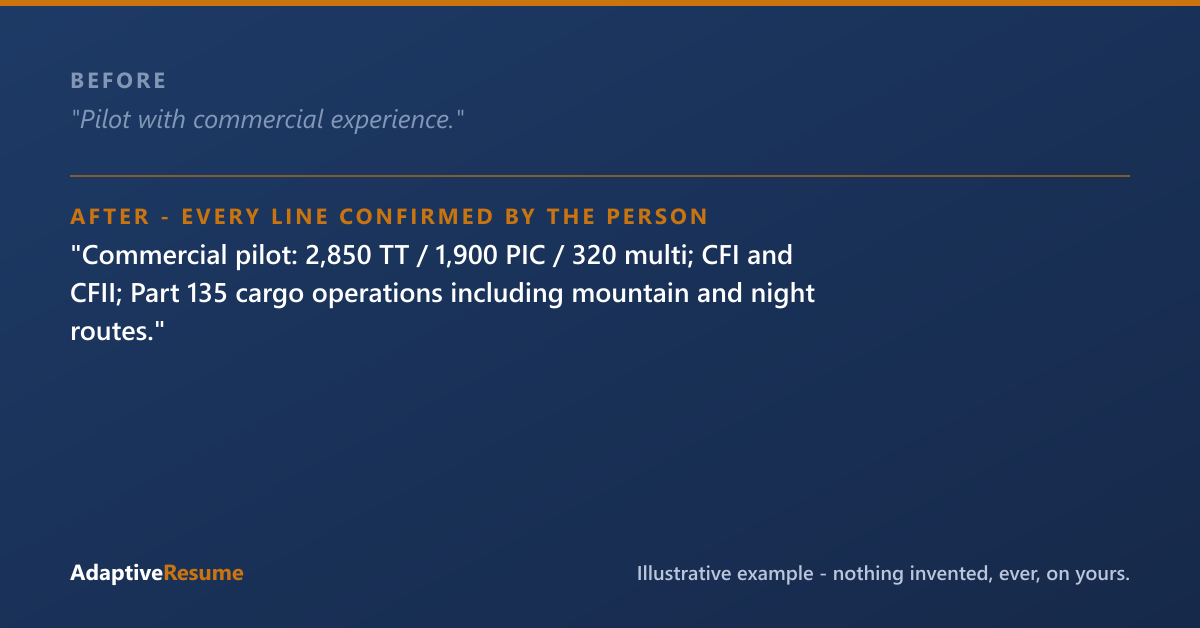
Illustrative example. On your resume, every line comes from your real history - proposed as a question, added only when you confirm it.
The Role Skills Checklist below helps you inventory what your flying history proves beyond the numbers. Our build works the same way — it reads your history, proposes what it implies, and asks you to confirm every line. In a field where claims get audited, nothing goes on the page you can’t back with a logbook.
Common questions
What goes first on a pilot resume - hours or certificates?
The block recruiters check in five seconds: total time, PIC, multi, and instrument hours, plus certificates and ratings exactly as held. Everything else follows.
How precise do flight hours need to be?
Logbook-precise at the moment of writing, then rounded honestly ('2,850 TT'). Numbers get verified against your logbook and records - a resume that overstates hours ends careers.
Do I list a checkride failure?
Not on the resume - but never hide it in interviews or applications that ask directly; airlines see the FAA record. The resume states what you hold; the application answers what it asks. Both must be true.
Role Skills Checklist
Pop your email in and the download unlocks right here — and being on the list before launch day locks in 25% off your first build. We'll also send the occasional useful note and tell you the moment AdaptiveResume goes live. No spam.
Download: Role Skills ChecklistThanks — you're on the launch list, your 25% is locked in, and your download is ready below.
That email didn't look right — mind trying it again?
Ready to do this on your own resume?
We'll find what you've left off and you approve every line — nothing made up.
Build your resume — $49Try the demo first — a sample review, no sign-up · See how the service works
Paid a resume service and got a template back? Start at Fix my resume.