Guides · For job seekers
Financial Analyst Resume: Scope, Models, and Credentials Written Right
Finance hiring reads for ownership: the budget you ran, the models you built, the cadence you kept, and credentials stated exactly the way their bodies allow. Here's how to write yours honestly.
Published 09/08/2026
Finance hiring runs on ownership. The manager reading your resume wants to know what you were actually responsible for: how big a budget, which models, and who read your work. Generic language (“responsible for financial analysis and reporting to support business decisions”) doesn’t answer that. The specifics do — the dollar size of what you owned, the cadence you kept, the systems you worked in, and your credentials stated exactly the way their governing bodies allow.
The other thing that trips up financial analyst resumes is that the title covers several different jobs. FP&A (financial planning and analysis), corporate finance, treasury, credit analysis, and equity or investment research all hire “financial analysts,” and a resume that only says “financial analyst” competes badly against one that names the lane. Say which kind of analyst you were, and what you did in it.
The scope line: what you owned in one sentence
Under each role, give one line a fellow analyst would recognize instantly.
Before: “Financial analyst responsible for budgeting, forecasting, and reporting for the company.”
After: “FP&A analyst owning the [$40M] operating budget for [three] business units; monthly variance analysis against forecast, quarterly reforecast, and the board deck; [NetSuite] and [Excel] models.”
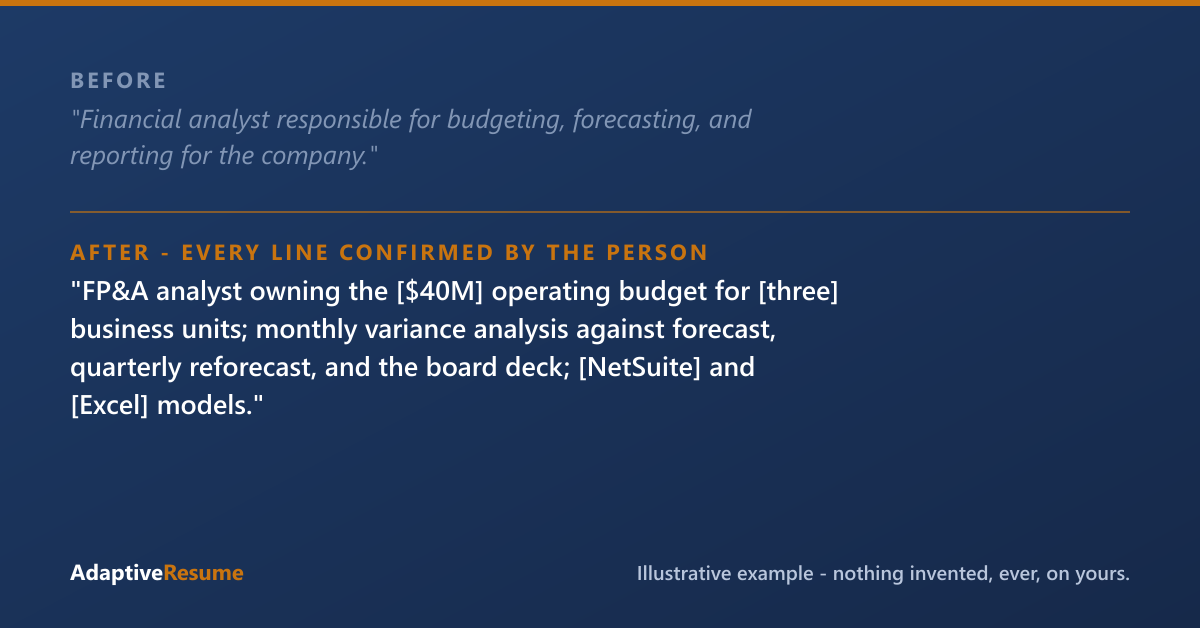
Illustrative example. On your resume, every line comes from your real history — proposed as a question, added only when you confirm it.
The second version is scannable in four seconds and answers what the first leaves a reader guessing at. Notice the rewrite invents nothing; it just says plainly what the vague version was hiding. Fill the brackets with your real numbers and systems.
Credentials, exactly as held
Every credential in finance is optional; plenty of strong analysts hold none. When you do hold one, it gets checked — so it has to be exactly right. Our guide on how to list certifications on a resume covers placement and format; here is what typically appears in a financial analyst block:
- CFA charter — the Chartered Financial Analyst designation from CFA Institute. Standard VII(B) of the CFA Institute Code and Standards governs how you may describe your status, and the Institute enforces it. Use “CFA” after your name only if you are a charterholder member in good standing. If you passed a level, state the fact: “Passed Level II of the CFA exam.” While you are registered for an upcoming exam or waiting on results you may call yourself a candidate: “Level III candidate in the CFA Program, [year].” Passed all three but not yet awarded the charter? The Standard’s own example is: “Passed all three levels of the CFA exam; eligible for the CFA charter upon completion of the required work experience.” Wording the Standard lists as not acceptable: “CFA, Level II,” “CFA, Expected [year],” and “Charter Pending” — anything that reads as a partial designation.
- CPA — the Certified Public Accountant license, issued by your state board of accountancy. Relevant in accounting-heavy finance roles. List the state and, if it’s inactive, say so — “CPA, [state] (inactive)” is honest and widely used.
- CMA — the Certified Management Accountant credential from IMA (the Institute of Management Accountants). A natural fit for FP&A and cost-analysis work.
- FMVA — the Financial Modeling & Valuation Analyst certification from Corporate Finance Institute (CFI). A training-based certification, not a license; list it as what it is.
Mid-program? Say exactly where you are. “About to have” a credential is not a credential; the honest, dated statement reads better than a claim that gets caught later.
The parts of the job that carry the most weight
Budget and forecast ownership. The single biggest signal is the size of what you owned: total budget in dollars, number of departments or business units, and whether you built the annual budget, ran the reforecasts, or both. “Supported the budget” and “owned the budget” are different jobs; write the true one.
Variance analysis and cadence. Monthly budget-versus-actual, forecast-versus-actual, and the commentary that goes with it. Name the cadence (monthly, quarterly reforecast, rolling 12-month) and who received it — that tells a reader you were the person business partners called.
Models. Three-statement models (income statement, balance sheet, cash flow), DCF (discounted cash flow) valuations, scenario and sensitivity analysis, headcount and pricing models. Say which ones you built from scratch and which you maintained. In investment research, add your coverage: sector, number of names, and whether you published or supported a senior analyst.
Month-end close support. Accruals, reclasses, account reconciliations, and the reporting package. If you sat between accounting and the business during close, say so — it’s a frequent ask.
Board and executive decks. Who read your work matters. Board decks, quarterly business reviews, and investor materials each earn a line, with the audience named.
Treasury. Cash forecasting (13-week is a frequent horizon), bank relationships, and debt covenant reporting each earn a line if they were part of your seat.
Systems. Name them: Excel (and what you do in it — Power Query, pivot tables, macros where true), SQL for pulling your own data, Power BI or Tableau for dashboards, and the ERP (enterprise resource planning system) and planning tools you worked in — SAP, Oracle, NetSuite, Anaplan, Workday Adaptive Planning. Screening software keys on the system names.
If you’re a credit analyst
Credit analysis is its own lane, and the resume should read like it. The scope line is the portfolio: dollar size, number of borrowers, and loan types (commercial and industrial, commercial real estate, consumer). Then the work:
- Spreading and ratios. Spreading financial statements, and the ratios you tested — debt service coverage, leverage, liquidity — against your institution’s policy thresholds.
- Risk ratings. The internal risk-rating scale you assigned under, and whether you recommended ratings or approved them. “Recommended” and “approved” are different jobs.
- Credit memos. Number of credit memos or annual reviews per month, the approval level you presented to (loan committee, senior credit officer), and the dollar range.
- Covenant monitoring. Cadence, number of borrowers tracked, and how breaches were escalated. If you handled watch-list or problem credits, say so — that experience is specifically filtered for.
For the approval seat on the same work, see our underwriter resume guide.
Format notes
Length follows your history, not a page rule. Two pages is normal and expected once you have more than one substantive analyst role to describe; one page is right for new graduates or first-year analysts. Order matters more than length: a short credentials block near the top if you hold one (screening software keys on it), then experience with a scope line atop each role. If you’re trimming to fit, cut older non-finance detail before you cut a single budget figure or model.
One genuine exception worth knowing: federal applications through USAJOBS cap at two pages as of the September 2025 OPM change. That’s a hard requirement, not a style preference.
Otherwise: reverse chronological, single column, standard headings, real text rather than graphics or tables. Skip charts — screening software can’t read them. Put the number in a sentence.
A bullet bank you can adapt — keep only what’s true
- “FP&A analyst owning the [$N]M operating budget for [N] business units; annual budget build and [quarterly] reforecast”
- “Delivered monthly variance analysis (budget vs. actual, forecast vs. actual) with commentary to [N] department heads and the [CFO]”
- “Built three-statement and DCF models for [acquisition/capital project/pricing] decisions; scenario and sensitivity analysis”
- “Supported month-end close: accruals, reclasses, and [N] account reconciliations; reporting package delivered by day [N]”
- “Prepared the quarterly board deck and [N] executive dashboards in [Power BI/Tableau]”
- “Credit analyst on a [$N]M, [N]-borrower [C&I (commercial and industrial) / CRE (commercial real estate)] portfolio; spread statements, assigned risk ratings, and ran quarterly covenant tests”
- “Wrote [N] credit memos per month for loan committee approval, [$N] to [$N] range”
Each bullet is a frame, not a claim. If a line isn’t true of your work, it doesn’t go on your page — an interviewer’s first follow-up question will find it.
What screening software looks for on a financial analyst resume
Corporate and bank filters read for the vocabulary of finance work, and a human reads for the same words minutes later. The terms that typically matter: financial analyst, FP&A, budgeting, forecasting, variance analysis, financial modeling, DCF, valuation, month-end close, reconciliation, GAAP (generally accepted accounting principles), cash flow forecasting, credit analysis, risk rating, covenant, Excel, SQL, Power BI, Tableau, SAP, Oracle, NetSuite, Anaplan, Workday Adaptive Planning, CFA, CPA, and CMA.
One honesty note on job codes: O*NET profiles this work under Financial and Investment Analysts (13-2051.00). Credit analysts have their own code (Credit Analysts, 13-2041.00), budget-heavy FP&A overlaps Budget Analysts (13-2031.00), and treasury and research sit inside 13-2051.00 — which is exactly why your scope line has to carry the message the code can’t. If your work leans toward data, our data analyst resume guide covers that side; if you came up through the books, the bookkeeper resume guide covers the ledger work you may be underselling.
The highest-risk lines are the ones that overstate scope — “owned” when you supported, a model you maintained written as one you built, or a credential stated in words its issuing body doesn’t allow. Finance is a checking profession, and employers check.
The Role Skills Checklist below helps you inventory what your finance work actually proves, which is often considerably more than the resume currently says. Our build does it with you: we work backwards from your real budgets, models, and systems, propose the lines and credentials that history supports — each one offered as a question, not a decision made for you — and ask you to confirm every item before it appears. We never add a credential, a budget figure, or a system you didn’t tell us about.
Common questions
How do I list the CFA on my resume if I haven't earned the charter yet?
Follow CFA Institute's Standard VII(B). If you passed a level, write the fact: 'Passed Level II of the CFA exam.' While you are registered for an exam or waiting on results you may write 'Level III candidate in the CFA Program.' Never put 'CFA' after your name until you are a charterholder, and never write 'CFA, Level II' or 'Charter Pending' as if they were a partial designation — the Standard lists those as not acceptable.
Do I need a CFA, CPA, or other credential to get a financial analyst job?
No. Many FP&A and corporate finance roles ask for a bachelor's degree and real modeling skill and nothing more. The CFA charter carries weight in investment research and asset management, the CPA in accounting-heavy finance roles, and the CMA in management accounting. If you hold one, it leads your credentials block; if you don't, your scope line and the models you have actually built carry the page.
How do I write a credit analyst resume so it doesn't read like a generic finance resume?
Name the portfolio and the decisions. Portfolio size in dollars and number of borrowers, the loan types (commercial and industrial, commercial real estate, consumer), the ratios you spread and tested, the risk-rating scale you assigned under, and how often you monitored covenants. 'Analyzed credit' says nothing; '[N]-borrower, [$N]M portfolio; spread statements, assigned risk ratings, quarterly covenant tests' says the job.
Should I list Excel on a financial analyst resume? Everyone has it.
Yes — and say what you do with it. 'Excel' alone is filler; 'three-statement models, scenario toggles, pivot tables, Power Query, and [N]-tab budget workbooks' is a skill. Add SQL, Power BI or Tableau, and your ERP and planning systems by name, because screening software keys on the system names and a hiring manager reads them for fit.
Role Skills Checklist
Pop your email in and the download unlocks right here — and being on the list before launch day locks in 25% off your first build. We'll also send the occasional useful note and tell you the moment AdaptiveResume goes live. No spam.
Download: Role Skills ChecklistThanks — you're on the launch list, your 25% is locked in, and your download is ready below.
That email didn't look right — mind trying it again?
Ready to do this on your own resume?
We'll find what you've left off and you approve every line — nothing made up.
Build your resume — $49Try the demo first — a sample review, no sign-up · See how the service works
Paid a resume service and got a template back? Start at Fix my resume.