Guides · For job seekers
Production Supervisor Resume: Crew, Shift Numbers, and the Standards Your Line Runs Under
Production supervisor resumes are read for the crew you lead, the shift numbers you own, and the quality and safety standards your line runs under. Here's how to write yours with real head counts, output, scrap, and safety figures, and the certifications plants screen for.
Published 10/05/2026 · Updated 10/30/2026
A production supervisor resume is read by a plant manager or an operations manager who thinks in shift numbers. How many people did you run, on how many lines, and what did the shift produce? What was the scrap rate, the changeover time, the overall equipment effectiveness? How many recordables? A resume that says “supervised production staff to meet daily goals” answers none of that and reads like every other supervisor resume in the folder.
A strong supervisor resume gives the crew size, the output, and the standards the line runs under, and it puts a number on the thing the supervisor improved. Those are numbers a supervisor tracks every shift, so use the ones you know from your own work.
Lead with the crew and the shift numbers
Before: “Production supervisor responsible for overseeing daily operations and ensuring production targets were met.”
After: “Second-shift production supervisor for a 22-person crew on three packaging lines: 180,000 units a shift, scrap reduced from 4.1% to 2.3% in one year, overall equipment effectiveness raised from 61% to 74%, zero recordable injuries in [N] months. Line runs under SQF and OSHA 29 CFR 1910.147 lockout/tagout.”
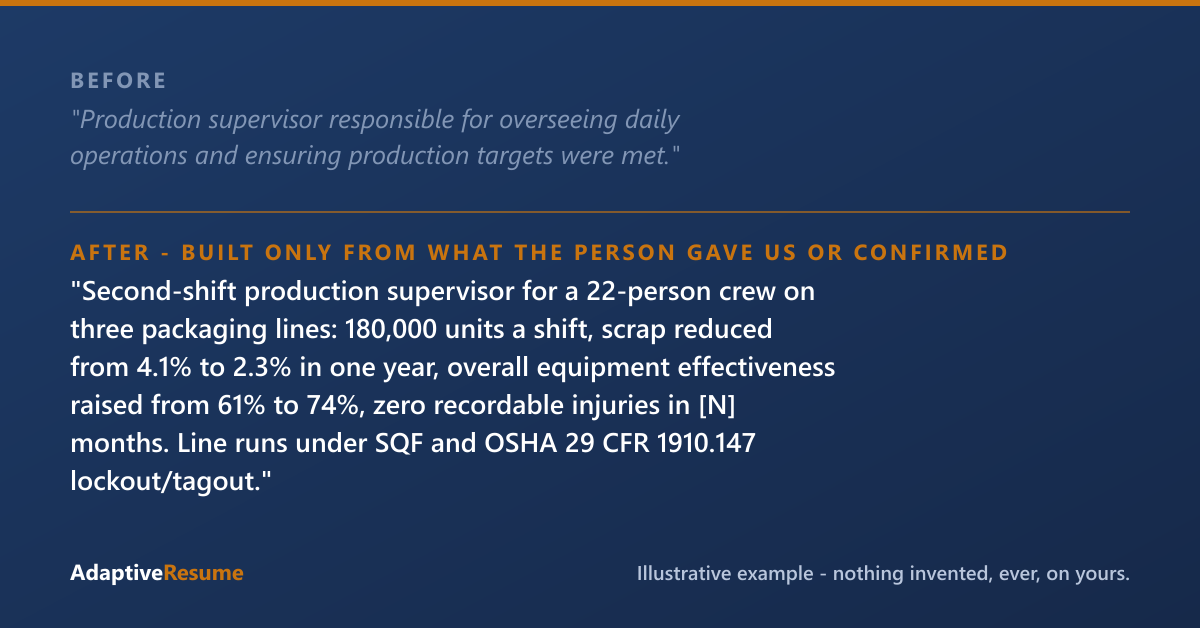
Illustrative example. Everything on your resume is yours: the experience you listed, plus the standards, systems, and safety training your work already involved, each added only after you confirm it’s true.
The second version gives the reader the crew, the equipment, the output, two improved numbers, the safety record, and the standards in one block. Use only figures you know from your own work and can explain, and never copy shift reports or plant records out of an employer’s systems.
The parts of the job that carry the most weight
Crew and shift. Give the head count, shift pattern, direct and indirect reports, and whether you handled scheduling, attendance, and performance reviews. “22 direct reports on second shift, scheduling and reviews included” is a complete answer.
Output and efficiency. Show units per shift, throughput, overall equipment effectiveness (OEE), changeover times, and on-time completion against the schedule. If your plant ran a manufacturing execution system or tracked OEE in software, name it.
Quality. Name scrap and rework rates, first-pass yield, customer complaints, and the quality system the line runs under: ISO 9001 for general manufacturing, IATF 16949 in automotive, SQF, BRCGS, or FSSC 22000 in food, current good manufacturing practice (cGMP) in pharmaceutical and medical device plants. Write the system your plant is actually certified to or regulated under.
Safety. Write the recordable incident rate, days without a lost-time injury, lockout/tagout and machine guarding compliance, safety audits, and the training you delivered. OSHA 30-hour General Industry is the card many plants list for supervisors, and it is a course-completion card rather than a certification.
Continuous improvement. List 5S, standard work, Kaizen events you led, root-cause analysis, and the result of each in a number. A supervisor who can write “led a changeover Kaizen that cut setup time from 45 to 28 minutes” has written a line a plant manager can check and remember.
People development. Count the operators you trained and cross-trained and the leads you developed, and give the turnover on your shift compared with the plant’s.
Working out the numbers from your own shifts
If your plant never handed you a scorecard, most of these numbers can be rebuilt from what you saw and did every shift. Rebuild them honestly, and label an estimate as an estimate.
Overall equipment effectiveness is availability times performance times quality: the share of planned time the line actually ran, how close it ran to its ideal speed while it was running, and the share of output that was good the first time. A line that ran 90% of planned time, at 85% of ideal speed, with 97% good parts, is at about 74% OEE. If your plant gave you an OEE figure, use it rather than your own math.
Recordable incident rate comes from OSHA’s formula: recordable injuries and illnesses times 200,000, divided by the hours your crew worked. The 200,000 stands for 100 full-time workers over a year, which is why the rate can be compared across plants of different sizes. If your safety department reported a rate for your shift, use that one.
Scrap rate is scrapped or reworked units divided by total units produced, and first-pass yield is the share that passed the first time. Changeover time is usually measured from the last good part of one run to the first good part of the next, which is how setup-reduction work counts it.
Certifications and training, exactly as held
List your OSHA 30-hour or 10-hour General Industry card with the year. List Lean and Six Sigma belts with the granting organization (an employer program, ASQ, or another body) and the year. If you operate a forklift, write that you were trained and evaluated under OSHA 29 CFR 1910.178, with the year of your last evaluation. In food plants, list food safety training such as HACCP or Preventive Controls Qualified Individual (PCQI). If you hold an APICS credential from ASCM, such as Certified in Planning and Inventory Management (CPIM), list it with the year. Training you completed without a credential is listed as training, with the provider.
Industry notes
In automotive and tier-supplier plants, name IATF 16949, the production part approval process (PPAP), layered process audits, takt time, and line balancing. In food and beverage, name SQF or BRCGS, sanitation and changeover, allergen control, washdown-rated equipment, and HACCP. In packaging and consumer goods, name high-speed lines, changeovers, and OEE. In pharmaceutical and medical device plants, name cGMP, batch records, deviations, and validated equipment. In process industries, name batch or continuous operation, control rooms, and process safety management under OSHA 29 CFR 1910.119 if your site is covered by it. Write your industry’s standards by name; a plant manager reads them as proof you have lived under them.
Format notes
Length follows your history, not a page rule. A supervisor with two plants, a promotion from lead, and a Lean project history has more that matters than one page holds. Two pages is normal and expected once you have more than one substantive job to describe. Keep the crew, the numbers, the standards, and the improvements; cut the duties every supervisor shares.
Use reverse chronological order and a single column, show a promotion as two entries under one employer, and leave out graphics and photos. If you were promoted from operator or lead, our guide on how to list promotions on a resume walks through the two-entry layout. Many plants run applications through screening software before a manager sees them, and a two-column template can scramble the read. One exception worth knowing: federal applications through USAJOBS cap at two pages as of the September 2025 OPM change.
A bullet bank you can adapt — keep only what’s true
- “Supervised a [N]-person crew on [N] [lines/cells] across [shift]; scheduling, attendance, and reviews”
- “Produced [N] units a shift against a target of [N]; on-time schedule completion of [N]%”
- “Reduced scrap from [N]% to [N]% and raised OEE from [N]% to [N]% in [N] months”
- “Led a [changeover/5S/Kaizen] event that cut [setup time/downtime] from [N] to [N] [minutes/hours]”
- “Zero recordable injuries in [N] months; delivered [lockout/tagout, machine guarding] training to [N] operators”
- “Ran the line under [ISO 9001/IATF 16949/SQF/cGMP]; passed [N] audits with no major findings”
- “Cross-trained [N] operators on [N] machines; shift turnover of [N]% against a plant average of [N]%”
- “OSHA 30-hour General Industry, [year]; Lean Six Sigma Green Belt, [organization], [year]“
What screening software looks for on a production supervisor resume
Filters commonly read for: production supervisor, shift supervisor, manufacturing, direct reports, OEE, throughput, scrap, first-pass yield, changeover, 5S, Lean, Six Sigma, Kaizen, continuous improvement, root cause, standard work, ISO 9001, IATF 16949, SQF, GMP, HACCP, lockout/tagout, OSHA 30, safety, scheduling, and the ERP or MES names in the posting (SAP, Oracle, or a plant system). O*NET’s profile for first-line supervisors of production and operating workers has the full task list.
The highest-risk lines are the ones a plant verifies through your references: a head count you did not lead, a number your last plant will not confirm, a belt you did not earn, or a safety record the plant’s log does not show. Write only the numbers your last plant would confirm.
The Role Skills Checklist below helps you inventory what your shifts actually prove, which is usually more than the resume currently says. Our build does it with you: we work backwards from your real lines, crews, and standards, and we ask you about the certifications, systems, and safety training that work like yours normally involves. Nothing goes on your resume that you didn’t give us or confirm, so a number, a standard, or a credential you never told us about stays off the page.
Common questions
I was promoted from operator or lead to supervisor. How do I show that?
Show it as two entries under the same employer, each with its own dates and its own scope, so the promotion is visible without a word of explanation. The operator entry carries the equipment and the output; the supervisor entry carries the crew, the shift numbers, and the decisions that stopped with you. Our guide on how to list promotions on a resume shows the layout.
Do I need a Six Sigma or Lean certification?
No, and many strong supervisors hold neither. What plants screen for is the practice: 5S, standard work, Kaizen events you led, and the results. If you hold a Yellow Belt or Green Belt, list it with the granting organization and the year, because belt programs are not standardized and the reader wants to know whose standard you met. If you completed Lean training on the job, list it as training.
What is the difference between a production supervisor and a warehouse supervisor resume?
The difference is in the numbers. A production resume is built on output, scrap, changeovers, overall equipment effectiveness, and the quality system the line runs under. A warehouse resume is built on orders, accuracy, throughput, and the warehouse management system. If you have supervised both, keep them as separate entries with their own numbers; our warehouse supervisor guide covers that side.
Which safety facts belong on the resume?
The ones a plant manager reports upward: the recordable incident rate on your shift, the days without a lost-time injury, the audits you passed, and the training you delivered. List your OSHA 30-hour General Industry card if you hold it, with the year. Never state a safety record your last plant would not confirm.
Role Skills Checklist
Pop your email in and the download unlocks right here. Joining our list also takes 25% off your first purchase within 30 days of joining, when you create your account with this same email. We'll also send the occasional useful note. No spam.
Download: Role Skills ChecklistThanks, you're on our list, and your download is ready just above. Your 25% off a first purchase is good for 30 days from the day this email joined our list.
That email didn't look right — mind trying it again?
Ready to do this on your own resume?
We'll find what you've left off, and nothing goes on your resume that you didn't give us or confirm.
Get your resume build — $29Every purchase is one payment, and nothing renews. A single resume build can be used any time within 12 months of buying it, and AR Pass builds you don't use end when its 90 days end.
Try the demo first — a sample review, no sign-up · See how the service works
Paid a resume service and got a template back? Start at Fix my resume.