Guides · For job seekers
Operations Manager Resume: P&L, Headcount, and Throughput
Operations manager resumes are read for the size of what you ran: the P&L or budget you owned, the people, the sites, the throughput, and the safety and cost numbers that moved. Here's how to write yours honestly, with worked examples by setting.
Published 09/09/2026
An operations manager resume is read for size and results before anything else. Size means the operation you ran: the P&L or budget, the headcount under you, the sites or shifts, and the volume that moved every day. Results means what changed while you ran it: on-time delivery, throughput, inventory accuracy, the safety rate, and the cost you took out. “Oversaw daily operations and led a team to meet company goals” gives a reader none of that. Put the size and the results in the first three lines under each role and the rest of the page has something to stand on.
“Operations manager” is also a title that stretches across very different jobs: a 400-person distribution center on three shifts, a plant with an OEE target, a region of twelve service branches, or a ten-person company that promoted the title without promoting the job. Nothing on the title line separates them. The scope line under each role has to do it: setting, budget, people, volume, and what moved.
The scope line: your operation in one sentence
Under each role, give one line another operations manager would recognize instantly: what the operation was, what you owned, and what moved.
Before: “Operations manager responsible for overseeing daily operations and leading a team to meet company goals.”
After: “Operations Manager, [N]-door distribution center; owned $[N]M annual operating budget, [N] direct and [N] indirect reports across [N] shifts; shipped ~[N]K units/day at [N]% OTIF, inventory accuracy [N]%, TRIR [N] (down from [N]); SAP and Manhattan WMS.”
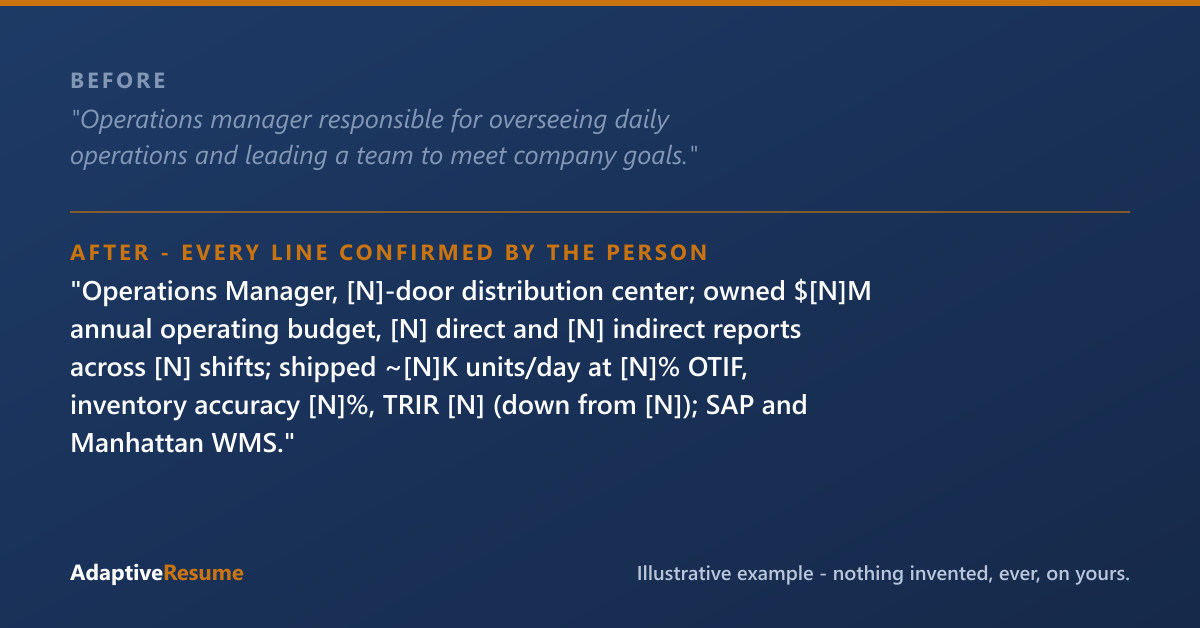
Illustrative example. On your resume, every line comes from your real history — proposed as a question, added only when you confirm it.
Read the second version the way an ops director reads it: budget, people, shifts, volume, service level, safety, systems — every question they would have asked in the first five minutes, answered before the bullets start. Nothing in it is new; it is the same job with the numbers left in. Fill the brackets from your own reports, not memory — a hiring manager can and will ask how you got each number.
Office manager, supervisor, or operations manager: draw the line once
Office manager work runs a workplace; operations manager work owns a process, a P&L, or a site, and usually the supervisors under it. If your job was the first, our office manager resume guide is the right page. If you ran a shift or a crew inside someone else’s building, the warehouse supervisor guide, the production supervisor section of the manufacturing resume guide, and the maintenance supervisor guide cover that level. This page is for the person the supervisors report to.
The numbers an operations resume is read for
Every setting has its own scorecard, but the same measures show up on nearly every operations review. Give the ones you owned, with the direction they moved.
Budget or P&L. The annual operating budget in dollars, and what was in it: labor, freight, supplies, maintenance, occupancy. If you owned the full site P&L, say so and give revenue or cost of goods. If you owned a cost center inside it, say that instead. Only the accurate one survives an interview.
Headcount. Direct reports (the supervisors and leads who reported to you) and indirect reports (everyone under them). “[N] direct / [N] indirect across [N] shifts” is the shape a reader expects. Add temp or agency labor at peak if you managed it.
Sites, shifts, and throughput. Buildings, branches, or lines; shifts; whether the operation ran 24x7. Square footage and dock doors are fair scale numbers for a distribution center; lines and annual units for a plant. Then the volume: units, orders, cases, pallets, or loads per day, in whatever unit your operation counted.
On-time delivery. OTIF (on-time-in-full, the share of orders delivered complete and by the promised date) is a standard measure in distribution and 3PL (third-party logistics) work. Give the rate and the period, and whether it was a customer’s scorecard or your own.
OEE. Overall equipment effectiveness, the plant measure that multiplies availability, performance, and quality into one percentage. If a line’s OEE moved while you ran it, that is one of the strongest lines on a plant operations resume.
Safety. TRIR (total recordable incident rate) is the OSHA (Occupational Safety and Health Administration) recordable-injury count normalized to 200,000 hours worked, roughly 100 full-time people for a year. Give your site’s rate and the prior year’s, and say if you also tracked DART (days away, restricted, or transferred) cases.
Cost-out and inventory. Dollars saved and the mechanism: a freight renegotiation, a labor model change, a Kaizen event that took a step out of the process. “Reduced costs” without a mechanism reads as filler. For inventory, give cycle-count accuracy as a percentage and shrink as a percentage of inventory value.
Our guide on quantifying resume bullets covers numbers you only have approximately; a rounded figure with a tilde beats a blank.
Systems and methods, named
Screening software and hiring managers both filter on product names, not on “proficient in ERP and WMS.” Name the ones you ran, at the depth you used them; configuring SAP is a different claim from running reports in it.
- ERP (enterprise resource planning): SAP S/4HANA (or the older SAP ECC), Oracle NetSuite, Oracle Fusion Cloud ERP, Microsoft Dynamics 365 (Business Central, or Supply Chain Management for larger operations). Say which module you lived in: production planning, materials management, order-to-cash.
- WMS (warehouse management system): Manhattan Active Warehouse Management, Blue Yonder Warehouse Management, SAP EWM (Extended Warehouse Management), and Infios (the company formerly called Körber Supply Chain Software, whose WMS came from HighJump). If your building still calls it Körber or HighJump, write the name on the login screen and add the current one in parentheses.
- Other floor systems: an MES (manufacturing execution system), CMMS (computerized maintenance management system), labor management system, or TMS (transportation management system), each by name if you owned it.
- Improvement methods: Kaizen events led (count them), 5S (the workplace organization method) rollouts, standard work written, value stream mapping, SMED (single-minute exchange of die) changeover projects, Gemba walks, daily tier meetings. Write the result next to the method: “5S rollout across [N] cells; changeover from [N] to [N] minutes.”
Certifications: all optional, and named by the body that issued them
None is required, and a resume with none of them and strong numbers beats one with three and vague scope. Where you hold one, name it exactly as the issuing body does. Our guide on how to list certifications on a resume covers placement; here is what typically appears on an operations manager page:
- APICS CPIM (Certified in Planning and Inventory Management) and APICS CSCP (Certified Supply Chain Professional), both from ASCM (Association for Supply Chain Management, formerly APICS). CPIM is the planning-and-inventory credential; CSCP is the end-to-end supply chain one. Distribution and logistics people may instead hold the APICS CLTD (Certified in Logistics, Transportation and Distribution).
- Lean Six Sigma belts. The public credentials are ASQ’s (American Society for Quality) Certified Six Sigma Green Belt (CSSGB) and Certified Six Sigma Black Belt (CSSBB), and the IASSC Certified Green Belt (ICGB) and IASSC Certified Black Belt (ICBB), now issued by PeopleCert (which acquired IASSC, the International Association for Six Sigma Certification, in 2020). A belt earned through your employer’s internal program is real experience but not a public credential; write it as “Green Belt, [company] program, [year]” so no one has to guess.
- PMP (Project Management Professional) from PMI (Project Management Institute), if you hold it; common where you ran site launches or system implementations.
- OSHA 30-hour Outreach Training card (general industry for plants and DCs, construction where that applies). It is a course-completion card, not a certification or a license — OSHA says so itself — so write “OSHA 30-hour General Industry, [year]”, never “OSHA certified.”
- Forklift. If you ran a distribution center and were yourself trained and evaluated under OSHA 29 CFR 1910.178(l), say so; the standard requires an operator evaluation at least every three years, so give the year.
Never list a certification you started but did not finish as if you hold it. “CSCP candidate, exam scheduled [month year]” is honest and reads fine; “CPIM” or “CSCP” alone, when you aren’t certified, does not. (CPIM has been a single exam since 2023, so there is no “Part 1” to list any more.)
Operations manager resume examples by setting
The same scope-line pattern works everywhere; the numbers change. Four settings, one line each, all brackets.
Manufacturing plant. “Operations Manager, [N]-line [product] plant; [N] direct / [N] indirect on [N] shifts; OEE on the [N] bottleneck lines from [N]% to [N]% in [N] months; scrap held under [N]%; TRIR [N]; SAP S/4HANA production planning.”
Distribution center or 3PL. “Operations Manager, [N] sq ft [3PL / retail] DC serving [N] client accounts; $[N]M operating budget; ~[N]K orders/day peak at [N]% OTIF; inventory accuracy [N]% on daily cycle counts; Manhattan WMS; seasonal ramp of [N] agency associates.”
Multi-site services or retail. “Regional Operations Manager, [N] locations in [N] states; $[N]M combined revenue; [N] site managers reporting; labor as a percent of sales from [N]% to [N]%; audit pass rate [N]%; rolled out [system] across all sites.”
Branch or field operations. “Branch Operations Manager, [N] technicians and [N] dispatchers; ~[N] service calls/week; first-visit completion [N]%; fleet of [N] vehicles; cut overtime [N]% by rebuilding the routing model.”
Moving up from assistant operations manager or supervisor
Lead to supervisor to assistant manager to manager is a common story on these resumes. Give each title its own dated entry and scope line, so the growth in headcount and budget reads down the page. Manager-level work you did before you had the title — the labor budget you built, the peak plan you ran, the [N] weeks you covered the site — goes under the role you held, with the result. Our guide on how to list promotions on a resume covers how to stack titles under one employer without hiding the progression.
Format notes
Length follows your history, not a page rule. Two pages is normal and expected once you have more than one substantive operations role to describe; one page is right for a first supervisor-to-manager move. Order matters more than length: a scope line at the top of every role, then three to six result bullets, then a short systems-and-methods block. If you’re trimming, cut duties every operations manager shares before you cut a single number.
One genuine exception worth knowing: federal applications through USAJOBS cap at two pages as of the September 2025 OPM change. That’s a hard requirement, not a style preference.
Otherwise: reverse chronological, single column, standard headings, real text rather than graphics or tables. Skip the dashboard screenshots; the numbers in plain text are what get read.
A bullet bank you can adapt — keep only what’s true
- “Ran [site type] operations across [N] shifts: $[N]M annual operating budget, [N] direct and [N] indirect reports”
- “Delivered [N]% OTIF on ~[N]K orders/day for [N] accounts; held inventory accuracy at [N]% through daily cycle counts in [WMS]”
- “Raised OEE on [N] lines from [N]% to [N]% through [SMED / standard work / Kaizen]; scrap under [N]%”
- “Cut TRIR from [N] to [N] over [N] months; led weekly safety walks and closed [N] corrective actions”
- “Took $[N]K out of annual cost via [freight renegotiation / labor model / process change]; result held [N] quarters”
- “Owned [SAP / Oracle NetSuite / Dynamics 365] [module] for the site; led go-live of [WMS] with [N] days of shipping disruption”
Each bullet is a frame, not a claim. If a line isn’t true of your operation, it doesn’t go on your page.
What screening software looks for on an operations manager resume
Filters read for the vocabulary of running an operation, and a hiring manager reads for the same words minutes later. The terms that typically matter: operations management, P&L, operating budget, direct reports, multi-site, throughput, OTIF, on-time delivery, OEE, TRIR, safety, cost reduction, inventory accuracy, continuous improvement, Lean, Six Sigma, Kaizen, 5S, standard work, ERP, SAP, Oracle, NetSuite, Dynamics 365, WMS, Manhattan, Blue Yonder, 3PL, distribution, logistics, labor planning, and vendor management.
One honesty note on job codes: O*NET profiles this work under General and Operations Managers (11-1021.00). That one code covers everything from a store manager to a plant GM, which is exactly why your setting, your scope line, and your numbers have to carry the message the code can’t.
The highest-risk lines overstate ownership: a P&L you reported into written as yours, a site’s headcount written as your direct reports, a company belt written as a public certification, a supervisor job relabeled as manager. Operations is a reference-checked field, and every one of those is a phone call away.
The Role Skills Checklist below helps you inventory what your operation actually proves, which is often considerably more than the resume currently says. Our build does it with you: we work backwards from your real budget, headcount, sites, throughput, and systems, propose the lines that history supports — each one offered as a question, not a decision made for you — and ask you to confirm every item before it appears. We never add a number, a system, or a certification you didn’t tell us about.
Common questions
Do I need a certification to be an operations manager?
No. Operations manager is not a licensed role, and many people in it hold no certification at all. What gets read first is scope: the budget or P&L you owned, the headcount, the sites, and the throughput, safety, and cost numbers that moved while you ran them. If you hold something real — an APICS CPIM or CSCP through ASCM, an ASQ Six Sigma belt, a PMP, an OSHA 30 card — list it with its true status and date. If your Green Belt came from a company program, write it that way: 'Green Belt, [company] program, [year]'.
Can I just use an operations manager resume sample and change the numbers?
Use a sample for shape, never for substance. The lines that carry an operations resume are the ones a reference check or a plant tour would confirm: your real budget, your real headcount, your real OTIF or OEE or TRIR, the system you actually ran. A sample's numbers belong to someone else's building. Fill the brackets from your own reports — the monthly ops review, the P&L pack, the safety dashboard — and leave off any line you can't back up.
I never owned the full P&L — just a cost center budget. What do I write?
Write exactly that, with the number. 'Owned $[N]M annual operating budget (labor, supplies, freight)' is a strong, honest line. 'Contributed to a $[N]M P&L' or 'managed labor spend of $[N]M within a $[N]M site P&L' is also honest and still gives a reader the scale of the operation. What doesn't work is writing 'P&L responsibility' for a budget you tracked but didn't own — a hiring manager will ask what was in it, and the answer will show.
I'm an assistant operations manager or a supervisor. How do I write scope I didn't fully own?
Write your slice and the whole it sat inside. 'Ran second shift ([N] people, [N] units/night) inside a [N]-person, [N]-shift distribution center' is accurate and shows both what you owned and the scale you operated in. Add the manager-level work you actually did — a budget line you built, a Kaizen event you led, a shift you covered for the manager — each with a real result. Don't relabel the supervisor job as manager; let the numbers argue for the step up. Our guide on listing promotions covers the climb line by line.
Role Skills Checklist
Pop your email in and the download unlocks right here — and being on the list before launch day locks in 25% off your first build. We'll also send the occasional useful note and tell you the moment AdaptiveResume goes live. No spam.
Download: Role Skills ChecklistThanks — you're on the launch list, your 25% is locked in, and your download is ready below.
That email didn't look right — mind trying it again?
Ready to do this on your own resume?
We'll find what you've left off and you approve every line — nothing made up.
Build your resume — $49Try the demo first — a sample review, no sign-up · See how the service works
Paid a resume service and got a template back? Start at Fix my resume.