Guides · For job seekers
How to Tailor Your Resume to a Job Description (Honestly)
Tailoring isn't rewriting your history — it's leading with the parts of it this job actually asks for. How to read a JD, mirror its real vocabulary, and reorder what's true.
Published 08/11/2026
You found a posting that genuinely fits, and now you’re staring at your resume knowing it was written for nobody in particular. Tailoring is how you fix that — and it has a bad reputation it doesn’t deserve, because most advice makes it sound like keyword-stuffing. Done honestly, tailoring your resume to a job description changes almost no facts at all. It changes which facts lead, and what words carry them.
Read the job description like a grader
Before touching your resume, sort the JD (job description) into two piles:
- Must-haves — the requirements the employer will actually screen on. They hide in plain sight: anything repeated more than once, anything in the first three bullets, anything with a number attached (“3+ years”), any named credential, license, or system, and everything under “Requirements” rather than “Nice to have.”
- Nice-to-haves — everything else: the wish-list items, the “familiarity with” lines, the culture adjectives.
Many postings have three to six real must-haves. Write them down as a literal list — that list is your grading rubric, because it’s the employer’s.
Mirror the JD’s vocabulary — where it’s true
Employers and screening software search for their words, and the same work goes by different names in different shops. If you write “client onboarding” and the JD says “customer implementation,” a keyword search misses you even though you’re a match.
So, for each must-have you genuinely meet: use the JD’s exact term for it, and keep your original term too if it’s the industry-standard one. This is translation, not invention. The line you may never cross: adding a term for something you haven’t done. The keyword gets you found; the human reading two minutes later checks whether it’s true, and an interview built on a pasted keyword collapses in the first five minutes.
Reorder so the relevant material leads
This is the most underused tailoring move, and it’s pure honesty — nothing changes but sequence:
- Within each job, move the bullets that hit this JD’s must-haves to the top. Recruiters skim the first bullet or two of each role; make those the ones that answer this posting.
- In your skills section, put the JD’s must-have skills first, not alphabetical order.
- In your summary, name the two or three strongest matches between your history and their requirements — specifically, not “results-driven professional.”
A worked mini-example
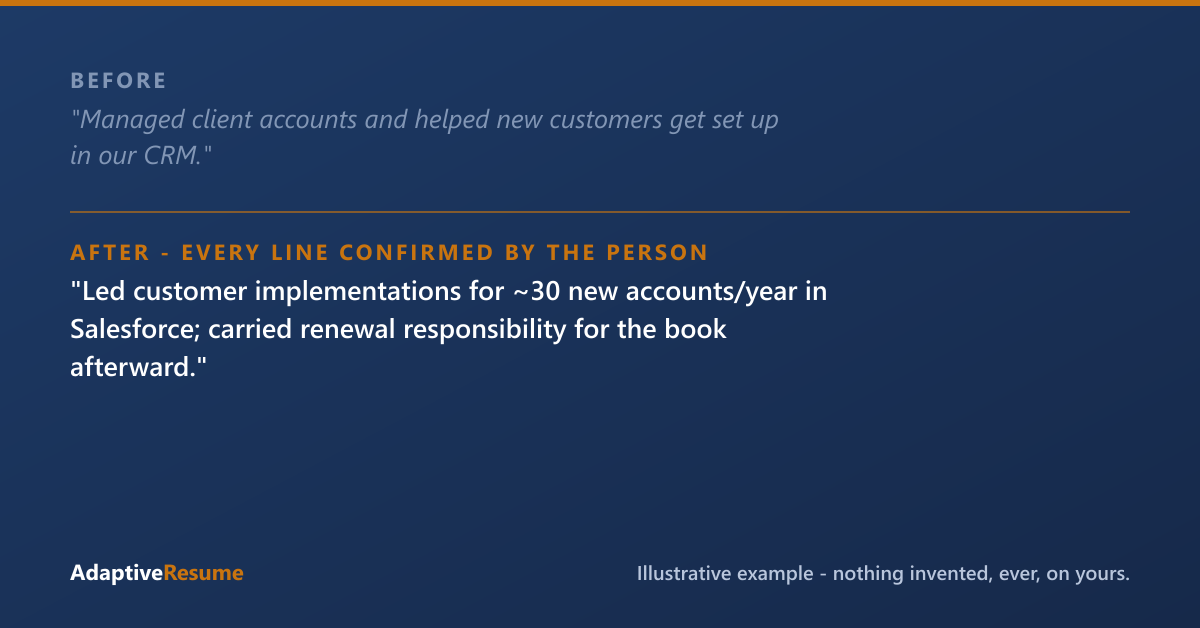
Illustrative example. On your resume, every line comes from your real history - proposed as a question, added only when you confirm it.
The JD’s must-haves: customer implementation, Salesforce, renewal retention. The candidate has done all three — but her resume says it in her old company’s dialect.
Before: “Managed client accounts and helped new customers get set up in our CRM.”
After: “Led customer implementations for ~30 new accounts/year in Salesforce; carried renewal responsibility for the book afterward.”
Every fact in the rewrite was already hers: the setups were implementations, the CRM was Salesforce, she owned renewals. The tailoring supplied zero new claims — it swapped her shop’s vocabulary for the JD’s and put the load-bearing terms where a skim finds them. That’s the entire method.
The honest limits of tailoring a resume to a job description
Tailoring rearranges and renames what’s true. It cannot manufacture a match that isn’t there — and it shouldn’t try:
- A missing must-have stays missing. Show your closest real experience and let the gap be visible. Some gaps are survivable; a discovered stretch never is.
- Vocabulary mirroring has a floor. If you have to squint to call what you did by their term, don’t. “I configured user accounts” is not “systems administration.”
- Don’t tailor your titles. Your job title is a checkable fact — reference calls and background checks compare it. If your real title undersold the work, keep the title and let the bullets carry the truth.
If honest tailoring can’t produce a decent match against the must-have list, that’s information too: your time is better spent on the next posting.
How we tailor a resume to a job description with you
This is exactly what our targeted build does. You give us the posting; we work backwards from what your work actually involved, line up your real history against the JD’s must-haves, and propose the vocabulary and reordering — as questions, not edits. “You wrote ‘set up new customers’ — was that what this posting calls implementation?” If yes, it goes in using their words. If no, it doesn’t, and the gap stays honest. Nothing lands on the page without your say-so, so every line survives an interview. The JD-to-Resume Tailoring Worksheet below walks the same passes on paper.
Common questions
Do I really need a different resume for every job?
Not a rewrite — an adjustment. The facts stay the same; what changes is which of them lead, and whether your wording matches the vocabulary this employer searches for. A short, focused pass per posting covers it for many applications.
Is it okay to copy keywords straight from the job description?
Yes — when the keyword names something you've genuinely done, use the JD's exact wording for it. What's not okay is pasting in terms for skills you don't have. The keyword gets you found; the human reading next checks whether it's true.
What if I'm missing one of the must-have requirements?
Don't paper over it. Lead with the requirements you do meet, show the closest real experience you have to the missing one, and let it be visibly absent rather than falsely present. Some gaps are disqualifying, some aren't — but a discovered stretch always is.
JD-to-Resume Tailoring Worksheet
Pop your email in and the download unlocks right here — and being on the list before launch day locks in 25% off your first build. We'll also send the occasional useful note and tell you the moment AdaptiveResume goes live. No spam.
Download: JD-to-Resume Tailoring WorksheetThanks — you're on the launch list, your 25% is locked in, and your download is ready below.
That email didn't look right — mind trying it again?
Ready to do this on your own resume?
We'll find what you've left off and you approve every line — nothing made up.
Start your targeted build — $149Try the demo first — a sample review, no sign-up · See how the service works
Paid a resume service and got a template back? Start at Fix my resume.