Guides · For job seekers
Warehouse Supervisor Resume: Crew Size, Throughput, and Safety Proof
Warehouse supervisor resumes are read for scope first — how many people, how many orders, how accurate, how safe. How to write yours with real crew size, throughput, inventory accuracy, and forklift training proof, plus what to do if your title is still warehouse associate or logistics coordinator.
Published 09/02/2026
A warehouse supervisor resume is read for scope before anything else. How many people did you run, on which shift, moving how much? A hiring manager at a distribution center is trying to match your operation to theirs — crew size, order volume, shift, and the type of work (pick/pack, receiving, returns, cross-dock) — and a resume that only says “supervised warehouse staff” makes them guess at all four.
The second thing they read is proof. Warehouses run on numbers: orders per day, order accuracy, on-time-in-full, inventory accuracy, and safety recordables. Those numbers were on a board near you every shift. Most resumes leave every one of them off. That is the easiest thing to fix.
Lead with crew, volume, and accuracy
Under each employer, give the context in one line before the bullets — shift, crew size, what the crew did, daily volume, and the accuracy numbers you were held to.
Before: “Supervised warehouse staff and made sure orders shipped on time.”
After: “Second-shift outbound supervisor for a [N]-person pick/pack crew; ~[N] orders/day at [N]% order accuracy and [N]% on-time-in-full; inventory accuracy held at [N]% through daily cycle counts in [SAP EWM / Manhattan].”
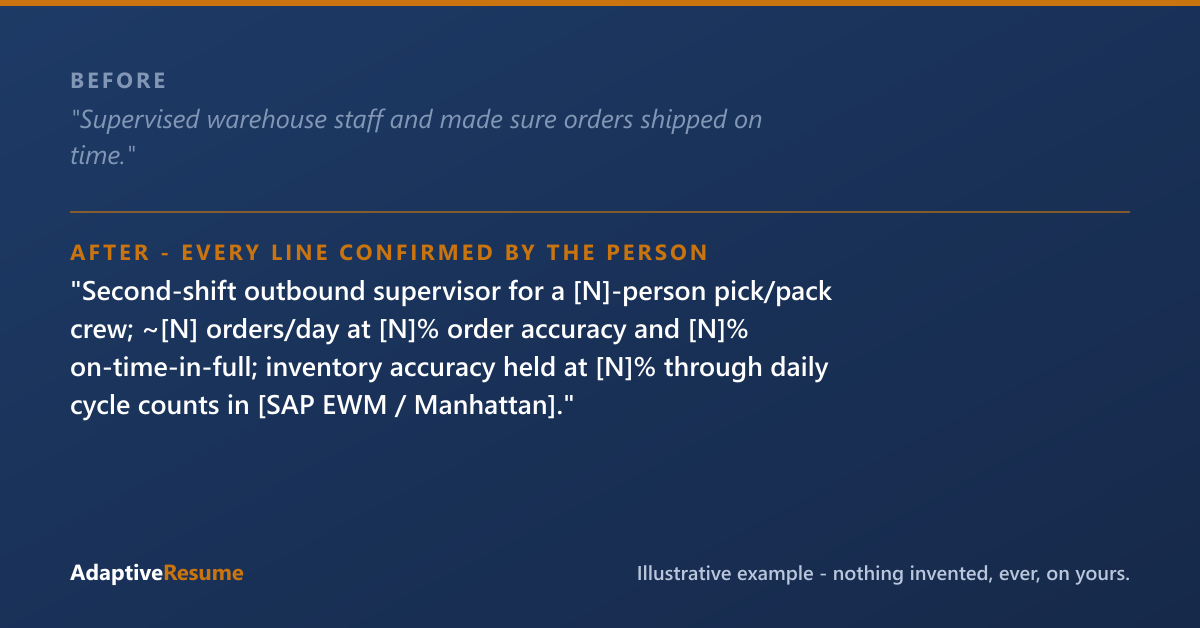
The second version answers the four questions in one read. It also names the system: a posting that says “Manhattan experience preferred” is a filter, and a resume that says “WMS” without the brand doesn’t pass it.
The parts of the job that carry the most weight
Throughput and service. Orders, lines, cases, or pallets per day — pick whichever unit your building measured. Then the service numbers: order accuracy, on-time ship, on-time-in-full (OTIF, the strict measure where an order counts only if it was both on time and complete), and dock-to-stock time on the receiving side. If you improved one of these, say from what to what, over what period.
Inventory. Cycle count programs, inventory accuracy percentage, shrink, and how you handled variances. If you ran the annual physical or moved the building from physicals to cycle counts, that is a real line.
Systems. Name the warehouse management system by its actual product name: SAP Extended Warehouse Management (SAP EWM), Manhattan Active Warehouse Management, Oracle Warehouse Management Cloud, Blue Yonder Warehouse Management, or whatever your building runs. Add the hardware — RF scanners and handheld mobile computers (Zebra and Honeywell are the common ones), label printers, and any conveyor, sortation, or pick-to-light equipment you supervised. If you built wave releases or set up new SKUs in the system, say so.
People. Headcount you scheduled, how you covered attendance and call-outs, temp-to-hire coordination with staffing agencies, new-hire onboarding, and cross-training. Write one-on-ones and corrective actions as what they were — that is real supervisory work, and hiring managers want to know you have done it.
Process. 5S, lean, kaizen events, standard work you wrote, and slotting changes you drove. Keep these concrete: “led a 5S reset of the pack line; added [N] stations” beats “lean mindset.”
Safety, exactly as held
Safety is the line a warehouse hiring manager reads most carefully, because it is the one that can shut a building down. Write it precisely.
Forklift and powered equipment. OSHA’s powered industrial truck standard, 29 CFR 1910.178, requires employers to train and evaluate every operator, to re-evaluate at least once every three years, and to certify in writing that it was done. There is no national forklift license, so the honest wording is employer training: list the truck types — sit-down counterbalance, stand-up reach, order picker, pallet jack — and the year of your last evaluation. If you were the designated trainer who ran that program for other operators, that is one of the strongest supervisor lines you can write.
OSHA Outreach cards. The OSHA 10-Hour and 30-Hour General Industry cards come from the OSHA Outreach Training Program. OSHA is explicit that these are course-completion cards, not certifications. The 30-hour is the one aimed at supervisors. List it as a card, with the year.
Hazmat. If your building shipped hazardous materials, you may have had DOT hazmat employee training under 49 CFR 172.704 — general awareness, function-specific, safety, and security awareness, repeated at least every three years. Only list it if you actually took it.
Safety numbers. If your site tracked its Total Recordable Incident Rate (TRIR, recordable injuries per 200,000 hours worked) or DART rate, and you know where your shift landed, write it. “Ran [N] consecutive months without a recordable on my shift” is a line hiring managers stop on. If you maintained the OSHA 300 log, ran toolbox talks, or led incident investigations, say so.
Warehouse resume — if you are not a supervisor yet
If your title is warehouse associate, picker, packer, forklift operator, or lead, the same rules apply at your scale. Replace “responsible for picking and packing” with what you actually moved and how well: “picked ~[N] lines per hour at [N]% accuracy on an RF gun in [WMS]; trained [N] new hires on the pack line.” Name your equipment and your truck types. Name the system.
Then put the supervisor-shaped work where it can be seen. Covered the supervisor’s shift when they were out. Built the daily assignment board. Ran the cycle count team. Trained new operators. Those lines are true whether or not anyone gave you the title.
Logistics resume — if the title is coordinator, planner, or dispatcher
Logistics coordinator, transportation coordinator, and dispatcher resumes get sent for warehouse supervisor roles all the time, and they compete well when they carry the same proof. Lead with volume and mode: loads per day or week, carriers managed, inbound versus outbound, LTL versus truckload versus parcel. Name the transportation management system or load board you worked in. Then the service numbers: on-time pickup and delivery, claims filed and resolved, detention and accessorial charges you cut, and the customers or accounts you scheduled for.
If you touched the floor — scheduled dock doors, audited BOLs against what was actually loaded — write those lines. They are the bridge from a desk role to a supervisor role.
Format notes
Length follows your history, not a page rule. If you have run two buildings, or you supervised somewhere before warehousing, or you came up through the floor over ten years, that history is your advantage. Cramming it onto one page throws it away.
The honest rule: two pages is normal and expected once you have more than one substantive role to describe. Every line still has to earn its space. Cut duties every supervisor shares — “ensured compliance with company policies” — and keep crew size, volume, accuracy, systems, and safety.
One genuine exception worth knowing: federal applications through USAJOBS cap at two pages as of the September 2025 OPM change. Federal warehouse and supply positions do exist, so if that is where you are headed, treat it as a hard requirement.
Otherwise: reverse chronological, single column, a one-line scope statement under every employer, and a clearly labeled block for systems and equipment. Skip the graphics and skill bars — the software that reads your file first handles plain text best.
A bullet bank you can adapt — keep only what’s true
- “Supervised a [N]-person [shift] crew across [pick/pack/receiving/returns]; scheduled coverage for [N] positions and held attendance at [N]%”
- “Ran ~[N] orders/day ([N] lines) at [N]% order accuracy and [N]% on-time-in-full in [SAP EWM / Manhattan / Blue Yonder / Oracle WMS]”
- “Owned the cycle count program: [N] counts/day, inventory accuracy from [N]% to [N]% over [months]”
- “Trained and evaluated [N] forklift operators under OSHA 1910.178 on [sit-down / reach / order picker]; maintained operator certification records”
- “[N] months with zero recordables on shift; led toolbox talks and [N] incident investigations; maintained the OSHA 300 log”
- “Led a 5S reset of the [pack line / receiving dock]; added [N] stations and cut [travel / staging time] by [N]%”
- “Onboarded [N] new hires and [N] agency temps per [month/peak season]; built the cross-training matrix for [N] roles”
- “Coordinated [N] inbound/outbound loads per day with [carriers]; cut detention charges by [N]% through dock scheduling”
What screening software looks for on a warehouse supervisor resume
Filters commonly read for: warehouse supervisor, shift supervisor, distribution center, fulfillment, pick/pack, shipping and receiving, inventory control, cycle counts, inventory accuracy, order accuracy, on-time, OTIF, throughput, WMS, SAP EWM, Manhattan, Blue Yonder, Oracle WMS, RF scanner, forklift, powered industrial truck, reach truck, order picker, OSHA, OSHA 30, safety, TRIR, 5S, lean, continuous improvement, scheduling, staffing, training, onboarding, KPI, and P&L where the role touches it. O*NET’s profile for first-line supervisors of material movers lists “Warehouse Supervisor” among its reported titles and has the full task list.
The highest-risk lines are the ones that inflate scope — a crew you covered for but did not run, a “certification” that was a course card, a number you never saw on a report. Warehouse hiring managers have run the same numbers you have, and they know what a real shift looks like.
The Role Skills Checklist below helps you inventory what your shift actually proves, which for most supervisors is considerably more than the resume currently says. Our build does it with you: we work backwards from your real crew, volume, systems, and safety record, propose the standards and software that work like yours normally involves, and ask you to confirm every item before it appears. We never add a credential, a system, or a number you didn’t tell us about.
Common questions
Is a forklift certification a real credential I can list?
Yes, with the right wording. OSHA's powered industrial truck standard (29 CFR 1910.178) requires your employer to train and evaluate you and to certify that it happened, with an evaluation at least every three years. So write it as employer training: 'Forklift operator, trained and evaluated under OSHA 1910.178 — sit-down counterbalance, reach truck, order picker.' If you were the person who trained and evaluated other operators, that is a supervisor-level line and belongs high on the page.
Is an OSHA 10 or OSHA 30 card a certification?
No. OSHA says so directly: the Outreach Training Program cards are course-completion cards, not certifications or licenses. List it as 'OSHA 30-Hour General Industry card' with the year. It still matters — plenty of postings ask for it — but calling it a certification is the kind of small overstatement a careful reader notices.
I was a lead, not a supervisor. Can I use the supervisor title?
Keep your real title and describe the real scope. A lead who ran a 12-person shift, built the schedule, and trained new hires has supervisor-shaped experience, and the bullets can say exactly that. The title line stays what payroll called you. Employers call previous employers, and a title that doesn't match the record costs more than an honest 'lead' ever would.
What numbers should I put on a warehouse supervisor resume if I never saw the official reports?
Use the numbers you can stand behind. You know how many people were on your shift, roughly how many orders or pallets moved on a normal day, and whether your accuracy or safety numbers were tracked and where they landed. Write those with an honest 'about' or a range. Leave off any figure you would have to guess at — a reader would rather see '~1,200 orders/day' than a suspiciously precise number you can't back up.
Role Skills Checklist
Pop your email in and the download unlocks right here — and being on the list before launch day locks in 25% off your first build. We'll also send the occasional useful note and tell you the moment AdaptiveResume goes live. No spam.
Download: Role Skills ChecklistThanks — you're on the launch list, your 25% is locked in, and your download is ready below.
That email didn't look right — mind trying it again?
Ready to do this on your own resume?
We'll find what you've left off and you approve every line — nothing made up.
Build your resume — $49Try the demo first — a sample review, no sign-up · See how the service works
Paid a resume service and got a template back? Start at Fix my resume.