Guides · For job seekers
Custodian Resume: The Buildings You Kept, the Floors You Ran, and the Training Behind It
Custodian resumes are read for the size and type of building you kept, the floor care and equipment you can run, the chemical and safety training you completed, and your attendance. Here's how to write yours with real numbers.
Published 10/13/2026 · Updated 10/30/2026
A custodian resume is read by a building services supervisor, a school district’s facilities office, or a contractor’s site manager. They are looking for proof that you can keep a building clean, safe, and ready on schedule: how big and what kind of building you kept, which floor machines and chemicals you can handle, what training you completed, and whether you show up every shift. A resume that says “responsible for cleaning and general maintenance” tells them none of that.
Custodial work is measured by area, inspections, and work orders, so you likely know your own numbers well: the rooms or square feet you covered, how your areas did on inspections, and the work orders you handled. Put them on the page.
Lead with your building, your floors, and your record
Before: “Custodian responsible for cleaning classrooms, restrooms, and hallways.”
After: “Night custodian at a [1,200]-student high school: cleaned about [28,000] square feet a shift, including [18] classrooms and [6] restrooms; stripped and refinished [N] floors each summer with an auto scrubber and burnisher; bloodborne pathogens training every year; [2] years with no missed shifts.”
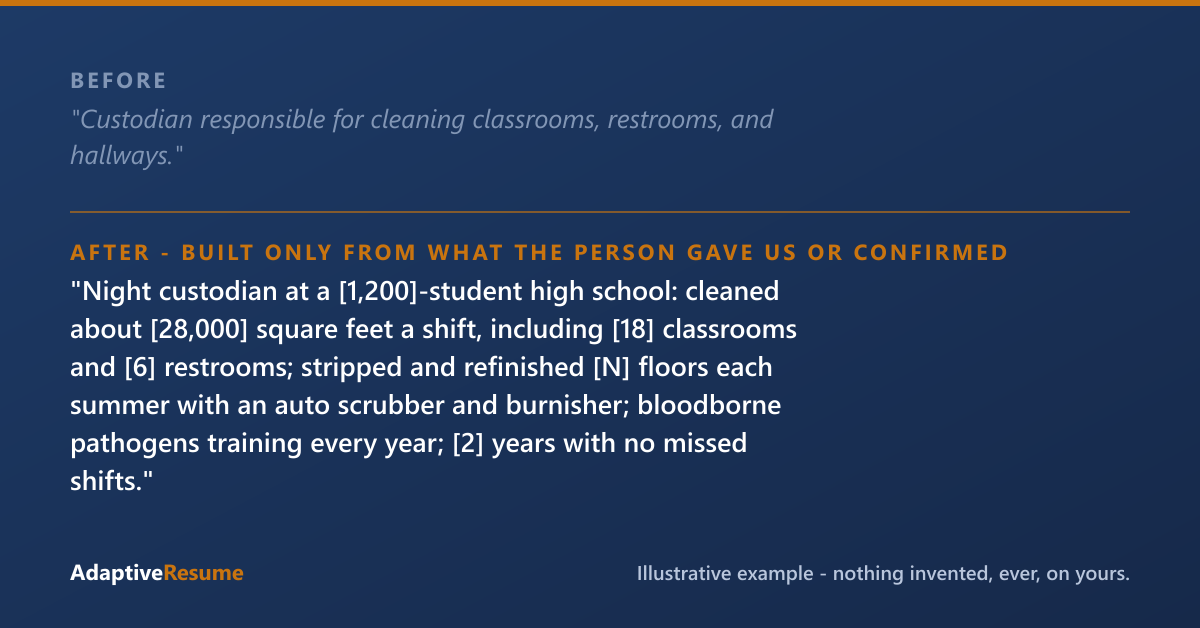
Illustrative example. Everything on your resume is yours: the experience you listed, plus the equipment, chemicals, and safety training your work already involved, each added only after you confirm it’s true.
The second version tells the supervisor the setting, the size of the assignment, the floor work, the training, and the reliability in two lines.
The numbers a building services supervisor reads
Area. Give the square footage or the rooms you cleaned per shift, the type of building, and the number of people who used it, such as students, patients, or employees.
Floor care. Write how many floors you stripped and refinished, burnished, or scrubbed, and how often. Summer and holiday floor projects are a strong line for school custodians.
Inspections. If your building was inspected, write your scores or the result, such as “passed every quarterly inspection” or “raised the area’s inspection score from [N] to [N].”
Work orders and setups. Give the number of work orders, event setups, or moves you handled, such as cafeteria and gym setups, testing rooms, or meeting rooms.
Attendance. Months without a missed shift and the overtime or emergency calls you covered show reliability, which a supervisor weighs heavily.
Training and safety, named exactly
Chemicals. OSHA’s hazard communication rule requires covered employers to train workers on the hazardous chemicals in their work area when they start, including the labels and safety data sheets. Name the training and the chemical systems you used, such as a dilution station, disinfectants, floor finish and stripper, and carpet extraction chemicals.
Bloodborne pathogens. If your job could expose you to blood or other potentially infectious materials, as it often does in schools, hospitals, and public buildings, OSHA’s bloodborne pathogens rule requires a covered employer to train you when you start and at least once a year after that; public schools are covered in states that run their own OSHA-approved plans. Write “bloodborne pathogens training, current [year].” It tells a hospital or a school you already know the cleanup procedures.
Infection prevention. Industry courses such as the Global Biorisk Advisory Council’s GBAC Fundamentals, offered through the cleaning industry association ISSA, cover cleaning and disinfection for infection control. List any course you completed with its issuer and year.
Other training. Lockout and tagout, ladder and lift safety, first aid and CPR, and green cleaning programs all belong on the resume with their dates. Some states and cities license boiler operators, and some school custodial jobs include boiler duties; if you hold a boiler license, name it and the issuing state or city.
Equipment and skills
Floor machines. Name what you run: auto scrubbers, burnishers, swing machines, carpet extractors, wet and dry vacuums, and backpack vacuums. Say whether you can run them alone and train others.
Cleaning and building checks. Describe restroom and kitchen sanitation, high-touch disinfection, trash and recycling, window and glass work, snow removal, and opening and closing the building. If you did security checks, alarm settings, or minor repairs such as changing bulbs or fixing a flush valve, say so.
Supplies and reporting. If you ordered or tracked supplies, kept logs, or entered work orders in a system, name the system and what you handled.
Moving up
Lines that point upward matter even for an entry-level job: training new custodians, covering a lead’s shift, owning the floor-care program, or being trusted with a whole building on nights or weekends. If you are aiming at a lead or maintenance job next, add the crew size, the building you ran, and any repair work you did. Our maintenance technician guide covers how that resume is read, and our maintenance supervisor guide covers the step after.
Format notes
Length follows your history. A custodian with one or two employers usually fits on one page. Two pages is normal and expected once you have more than one substantive job to describe, such as a school district plus a contract cleaning company, or a military history. Keep the area, the floor work, the training, and the numbers; cut the duties every custodial job shares.
Use reverse chronological order and a single column, and leave out graphics and photos. Many school districts, hospitals, and large contractors run applications through hiring software, and a two-column template can scramble the read. Put your training in its own section, where a supervisor sees it quickly.
Gaps get one plain dated line. Contract cleaning work that moved you between sites can be listed under the contractor’s name with the buildings you served.
Custodian resume examples: a bullet bank you can adapt — keep only what’s true
- “Cleaned about [N] square feet a shift at a [school/hospital/office building], including [N] restrooms and [N] classrooms or offices”
- “Stripped and refinished [N] floors each summer; burnished hallways [weekly/nightly] with a [propane/battery] burnisher”
- “Passed every [quarterly/annual] building inspection in [year]”
- “Handled about [N] work orders and [N] event setups a month in [system]”
- “Bloodborne pathogens training, current [year]; hazard communication training on [N] cleaning chemicals”
- “Completed [GBAC Fundamentals/other course] through [issuer], [year]”
- “Opened and closed the building, set alarms, and ran nightly security checks”
- “[N] months with no missed shifts; trained [N] new custodians on floor care”
What screening software looks for on a custodian resume
Filters commonly read for: custodian, janitor, building services, porter, floor technician, cleaning, sanitation, disinfection, restrooms, floor care, stripping and waxing, burnishing, auto scrubber, carpet extraction, chemicals, safety data sheets, OSHA, bloodborne pathogens, hazard communication, infection control, setups, work orders, trash and recycling, snow removal, security checks, and minor repairs. O*NET’s profile for janitors and cleaners has the full task list.
The highest-risk lines are the ones a supervisor can check with one call: training you never completed, a machine you have never run, or an inspection result you cannot show. Write what you actually did.
The Role Skills Checklist below helps you inventory what your custodial history actually proves, which is usually more than the resume currently says. Our build does it with you: we work backwards from your real jobs, buildings, and shifts, and we ask you about the equipment, chemicals, and training that work like yours normally involves. Nothing goes on your resume that you didn’t give us or confirm, so a training course, a machine, or a number you never told us about stays off the page.
Common questions
What is the difference between a custodian and a janitor on a resume?
There is often very little difference, and many employers use the titles for the same job. Use the title your employer used, and if the posting uses the other word, mention it once in your summary. Schools and public agencies often say custodian, and their jobs can include building checks, opening and closing, and minor repairs, so list those duties if you did them.
How do I figure out how many square feet I cleaned?
Start with what you were told when you were given your area, because many cleaning departments assign each custodian a set area by square footage or by number of rooms. If you do not know the figure, count what you can: classrooms, restrooms, floors, or offices, and write that instead.
Do I need a certification to be a custodian?
Usually you do not need one, but training counts. Under OSHA's rules, a covered employer had to train you on the hazardous chemicals you used. If cleaning up blood was part of your job, that employer also had to train you on bloodborne pathogens every year. List that training with the year. Industry courses on infection prevention and floor care are worth listing too.
I'm applying for a lead custodian job. What should I add?
Add the crew you led, the building or area you were responsible for, how you scheduled the work, how you trained new staff, and any inspection scores or supply budgets you handled. A lead is read for keeping a building ready with a team, not just for the cleaning.
Role Skills Checklist
Pop your email in and the download unlocks right here. Joining our list also takes 25% off your first purchase within 30 days of joining, when you create your account with this same email. We'll also send the occasional useful note. No spam.
Download: Role Skills ChecklistThanks, you're on our list, and your download is ready just above. Your 25% off a first purchase is good for 30 days from the day this email joined our list.
That email didn't look right — mind trying it again?
Ready to do this on your own resume?
We'll find what you've left off, and nothing goes on your resume that you didn't give us or confirm.
Get your resume build — $29Every purchase is one payment, and nothing renews. A single resume build can be used any time within 12 months of buying it, and AR Pass builds you don't use end when its 90 days end.
Try the demo first — a sample review, no sign-up · See how the service works
Paid a resume service and got a template back? Start at Fix my resume.