Guides · For job seekers
EMT Resume: Certification Level, Calls, and Protocols
EMT resumes are read certification-first — NREMT level, state license, then the calls. How to show 911 vs IFT honestly and write the step toward medic or fire.
Published 07/30/2026 · Updated 08/06/2026
EMS hiring starts with one fact: your certification level. Everything else on an EMT resume supports it. Put the level where it can’t be missed, describe the service honestly — 911, interfacility, event standby — and let the call work show your judgment. Agencies verify everything, so precision beats polish on every line.
The EMT resume certification block, exactly
Top of the resume, before work history: your NREMT certification at its true level — EMT, AEMT, or Paramedic — plus your state license (state and expiration), CPR/BLS, and level-appropriate additions (ACLS and PALS for medics; PHTLS/ITLS if held; EVOC/CEVO driving certification if your service required it). Exact names and current dates only. If your NREMT lapsed and your state license is active — or the reverse — say what’s true; agencies see that pattern all the time and respect the accurate version.
911, IFT, and event work: name which one
The biggest honesty issue on EMT resumes is blurring interfacility transport into emergency response. They’re different jobs with different evidence — and IFT experience is real experience when named as itself:
Before: “Responded to emergency calls and provided patient care and transport.” After (911): “911 EMT on a dual-medic ALS ambulance, ~8-12 calls/shift across a mixed urban/highway district; BLS assessments, immobilization, and assist on ALS interventions.” After (IFT): “Interfacility transport EMT, ~10 transports/shift including cardiac and dialysis patients; monitoring, documentation, and transfer-of-care reporting between facilities.”
Both versions read as real experience. The blurred version invites the one interview question that unravels a resume.
Bullets that show EMS judgment
Call volume and district type; assessments and interventions within your scope; documentation (the ePCR — electronic patient care report — system by name; agencies filter on them); lifting/moving as the physical reality it is (“2-person crew, ~15 patient moves/shift”); mass-casualty or standby events worked; FTO/preceptor duties if you trained new hires. If you kept a clean driving record through emergency operations, that single line carries weight with every fleet insurer.
The step up: medic school, fire, nursing
Writing toward the next rung follows one rule — claim completed scope, label in-progress things as in progress. “Paramedic student, [program], clinical rotations begun [month/year]” is a legitimate, strong line. Fire-track EMTs: list CPAT (Candidate Physical Ability Test) completion and any Firefighter I/II coursework exactly as far as you’ve actually gotten. EMS-to-nursing: your patient-contact volume is the asset; count it honestly.
New certificate, no runs yet
Lead with the certification block, then ride-alongs and clinical hours from your course (they’re real patient contacts — count them), then whatever work history shows reliability under pressure. Agencies hire new EMTs all the time; the resume’s job is to make the credential verifiable and the person dependable.
Format notes
One page if you’ve held one substantive role; two pages is normal once you have more than one to describe (federal EMS applications through USAJOBS cap at two pages as of the September 2025 OPM change). Single column, certification block clearly labeled at top, service type named for every employer. Skip the lights-and-sirens graphics — the parser can’t read them and the chief has seen them a thousand times.
A bullet bank you can adapt - keep only what’s true
- “911 EMT with [service]: [~N] calls over [period] across [911/IFT/event] operations”
- “BLS, CPR/AED, [NIMS/ICS-100] certified - listed exactly as held, with dates”
- “Documented every run to [county/state] protocol in [ePCR system]; [N] chart audits passed”
- “Precepted [N] new EMTs through field training”
- “Maintained rig readiness: daily checks, narcotics counts witnessed, restock to par”
What screening software looks for on an EMT resume
Filters read for: NREMT, BLS, CPR/AED, patient assessment, patient transport, ePCR documentation, HIPAA, NIMS/ICS, extrication assist, IFT, 911 response. O*NET’s EMT profile lists the full task set. Certifications are the highest-risk lines on any EMS resume - exact names, exact status, nothing assumed.
The before-and-after, at a glance
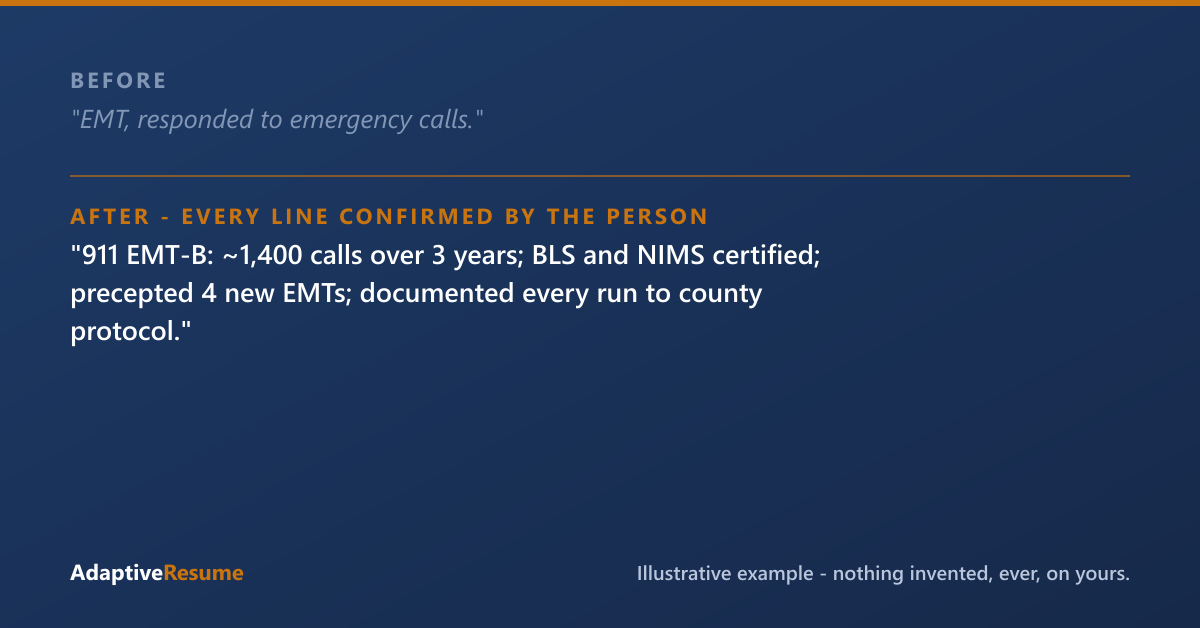
Illustrative example. On your resume, every line comes from your real history - proposed as a question, added only when you confirm it.
The Role Skills Checklist below helps you inventory what your time on a truck proves. Our build does it with you — proposes what your history implies, asks you to confirm each item, and never lists a certification you didn’t tell us you hold. In EMS, that’s just how the job works.
Common questions
How do I list EMT certifications that expire?
With their status, exactly: 'EMT (NREMT, current through [date])'. An expired cert stated as expired is a renewal task; one listed as current is a background-check failure.
Does volunteer EMS count as real experience?
Completely - calls are calls. State the service, the call volume, and your role exactly as they were; paid vs volunteer matters less than what you ran and documented.
What if my call volume was low?
Say what's true and let the setting explain it: a rural service with long transports builds different strengths (extended patient contact, autonomous decisions) than an urban high-volume system. Name the strength your setting actually built.
Role Skills Checklist
Pop your email in and the download unlocks right here — and being on the list before launch day locks in 25% off your first build. We'll also send the occasional useful note and tell you the moment AdaptiveResume goes live. No spam.
Download: Role Skills ChecklistThanks — you're on the launch list, your 25% is locked in, and your download is ready below.
That email didn't look right — mind trying it again?
Ready to do this on your own resume?
We'll find what you've left off and you approve every line — nothing made up.
Build your resume — $49Try the demo first — a sample review, no sign-up · See how the service works
Paid a resume service and got a template back? Start at Fix my resume.