Guides · For job seekers
Automotive Technician Resume: ASE Areas, Flat-Rate Numbers, and the Systems You Fix
Automotive technician resumes are read for the ASE areas first, then for the numbers a service manager lives on: flat-rate hours, efficiency, and comebacks. Here's how to write yours with the exact certifications, the real numbers, and the diagnostic work that separates a technician from a parts changer.
Published 10/05/2026 · Updated 10/30/2026
An automotive technician resume is read by a service manager who thinks in ASE areas and flat-rate hours. The first question is which systems you are certified in and which you actually work on. The second is whether you turn hours: how many flat-rate hours a week, at what efficiency, with how many comebacks. A resume that says “experienced in all aspects of automotive repair” answers neither, and it reads like every other resume in the stack.
A strong technician resume writes the certifications exactly, puts numbers on production, and names the diagnostic work that separates a technician from a parts changer. All of that is already true of your work. It just is not on the page yet.
Lead with the ASE areas and the numbers
Before: “ASE certified technician with 8 years of experience in brakes, engines, and electrical.”
After: “ASE Master Automobile Technician (A1–A8), current through [month/year]; L1 Advanced Engine Performance Specialist. Flat-rate technician at a [brand] dealership: about 55 flat-rate hours a week at 125% efficiency, comeback rate under 2%, drivability and electrical diagnosis on about a third of tickets.”
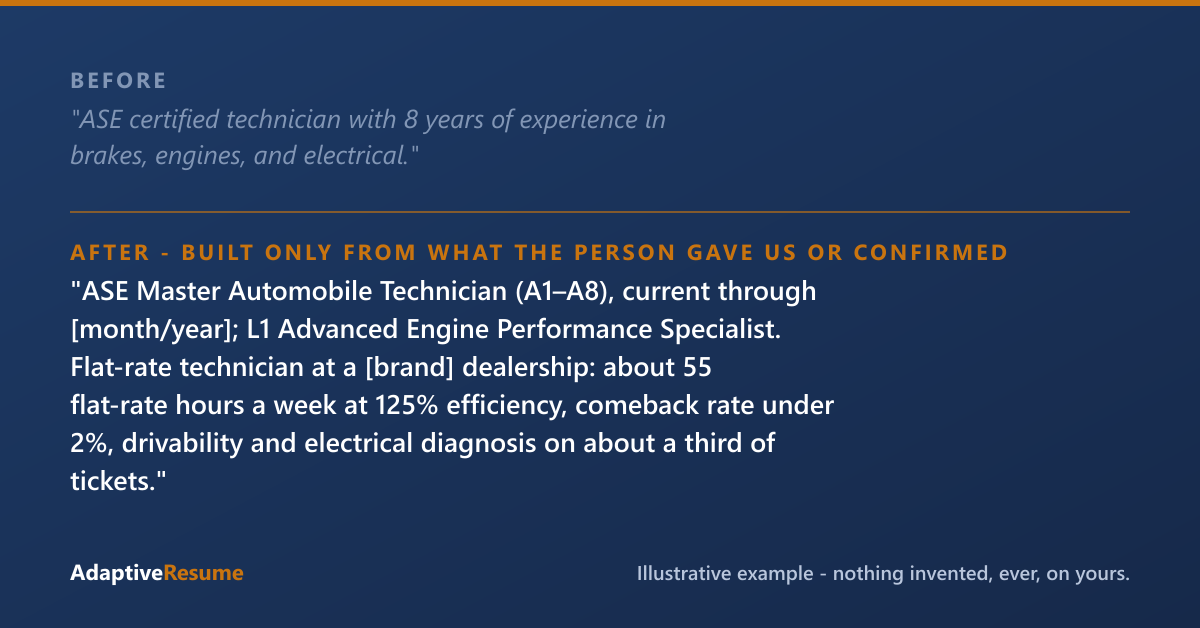
Illustrative example. Everything on your resume is yours: the experience you listed, plus the certifications, tools, and safety training your work already involved, each added only after you confirm it’s true.
The second version tells a service manager which areas you hold, that you are a producer, and that you diagnose rather than swap parts. Your pay stubs show your flat-rate hours, and the rest of the numbers in a line like this are ones you know from your own work and can explain. Never copy repair orders or anything out of a shop’s system.
Certifications, by their exact names
ASE areas. List each automobile and light truck area you hold by letter and name: A1 Engine Repair, A2 Automatic Transmission/Transaxle, A3 Manual Drive Train and Axles, A4 Suspension and Steering, A5 Brakes, A6 Electrical/Electronic Systems, A7 Heating and Air Conditioning, A8 Engine Performance, A9 Light Vehicle Diesel Engines. Master Automobile Technician status means A1 through A8 are all current. ASE’s advanced-level tests include L1 Advanced Engine Performance Specialist and L3 Light Duty Hybrid/Electric Vehicle Specialist. ASE certifications must be recertified every five years, so write the expiration.
EV and hybrid safety. If you have completed ASE’s xEV Electrical Safety Awareness Certification (Level 1) or xEV Technician Electrical Safety Certification (Level 2), list it by that name with the year; both are valid for five years. Some dealerships with electric models and some fleets that are electrifying ask for it.
Refrigerant. EPA Section 609 technician certification for motor vehicle air conditioning is required to service vehicle A/C for pay. Write “Section 609,” not “EPA certified,” so it is not confused with the stationary Section 608 credential.
State licenses and inspections. Some states license technicians or inspection stations separately, and emissions and safety inspector licenses are state-issued. If you hold one, list the state, the license type, and the expiration.
Manufacturer training. Factory programs and certifications (for example, Toyota T-TEN, GM ASEP, Ford ASSET, and brand-specific master-technician tracks) are strong lines at a dealership of that brand and good lines anywhere. List the brand, the program, and the level reached.
The parts of the job that carry the most weight
Production numbers. Give flat-rate hours per week or per pay period, your efficiency percentage, and your comeback rate. If your shop pays hourly, use tickets per day and the mix of work. Service managers hire on these numbers because the shop’s revenue is made of them.
Diagnostic work. Show drivability, no-start, and electrical diagnosis; network and module communication faults; ADAS (advanced driver assistance system) calibration after windshield, alignment, or collision work; and the scan tools and lab scopes you use by name (factory tools, Snap-on, Autel, PicoScope). Name the make-specific diagnostic software you have used, because a dealership posting will ask for it.
Systems and repairs. List the systems you repair, such as engines, transmissions, driveline, suspension and steering, brakes including ABS and electronic parking brakes, HVAC, electrical, and emissions. Write the ones you actually do, and mark the ones you lead on.
Shop systems and process. Name the repair-order and inspection software you use (for example, dealership management systems and digital multipoint inspection tools), along with parts lookup and warranty documentation. Warranty-claim accuracy is a real skill at a dealership, and a technician who writes clean stories on warranty claims saves the shop money.
Mentoring. Count the apprentices and lube technicians you have trained, and list any shop foreman or team lead duties.
Dealership, independent, fleet, and quick service
Write the setting, because the work differs. A dealership resume leads with the brand, the factory training, and warranty work. An independent shop resume leads with the range of makes and the diagnostic mix. A fleet resume leads with the vehicle count, preventive maintenance schedules, and uptime. A quick-service resume leads with volume, inspection accuracy, and the upsell you found honestly. None of these is lesser; each has its own numbers. If most of your work is on diesel trucks, our diesel mechanic resume guide covers the T series and fleet work.
Format notes
Length follows your history, not a page rule. A technician with three shops, two brands, and a master certification has more that matters than one page holds. Two pages is normal and expected once you have more than one substantive job to describe. Keep the certifications, the production numbers, the diagnostic work, and the systems; cut the duties every technician shares.
Use reverse chronological order and a single column, put the certification block near the top, and leave out graphics and photos. Many dealership groups run applications through screening software, and a two-column template can scramble the read. One exception worth knowing: federal applications through USAJOBS cap at two pages as of the September 2025 OPM change, and federal mechanic postings ask for details a shop application does not.
A bullet bank you can adapt — keep only what’s true
- “ASE certified in [A4, A5, A6, A8], current through [month/year]; registered to test [A1, A2]”
- “Turned about [N] flat-rate hours a week at [N]% efficiency with a comeback rate under [N]%”
- “Diagnosed drivability, no-start, and electrical faults with [scan tool/lab scope]; about [N]% of tickets were diagnosis”
- “Performed ADAS calibrations after [windshield/alignment] work on [N] vehicles a month”
- “EPA Section 609 certified; serviced [N] A/C systems a month including [refrigerant type]”
- “Completed [brand] factory training to [level]; performed warranty repairs with [N]% claim approval”
- “Maintained a fleet of [N] vehicles on a preventive maintenance schedule; [N]% uptime”
- “Trained [N] apprentices and lube technicians on inspections and shop safety”
What screening software looks for on an automotive technician resume
Filters commonly read for: ASE certified, Master Technician, A1 through A9, L1, L3, EPA 609, diagnostics, drivability, electrical, scan tool, lab scope, ADAS calibration, hybrid, EV, high voltage, brakes, suspension, alignment, transmission, HVAC, emissions, state inspection, flat rate, multipoint inspection, warranty, and the brand and dealership management system names in the posting. O*NET’s profile for automotive service technicians and mechanics has the full task list.
The highest-risk lines are the ones a dealership verifies before an offer: an ASE area you have not passed, a lapsed certification written as current, a factory level you did not reach, or production numbers your last shop will not confirm. Write what your certificates and your pay stubs show.
The Role Skills Checklist below helps you inventory what your shop history actually proves, which is often more than the resume currently says. Our build does it with you: we work backwards from your real shops, brands, and systems, and we ask you about the certifications, tools, and safety training that work like yours normally involves. Nothing goes on your resume that you didn’t give us or confirm, so a certification, a tool, or a number you never told us about stays off the page.
Common questions
Do I need ASE certifications to be hired as an automotive technician?
No law requires them, and many working technicians hold none. Dealerships and larger shops screen for them, and pay plans often step up with them. List exactly the areas you hold, by their letter and name, with the expiration, since ASE certifications must be renewed every five years. If you are registered to test, say so; do not list an area you have not passed.
What is the difference between an automotive technician and a diesel mechanic on a resume?
The ASE series, the vehicles, and the systems. Automobile and light truck certifications are the A series (A1 through A9); medium and heavy trucks are the T series. If you work on both, list both series. If you work mainly on diesel trucks and equipment, our diesel mechanic guide fits your resume better, and the two should not be blended into one vague 'mechanic' title.
How do I show diagnostic skill instead of just repairs?
Name the scan tools and the work: drivability and no-start diagnosis, electrical fault tracing with a lab scope, network and module diagnosis, ADAS calibration, and the make-specific tools you used. Then put a number on it: diagnostic hours per week, comeback rate, or the share of your tickets that were diagnosis rather than replacement.
Should I list EPA 609 if I service air conditioning?
Yes, and by its exact name: EPA Section 609 technician certification for motor vehicle air conditioning. It is required to service vehicle A/C systems for pay, it carries no federal expiration date, and shops verify it. It is different from EPA Section 608, which covers stationary refrigeration and HVAC; list the one you actually hold.
Role Skills Checklist
Pop your email in and the download unlocks right here. Joining our list also takes 25% off your first purchase within 30 days of joining, when you create your account with this same email. We'll also send the occasional useful note. No spam.
Download: Role Skills ChecklistThanks, you're on our list, and your download is ready just above. Your 25% off a first purchase is good for 30 days from the day this email joined our list.
That email didn't look right — mind trying it again?
Ready to do this on your own resume?
We'll find what you've left off, and nothing goes on your resume that you didn't give us or confirm.
Get your resume build — $29Every purchase is one payment, and nothing renews. A single resume build can be used any time within 12 months of buying it, and AR Pass builds you don't use end when its 90 days end.
Try the demo first — a sample review, no sign-up · See how the service works
Paid a resume service and got a template back? Start at Fix my resume.