Guides · For job seekers
Bank Teller Resume: Accuracy, Volume, and Referrals
Teller work is measured daily — drawer accuracy, transaction volume, referrals. Put those numbers on the page and the resume does the arguing for you.
Published 07/30/2026 · Updated 09/29/2026
Teller work generates its own evidence every single day: a drawer that balances, a transaction count, referral numbers your branch tracked on a whiteboard. Many teller resumes leave all of it off and write “processed customer transactions” instead. The numbers were the job — put them on the page.
The three numbers on a bank teller resume branch managers scan for
- Accuracy — drawer balancing is the trust metric. If your drawer balanced consistently, say it plainly: “balanced a $10-15k drawer daily with no unresolved discrepancies.” Use your true figures; banks can and do check references on exactly this.
- Volume — transactions per day, customers served, peak-window load. “~150 transactions/day at the branch’s busiest window” is workload proof.
- Referrals — many teller jobs are part sales. Referrals to bankers, cards opened, appointments set: whatever your branch measured, report your honest numbers. This is the line that moves a teller resume toward personal banker.
Before: “Processed deposits, withdrawals, and other transactions for customers.” After: “Handled ~150 transactions/day with a consistently balanced drawer; generated 8-12 qualified referrals/month to personal bankers; trusted with vault dual-control and ATM balancing.”
Compliance fluency you already have
Teller work builds regulatory habits worth naming exactly — and only as deep as they truly go: CTR (currency transaction report) completion for cash transactions over the reporting threshold, suspicious-activity escalation per BSA/AML (Bank Secrecy Act / anti-money-laundering) training, Reg CC (funds-availability) hold decisions, OFAC (sanctions-list) check workflows. “Completed annual BSA/AML training; escalated suspicious activity per policy” is honest and screenable. Don’t claim compliance expertise you don’t have — claim the operational fluency you do.
Trust positions: say what you were handed
Vault teller or dual-control duties, ATM servicing and balancing, opening/closing the branch, training new tellers, head-teller coverage. Each is a bullet — banks read these as vetting shortcuts, because someone already vetted you.
Toward personal banker or head teller
The path out of the teller line runs through the referral numbers and the trust positions above — lead with them. If you covered platform duties (account openings, service requests) during banker absences, claim that work explicitly with its real frequency. Licensing in progress (life insurance, notary commission) gets listed as in progress, exactly as far as you’ve gotten.
Coming from retail or cashier work
Cash handling, shrink accountability, POS reconciliation, and high-volume customer service translate directly — name them in banking’s terms without inflating them. “Reconciled a register within policy nightly across 3 years” is teller-relevant evidence from any store. What you don’t have yet (regulated environment, referral selling) the branch will train; what they screen for (accuracy, reliability, customer temperament) your retail history can already prove.
Format notes
One page if you’ve held one substantive role; two pages is normal once you have more than one to describe. Single column, clean dates on every role — banking hiring is stability-sensitive and gap-sensitive, so handle any gap with a plain, honest line rather than a stretch. A short skills block (systems used, languages spoken — bilingual tellers should say so prominently) and then bullets carrying the numbers.
A bullet bank you can adapt - keep only what’s true
Patterns with placeholders - your real numbers go in, and anything not genuinely yours stays out.
- “Processed [~N] transactions/day across [drawer/vault/ATM] with [zero / N] discrepancies over [period]”
- “Balanced a [$N] drawer daily; [N] months without a variance”
- “Referred [~N] customers/month to platform services (loans, cards, accounts); [N] closed”
- “Trained [N] new tellers on cash handling, hold policies, and fraud flags”
- “Caught [counterfeit / altered / structuring] activity and escalated per BSA procedure”
- “Handled vault duties: ordered, shipped, and reconciled branch cash to [$N] limits”
What screening software looks for on a bank teller resume
The filter terms worth stating wherever true: cash handling, drawer balancing, transaction processing, referrals, cross-selling, BSA/AML awareness, fraud detection, regulation familiarity (Reg CC holds), vault operations, plus the core systems by name (the teller platform, Fiserv/FIS/Jack Henry if you know which). O*NET’s teller profile has the standard task vocabulary - scan it for true lines you never wrote down.
Use exact terms only for real experience: a planted compliance keyword fails the first scenario question in the interview.
The before-and-after, at a glance
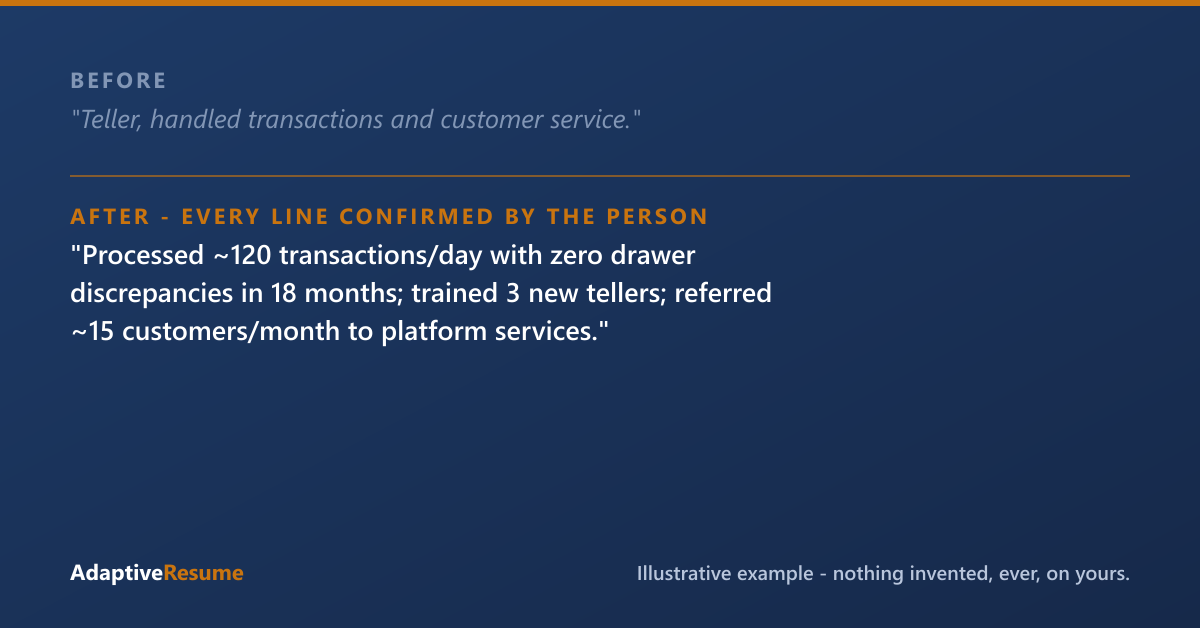
Illustrative example. Everything on your resume is yours: the experience you listed, plus the skills, tools, responsibilities, and credentials your work already involved, each added only after you confirm it’s true.
The Role Skills Checklist below helps you pull the measurable facts out of branch work. Our build does it with you — reads your history, proposes what it implies, and asks you to confirm every number before it appears. In a job built on balancing to the penny, your resume should hold to the same standard.
Common questions
Do bank teller resumes need a college degree?
No — tellers are hired on accuracy, cash handling, and trust signals. A clean drawer record and referral numbers do more than coursework; list any finance-adjacent certificate exactly as held.
What matters more: transaction speed or accuracy?
Accuracy, always — a fast teller with drawer discrepancies is a liability. Lead with balancing record and error-free streaks stated honestly, then volume.
How do I show sales results without overclaiming?
Banks track referrals precisely, so estimate conservatively and mark it: '~15 platform referrals/month' reads honest. Never inflate a number your old branch manager could contradict in a reference call.
Role Skills Checklist
Pop your email in and the download unlocks right here. Joining our list also takes 25% off your first purchase within 30 days of joining, when you create your account with this same email. We'll also send the occasional useful note. No spam.
Download: Role Skills ChecklistThanks, you're on our list, and your download is ready just above. Your 25% off a first purchase is good for 30 days from the day this email joined our list.
That email didn't look right — mind trying it again?
Ready to do this on your own resume?
We'll find what you've left off, and nothing goes on your resume that you didn't give us or confirm.
Get your resume build — $29Every purchase is one payment, and nothing renews. A single resume build can be used any time within 12 months of buying it, and AR Pass builds you don't use end when its 90 days end.
Try the demo first — a sample review, no sign-up · See how the service works
Paid a resume service and got a template back? Start at Fix my resume.