Guides · For job seekers
Sterile Processing Technician Resume: Certification, Tray Volume, and the Standards Behind Every Load
A surgical services department reads a sterile processing resume for three things: the certification written exactly right, the department size and tray volume you handled, and whether the standards and systems on the page match what a manager would confirm. Here's how to write yours honestly.
Published 09/26/2026 · Updated 10/30/2026
A surgical services director or a sterile processing manager reads a technician resume in a few seconds, and it reads for three things. Is your certification current and written the way the issuer writes it? What size department and what tray volume did you handle, across which surgical services? And do the standards, sterilizers, and tracking systems on the page match what your former lead would confirm if someone called? “Detail-oriented sterile processing technician with a commitment to patient safety” answers none of that. The specifics do.
The other thing that sinks sterile processing resumes is leaving off the work. Techs do a great deal that never makes the page: decontamination with the right chemistry and the right PPE (personal protective equipment), inspection under magnification, assembly against count sheets, sterilizer loads with every indicator logged, case carts picked for tomorrow’s schedule, loaner trays turned around overnight, and the daily tests that keep the department survey-ready. Nearly all of it is what a department manager screens for, and this guide is about getting it on the page without adding a load you never ran.
The shift line: your scope in one sentence
Under each job, give one line another tech or a department manager would recognize instantly.
Before: “Sterile processing technician responsible for cleaning and sterilizing surgical instruments.”
After: “CRCST (HSPA, active); [12]-OR (operating room) hospital SPD (sterile processing department), [evening] shift; decontamination, inspection and assembly of [60]-[80] trays a shift, steam and [hydrogen peroxide] sterilization with Bowie-Dick, chemical and biological indicator logging under AAMI ST79; tracked in [CensiTrac].”
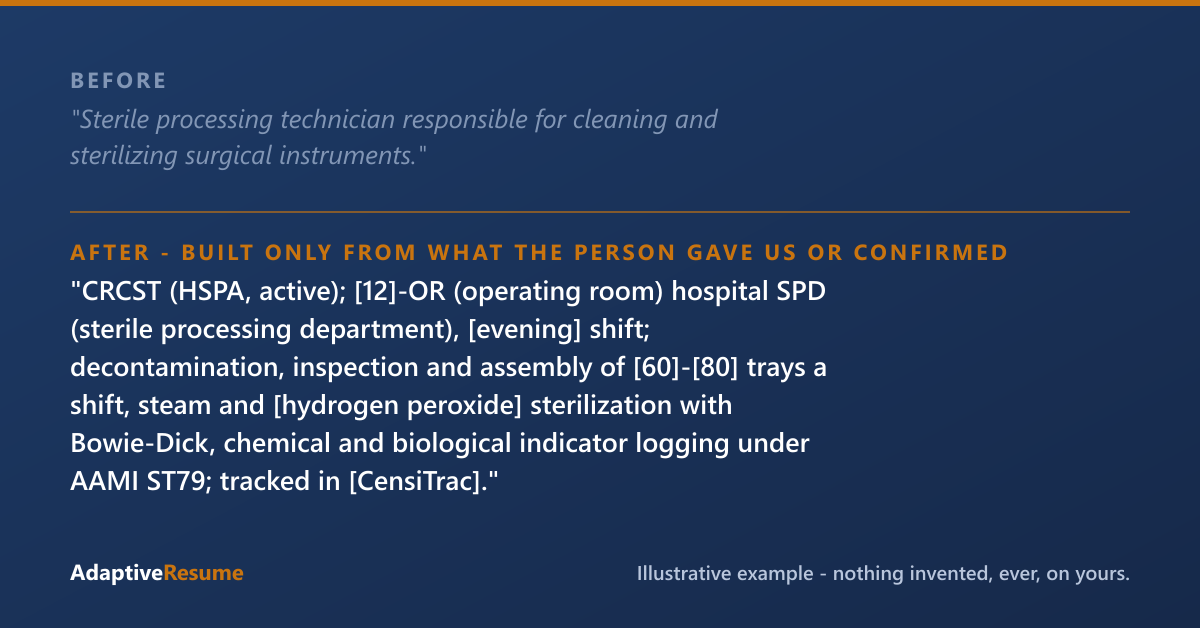
Illustrative example. Everything on your resume is yours: the experience you listed, plus the skills, tools, responsibilities, and credentials your work already involved, each added only after you confirm it’s true.
The second version answers, in one line, what the first leaves a reader guessing at: what you hold, how big the department, what shift, what you actually did and at what volume, what standard you worked under, and what system you documented it in. It invents nothing. Fill the brackets from your real department and the loads you actually ran, not from what a “typical” tech does.
Credentials, exactly as held
A sterile processing tech’s credential block is short, and every line in it gets looked up. Our guide on how to list certifications on a resume covers placement; here is what belongs in yours.
- CRCST. The Certified Registered Central Service Technician credential from HSPA (the Healthcare Sterile Processing Association) is the one most hospital postings name. It requires a passing exam and 400 hours of hands-on experience, completed before the exam or within six months after passing it, and it renews every year on 12 continuing education credits. Write it exactly: “CRCST, HSPA, current through [month year].” If your hours are in progress, write “provisional” and the date.
- CSPDT. The Certified Sterile Processing and Distribution Technician credential from CBSPD (the Certification Board for Sterile Processing and Distribution) is the other national credential. You qualify through one of four routes: 12 months of full-time sterile processing work, six months in another clinical role plus six in the department, a training course passed at 70 or better, or 12 months of related sales or service. The exam is 150 questions, 25 of them unscored pretest items, in three hours, and the certification runs five years on continuing education points or re-examination. Write it by its name and issuer. Don’t write “CRCST” if you hold the CSPDT; managers know the difference and so does the lookup.
- Your state’s requirement, if it has one. Seven states (Connecticut, Delaware, Minnesota, New Jersey, New York, Pennsylvania, and Tennessee) require sterile processing technicians to be certified by law as of this writing, some with a grace period after hire and some with annual continuing education. If you work in one, write the credential that satisfies it and, if you’re inside a grace period, the deadline. Everywhere else, write what you hold; don’t write “state licensed” in a state that doesn’t license the job.
- Specialty credentials. HSPA’s CIS (Certified Instrument Specialist), CER (Certified Endoscope Reprocessor), and CHL (Certified Healthcare Leader), each by name, issuer, and year, if you hold them. An endoscope reprocessing credential belongs on its own line, because that work runs under its own standard and many departments staff it separately.
- Program and other training. A sterile processing program with the school, hours, and year. Hospital competencies, such as loaner tray management, flexible endoscope reprocessing, or a specific sterilizer’s operator training, as a short line with the hospital and the year. These are training, not certifications.
List exactly what you hold, with real status. A lapsed CRCST written as current is a “was,” not an “is,” and the HSPA lookup says so to anyone who checks.
The parts of the job that carry the most weight
Department size and volume. The number of operating rooms the department serves, the surgical services it supports, and the trays you handled per shift. “[12]-OR hospital, [60] to [80] trays a shift across [general, ortho, neuro, and cardiac] services” and “[4]-OR ambulatory surgery center, [30] trays a day, mostly [ophthalmic and ENT (ear, nose, and throat)]” are both honest and both tell a manager what pace and complexity you’ve handled.
Decontamination. Point-of-use treatment received, manual cleaning, enzymatic and detergent chemistry, ultrasonic cleaners, washer-disinfectors, and cart washers, with the PPE and the manufacturer’s instructions for use behind them. “Decontamination lead on [evening] shift: manual cleaning and [ultrasonic] pre-cleaning, [washer-disinfector] cycles logged, IFU (instructions for use) followed for [robotic and powered] instruments.”
Inspection and assembly. Inspection under magnification and, where your department used one, borescope inspection of lumened instruments; assembly against count sheets; instrument identification across services; missing and damaged instrument reporting. “Assembled [N] trays a shift against count sheets in [tracking system]; flagged [N] damaged instruments a month for repair.”
Sterilization and monitoring. The sterilizer types you ran and the monitoring you logged. Steam sterilization under ANSI/AAMI ST79 (the Association for the Advancement of Medical Instrumentation’s steam sterilization standard, approved by the American National Standards Institute) sets the monitoring routine. Dynamic-air-removal sterilizers get a Bowie-Dick test each day they are used, before the first processed load. Every package carries a chemical indicator, biological indicators run on your department’s schedule and in every load with an implant, and each load is recorded with the sterilizer, cycle, date, and operator. Low-temperature sterilization with hydrogen peroxide systems runs under its own IFU and indicators. Write what you ran and what you logged: “steam and [hydrogen peroxide] sterilization; daily Bowie-Dick, chemical and biological indicators logged per ST79; [zero] failed loads unaccounted for in [year].”
Case carts and distribution. Picking case carts against the next day’s surgical schedule, preference cards, sterile storage rotation and event-related shelf life, and stat requests from the OR. “Picked [N] case carts a shift against preference cards; [N] stat requests turned around under [policy] minutes.”
Loaner and vendor trays. Receiving, decontamination, assembly, and sterilization of loaner sets on the vendor’s IFU and the department’s turnaround policy. Managers who run heavy orthopedic and spine volume look for this specifically.
Endoscope reprocessing, if you did it. Leak testing, manual cleaning, automated endoscope reprocessor cycles, drying and storage, and the tracking behind them, under ANSI/AAMI ST91, the flexible endoscope standard. Write it as its own line with the scopes and the reprocessor named.
Tracking and documentation. Name the system: CensiTrac, SPM, T-DOC, or the one your department used. Load records, indicator results, tray histories, and recall procedures live there, and a surveyor reads them. “Documented every load and indicator in [CensiTrac]; supported [two] surveys with complete load records” is a line a manager can picture.
Quality and survey readiness. Recalls you worked, audits you supported, competencies you helped train, and any survey your department passed on your shift. Say what you did, not what the department did.
Notice what isn’t in this list: anything in the operating room itself. A sterile processing tech’s authority ends at the instrument, and the resume should read that way. If you circulated or scrubbed cases, that was a different role with its own page; our operating room nurse resume guide describes the OR side of the same instruments.
Sterile processing technician resume skills: the list, and how to make it true
Put a skill on a sterile processing resume only if you did it in a real department and could walk a manager through it. Here are the ones postings name most, in their own words: decontamination, manual and mechanical cleaning, washer-disinfector and ultrasonic operation, instrument inspection and identification, tray assembly and count sheets, steam sterilization, low-temperature sterilization, Bowie-Dick testing, chemical and biological indicators, AAMI ST79, sterile storage, case cart picking, loaner tray management, endoscope reprocessing and AAMI ST91, instrument tracking systems, IFU compliance, infection prevention, and PPE.
Two rules keep it honest. First, list only what you’ve done, not what your program covered; a classroom sterilizer is not a department. Second, put the setting next to the skill where it changes the meaning: assembly in a four-OR surgery center and assembly on a 12-OR trauma hospital’s evening shift are the same words in very different nights.
Format notes
Length follows your history, not a page rule. One page is right for a new tech or for a couple of years in one department. Two pages is normal once you have more than one substantive role to describe, a hospital department and a surgery center, say, each with its own volume and systems. Order matters more than length: CRCST or CSPDT near the top in its own labeled section, because screening software keys on it, then experience with a shift line atop each role.
There is one hard exception. Since the Office of Personnel Management (OPM) change that took effect on September 27, 2025, USAJOBS accepts resumes of two pages or fewer. The Department of Veterans Affairs posts sterile processing jobs as “Medical Supply Technician (Sterile Processing)” on USAJOBS, so if that is where you are headed, two pages is the limit.
Otherwise: reverse chronological, single column, standard headings, real text rather than graphics or tables; applicant systems parse plain layouts most reliably.
Sterile processing technician resume examples: a bullet bank you can adapt — keep only what’s true
- “Sterile Processing Technician, CRCST (HSPA, current through [month year]); [N]-OR [hospital / surgery center], [shift]; [N] trays a shift across [services]”
- “Ran decontamination on [shift]: manual cleaning, [ultrasonic] pre-cleaning, and [washer-disinfector] cycles logged; IFU followed for [robotic / powered / ophthalmic] instruments”
- “Inspected and assembled [N] trays a shift against count sheets in [CensiTrac]; flagged [N] damaged instruments a month for repair”
- “Operated [steam] and [hydrogen peroxide] sterilizers; daily Bowie-Dick, chemical and biological indicators logged per AAMI ST79; [zero] unresolved failed loads in [year]”
- “Picked [N] case carts a shift against preference cards; turned [N] stat requests a week under [N] minutes”
- “Managed loaner trays for [ortho / spine] cases: receipt, decontamination, assembly, and sterilization on vendor IFU with [N]-hour turnaround”
- “Reprocessed flexible endoscopes under AAMI ST91: leak testing, manual cleaning, [AER] (automated endoscope reprocessor) cycles, drying and storage; tracked in [system]”
- “Completed [sterile processing program], [school], [N] hours, [year]; [400] hands-on hours at [hospital] toward CRCST”
Each bullet is a frame, not a claim. If a line isn’t true of your department, it doesn’t go on the page; your former lead is the reference.
What screening software looks for on a sterile processing technician resume
Department filters read for the vocabulary of the work, and a manager reads for the same words minutes later. The terms that typically matter: sterile processing, central sterile, central service, SPD, CRCST, CSPDT, HSPA, decontamination, washer-disinfector, ultrasonic, instrument assembly, count sheets, steam sterilization, low-temperature sterilization, hydrogen peroxide, Bowie-Dick, biological indicator, chemical indicator, AAMI ST79, ST91, case carts, loaner trays, endoscope reprocessing, instrument tracking, CensiTrac, IFU, and infection prevention.
One honesty note on job codes: O*NET profiles this work under Medical Equipment Preparers (31-9093.00), and its own sample titles include Central Sterile Technician, Certified Registered Central Service Technician, Sterile Processing and Distribution Technician, and Sterile Technician, which is exactly why writing your department’s title plus “sterile processing technician” once covers you on every posting.
The highest-risk lines overstate standing or scope: a provisional CRCST written as full, a CSPDT written as a CRCST, a sterilizer you never operated, or OR work written as sterile processing. Every load you ever ran left a record and every credential has a public lookup; each of those claims is one search or one call to a former lead from being caught.
The Role Skills Checklist below helps you inventory what your training and your shifts actually prove, which is often considerably more than the resume currently says; our skills you forgot, by trade guide is built around exactly that problem. Our build does it with you: we work backwards from your real departments, volumes, systems, and credentials, propose the lines that history supports, each one offered as a question rather than a decision made for you, and ask you to confirm every item before it appears. We never add a credential, a number, or a skill you didn’t tell us about.
Common questions
I passed the CRCST exam but I'm still finishing my hands-on hours. What do I write?
Exactly that, in the issuer's terms. HSPA grants the CRCST provisionally after a passing exam and requires 400 hours of hands-on experience within six months to make it full; write 'CRCST, HSPA, provisional, hands-on hours in progress ([N] of 400, complete by [month year]).' Managers do hire provisional techs, and they need to know your date. What they don't forgive is 'CRCST certified' with the hours unfinished, because the HSPA lookup shows the status.
Do I need certification to work in sterile processing?
It depends on your state and your employer. As of this writing, seven states require sterile processing technicians to hold a certification by law: Connecticut, Delaware, Minnesota, New Jersey, New York, Pennsylvania, and Tennessee, some with a grace period after hire and some with annual continuing education. Everywhere else it's the employer's call, and many hospitals require it at hire or within a set period after. Write your state's rule the way your state writes it, and if you're inside a grace period, say so with the deadline.
How do I show my work when every tray looks the same on paper?
With volume, specialties, and standards. '[60] to [80] trays a shift across [general, ortho, and neuro] services' tells a manager the pace and the complexity. Naming the loaner-tray process, the sterilizer types you ran, the indicators you logged, and the tracking system you used tells them you can walk into their department. 'Cleaned and sterilized instruments' is what every resume says; the specifics are what yours should say.
Should I list the sterilizers and equipment by brand?
Yes, because managers filter on them. Steam sterilizers, low-temperature hydrogen peroxide systems, washer-disinfectors, ultrasonic cleaners, and cart washers by manufacturer and model where you know it, and the tracking system by name. Write only what you actually operated, though. A department that runs a system you named will ask you about it in the first ten minutes of the interview.
Role Skills Checklist
Pop your email in and the download unlocks right here. Joining our list also takes 25% off your first purchase within 30 days of joining, when you create your account with this same email. We'll also send the occasional useful note. No spam.
Download: Role Skills ChecklistThanks, you're on our list, and your download is ready just above. Your 25% off a first purchase is good for 30 days from the day this email joined our list.
That email didn't look right — mind trying it again?
Ready to do this on your own resume?
We'll find what you've left off, and nothing goes on your resume that you didn't give us or confirm.
Get your resume build — $29Every purchase is one payment, and nothing renews. A single resume build can be used any time within 12 months of buying it, and AR Pass builds you don't use end when its 90 days end.
Try the demo first — a sample review, no sign-up · See how the service works
Paid a resume service and got a template back? Start at Fix my resume.