Guides · For job seekers
Charge Nurse Resume: Staffing, Bed Flow, and the Shift You Run
Charge is a trust role: assignment-making by acuity, staffing through call-offs, bed flow, and being the shift's first escalation point. Put that scope on the page.
Published 08/11/2026
Charge is the job interviews ask about and resumes mysteriously hide. If you’ve run a shift — made the assignments, absorbed the call-offs, kept beds moving, taken the escalations — you’ve been doing a leadership job, whether or not your title ever changed. A charge nurse resume has one purpose: make that scope visible instead of leaving it buried inside “staff RN.”
What hiring managers and screening software look for on a charge nurse resume
Managers hiring for charge, house supervisor, or unit leadership read for scope words, and screening software searches for the same ones:
- Assignment-making: matching nurses to patients by acuity and skill mix, adjusting mid-shift as the unit changes.
- Staffing: working the schedule in real time — call-offs, floats, sitters — and coordinating with the house supervisor or staffing office.
- Bed flow: admissions, discharges, and transfers; the throughput work that keeps a unit from silting up.
- Escalation: being the shift’s first call — rapid responses, family concerns, conflicts, equipment failures — and knowing what to resolve and what to move up the chain.
- The steady layer: huddles, incident reporting, precepting and mentoring, and your clinical base (unit type, certifications as held, Epic or Cerner).
For the underlying occupation vocabulary, O*NET profiles this work under Registered Nurses (29-1141.00) — charge is a leadership role within the RN occupation, not a separately coded job. That’s exactly why your resume has to state the scope explicitly: no job code is going to say it for you.
Name the scope: beds, staff, and shift
The strongest single line on a charge nurse resume is the one that sizes the job:
Before: “Served as charge nurse and handled various leadership duties on the unit.” After: “Charge nurse, [N]-bed [unit], [nights]: acuity-based assignments for [N] RNs and [N] techs; bed flow with the house supervisor; first escalation point for the shift.”
Nothing was invented in the rewrite. The vague version had all the same facts and surrendered them; the rewrite states them at their real size.
A bullet bank you can adapt — keep only what’s true
- “Charge nurse ([permanent / rotating, frequency]), [N]-bed [unit], [shift]”
- “Made acuity-based assignments for [N] RNs and [N] support staff each shift”
- “Adjusted staffing through call-offs and census swings; coordinated floats with the staffing office”
- “Managed bed flow: admissions, discharges, and transfers in coordination with the house supervisor”
- “First escalation point for clinical concerns, family issues, and staff conflicts; escalated per chain of command when warranted”
- “Led shift huddles; communicated safety and practice updates to the oncoming shift”
- “Responded to rapid responses and codes on the unit as charge”
- “Precepted [N] new nurses; mentored [N] into their own charge rotation”
- “Completed incident reports and followed up with unit leadership on recurring issues”
- “Kept a full or modified patient assignment while in charge [if true — say which]”
That last bracket matters. Charge-with-assignment and charge-out-of-count are different workloads, and hiring managers know it. State yours as it was.
Does a charge nurse resume need a separate leadership section?
Usually not. The cleaner pattern is to keep one experience section and put a scope line plus charge bullets at the top of each role where you held or rotated charge, so the leadership sits in context next to the clinical work it grew out of. Add a separate “Leadership” heading only if you’re aiming at supervisor or manager postings and have enough material — committee work, project leads, precepting programs — to fill it honestly. Everything else follows standard nursing format: certifications in their own labeled block near the top, single column, plain headings, one to two pages (federal applications through USAJOBS — VA roles, for example — cap at two pages as of the September 2025 OPM change).
Aiming at supervisor or manager? Shift the emphasis, not the facts
The same record supports the next step up; what changes is which lines lead. For house supervisor and assistant manager postings, move the operational decisions forward: staffing adjustments you made and why, escalations you resolved versus escalated, throughput work with the house supervisor, and any committee or project involvement — practice councils, rollout support for a charting change, scheduling committees. Keep the clinical base visible underneath; nursing leadership hires people who can still read the unit. And resist the temptation to retitle yourself: “charge nurse” with real scope lines outranks an inflated title every time, because the person interviewing you will ask exactly what you ran.
The before-and-after, at a glance
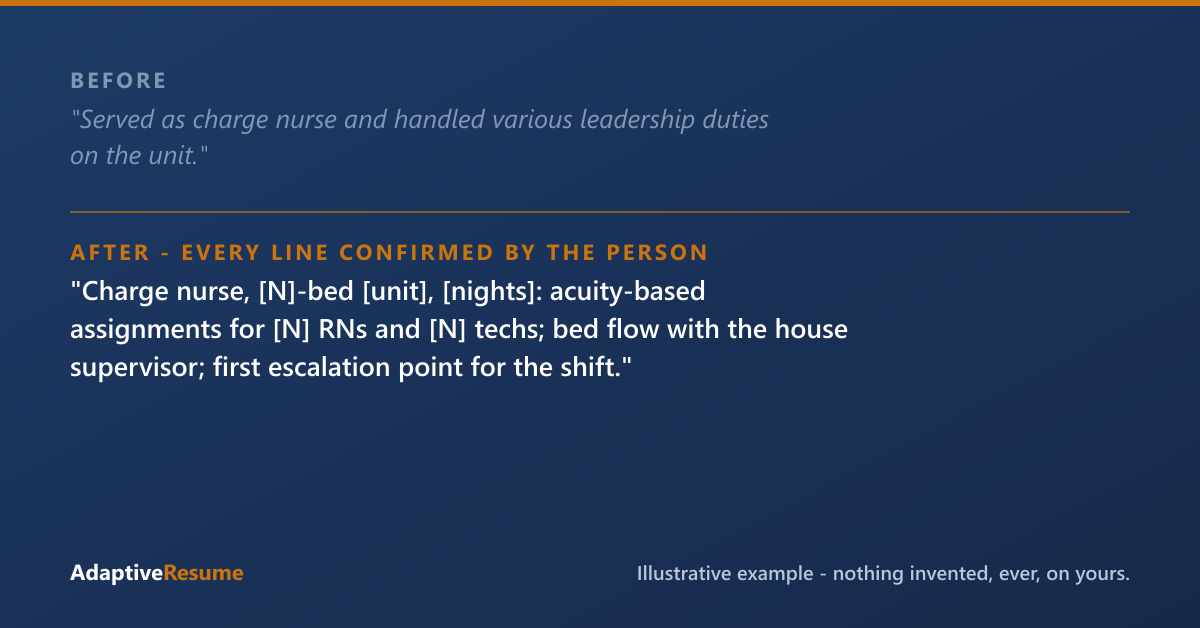
Illustrative example. On your resume, every line comes from your real history - proposed as a question, added only when you confirm it.
How AdaptiveResume helps
We work backwards from what your work actually involved. Nurses often undersell charge — it was “just part of the job,” so it never made the page. When you tell us about your unit and your shifts, we propose the scope lines your history supports — the assignment-making, the staffing calls, the escalations — and ask you to confirm, adjust, or skip each one. Nothing lands without your say-so, and nothing gets inflated past what you actually ran. If you’ve been running shifts, the record already exists; we help you write it down at its true size. The Charge Nurse Resume Skeleton below is the place to start.
Common questions
I only rotate into charge — can I still put it on my resume?
Yes, and you should, labeled exactly as it is: 'rotating charge, [frequency]' or 'relief charge.' Rotating charge is how many nurses build the record that permanent charge and supervisor roles are hired from.
What's the difference between a charge nurse resume and a regular RN resume?
One added layer: scope. Beds, staff count, shift, and the decisions you owned — assignments, staffing adjustments, escalations. Your clinical bullets stay; the charge lines sit on top of them.
Do I need a management degree or certification to move up from charge?
Postings vary, and many supervisor roles are filled on demonstrated charge experience. List what you hold honestly — a BSN, a leadership course, NE-BC if you have it — and let your shift-running record do the arguing.
Charge Nurse Resume Skeleton
Pop your email in and the download unlocks right here — and being on the list before launch day locks in 25% off your first build. We'll also send the occasional useful note and tell you the moment AdaptiveResume goes live. No spam.
Download: Charge Nurse Resume SkeletonThanks — you're on the launch list, your 25% is locked in, and your download is ready below.
That email didn't look right — mind trying it again?
Ready to do this on your own resume?
We'll find what you've left off and you approve every line — nothing made up.
Build your resume — $49Try the demo first — a sample review, no sign-up · See how the service works
Paid a resume service and got a template back? Start at Fix my resume.